Adam Elliot made grief out of clay and it holds its shape
Elliot's second feature is a hoarder's inventory of loss, rendered in plasticine and voiced by Sarah Snook, and it is the best Australian film of 2024.
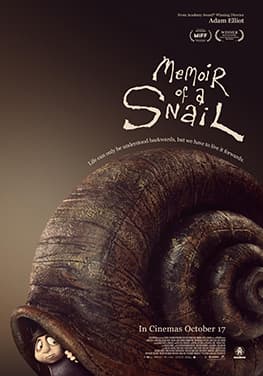
There is something about claymation that resists irony. The medium carries its labour on its surface; you can see the thumbprints, the slight imperfections where a figure was repositioned between frames, the faint wobble of a hand-built set under studio lights. Every frame of a claymation film is an artefact of someone having touched it, and this quality of touch is what makes Adam Elliot’s Memoir of a Snail feel less like a film and more like an object you could hold in your hands, turn over, examine for the places where the grief was pressed in.
Elliot has been working in this mode for over two decades. His short films, Uncle (1996), Cousin (1998), Brother (1999), and the Oscar-winning Harvie Krumpet (2003), established a territory he has never left: the awkward, the lonely, the physically imperfect, the people who collect things because collecting is a way of imposing order on a life that will not cooperate. His first feature, Mary and Max (2009), was a correspondence between a lonely eight-year-old girl in Melbourne’s outer suburbs and a middle-aged man with Asperger syndrome in New York City. It was funny and devastating and it took him six years to make. Memoir of a Snail took him another fifteen, and the patience shows in every frame; this is a picture built with the slow, compulsive attention of the hoarder it depicts.
The inventory of Grace Pudel
Grace Pudel, voiced by Sarah Snook, is a woman who collects snail figurines. She has hundreds of them. They fill her house in Canberra, covering every surface, occupying every shelf, spilling off tables and windowsills in ceramic and glass and porcelain drifts. The collection is not charming. It is clinical, obsessive, a material record of every loss Grace has absorbed since childhood: the death of her father, separation from her twin brother Gilbert, a series of foster homes, a marriage to a man who confiscated her belongings, another marriage that ended differently but no less painfully. Each snail marks a wound. The collection is a body count.
Elliot films this accumulation with the tenderness of someone who understands that hoarding is not greed but architecture; it is a way of building walls out of the only materials available. Grace’s house is a fortress made of loss, and the film’s narrative is structured as an act of dismantling, a slow process of removing objects and examining what they were protecting her from. Snook’s vocal performance carries this weight without melodrama. She reads Grace’s narration in a register that is flat, dry, occasionally wry, never pitying. There is a refusal of sentimentality in the performance that matches Elliot’s visual style, which is grotesque and beautiful in equal measure, figures with bulbous noses and tiny eyes and bodies that look like they were made by someone who finds the human form simultaneously ridiculous and dear.
Melbourne’s working-class clay
Elliot’s settings are always specific, and they are always working-class. Grace grows up in Melbourne’s inner north, in a fibro house with a corrugated-iron fence, on a street where the houses are close enough together that you can hear your neighbours arguing. The claymation renders this world with a fidelity that live-action rarely achieves, because the miniature sets are built with the same care as the characters; every chipped coffee mug, every stained carpet, every venetian blind with two missing slats has been constructed by hand and placed deliberately. The effect is not nostalgia. It is recognition. If you grew up in this kind of house, in this kind of suburb, the sets of Memoir of a Snail will produce a physical response, a tightening in the chest that comes from seeing your own domestic landscape rendered in three-dimensional miniature, held up for examination, treated as worthy of art.
This is what separates Elliot from the Pixar and DreamWorks tradition. Those studios build worlds you want to visit. Elliot builds worlds you have already lived in, and the animation does not beautify them; it preserves them. The plasticine holds its shape. The thumbprints are still visible. The grief is still there, pressed into the surface like a fossil.
The distance from Mary and Max
Mary and Max established Elliot’s emotional method: take two lonely people, connect them through some fragile mechanism (letters, in that case; memory, in this one), and then subject the connection to every pressure the world can generate. What has changed in the fifteen years between the two features is not the method but the precision. Mary and Max was sprawling, episodic, occasionally indulgent; it covered decades and continents and sometimes lost its focus in the accumulated detail. Memoir of a Snail is tighter, more controlled, more willing to leave things out. Elliot has learned what to cut, and the cutting makes the remaining material sharper.
The voice cast helps. Jacki Weaver plays Pinky, Grace’s elderly confidante, a woman who has lived enough life to know that advice is mostly useless but who gives it anyway, with a warmth that Weaver delivers so naturally it barely registers as performance. Kodi Smit-McPhee voices Gilbert, Grace’s twin, and the separation between them, one in Canberra, one in a rural commune, unable to reach each other, is the film’s structural engine. Everything Grace collects is a substitute for Gilbert. Every snail is a stand-in for the person she cannot have in the room.
The best Australian film of 2024
This is not a claim I make lightly, and I am aware that 2024 produced strong work across the industry. But Memoir of a Snail does something that none of the other candidates achieve: it takes a medium that audiences associate with children’s entertainment and uses it to deliver an adult emotional experience of genuine complexity, without compromise, without softening, without the safety net of live-action naturalism. The clay does not protect you from the feeling. If anything, it intensifies it, because the characters are so clearly made, so obviously the product of human hands, that their suffering carries a doubled weight. You grieve for Grace and you grieve for the figure of Grace, the small plasticine body that someone shaped and reshaped and moved frame by frame through a story of loss and recovery and the stubborn, irrational persistence of love.
Elliot premiered the picture at Cannes, in the Un Certain Regard section, and it won the top prize. It opened in Australian cinemas to strong reviews and the kind of audience response that is difficult to manufacture: people leaving the cinema quietly, not talking immediately, holding the film inside themselves for a few minutes before letting language back in. That silence is the highest compliment a film about hoarding can receive. For once, there is nothing to collect. The picture has already given you everything, and what it has given you holds its shape.

Bronte writes long-form criticism of Australian cinema and the international art films that feed into it. She was on the ground at Cannes in 2019 and has not entirely forgiven the festival for 2020. Patient with slow films; impatient with tidy ones.
MORE BY BRONTE HAUGHEY →
Australia sent a claymation snail to the Oscars and it was the right call
The selection of Memoir of a Snail as Australia's Oscar entry is a bet on craft over scale, and the bet is sound.

Adam Elliot makes grief out of clay because clay holds its shape when everything else falls apart
Elliot's characters are made of plasticine and painted with fingerprints, and the imperfection is not an aesthetic choice; it is the whole argument.
The score for Memoir of a Snail moves at the speed of grief
Elena Kats-Chernin's score for Adam Elliot's claymation opus is patient, fragile, and refuses to tell the audience when to cry.