Boy Swallows Universe and what Netflix actually paid for
Twenty months after Netflix dropped the Trent Dalton adaptation in January 2024, the show has aged into one of the few streamer-funded Australian dramas that didn't get cancelled out of spite.

I want to say something nice about Netflix, which is, hand on heart, not a thing I usually say in print. Boy Swallows Universe, which dropped on the platform on 11 January 2024 in seven episodes and was promoted to the top of the homepage carousel for the better part of three weeks, is the rare instance in which Australian television benefited from being made by a foreign streamer rather than ruined by one. The show is, almost two and a half years on, still streaming. It has not been hidden, deindexed, mid-series cancelled, or quietly buried in the Australian regional library while being kept on the US dashboard. (The less said about Heartbreak High season three the better.)
Look, the show is good. The book it is adapted from, by Trent Dalton, is good. The decision to film it in Brisbane, with Brisbane crew, on Brisbane locations, in Brisbane light, was good. Most of the choices that produced the seven hours of television in question were good. What I want to write about is the choices that were not, and the way that, on a rewatch, the failures of the show have aged better than its successes have.
The good problem and the bad problem
The good problem is that Boy Swallows Universe is essentially a coming-of-age memoir filmed at the production scale of a prestige drama. Felix Cameron, who was eleven during principal photography, plays the younger Eli Bell, and is doing some of the most committed child-actor work I have seen in Australian television since Yael Stone in The Secret Life of Us. (To its credit, the show does not make him do too much. The scripts are generous about what they leave unsaid.) Lee Tiger Halley plays the older Eli across the back two episodes and inherits the role without dropping the thread. Travis Fimmel, as Lyle the stepfather, is doing the kind of contained, hollow-eyed work that he has been quietly perfecting since the second season of Vikings. Simon Baker, as the absent biological father Robert, has the smaller part and is, frankly, the surprise of the season; the role is closer to King Lear than to anything in The Mentalist, and Baker plays it with a willingness to look bad that I had not seen from him in a decade.
The bad problem is that the seven episodes are uneven in a specific, fixable way. Episodes one through four operate at the patience of literary adaptation. Episodes five through seven operate at the urgency of a streaming algorithm. The show was developed by John Collee and showrun across the season, and the late-season acceleration reads as a note from above rather than a structural choice. There is, in particular, a courtroom sequence in episode six which compresses what the book treats as two months of legal limbo into a single ten-minute scene and which produces, as a consequence, the most stilted performance that Anthony LaPaglia has given on screen since Holding the Man. (LaPaglia, as the journalist Brian Robertson, is otherwise fine. The script, in his late scenes, is not fine.)
What Brisbane actually looks like
Cinematographer Craig Barden, working with director Bharat Nalluri across the first three episodes and Jocelyn Moorhouse across the back four, photographed Brisbane on Brisbane terms. The light is harsh and the shadows are short and the late-afternoon sun, which in Sydney drama is photographed with a postcard romance and in Melbourne drama is photographed with a damp moodiness, in Brisbane is photographed flat and unforgiving and absolutely correct for the city. The Darra and Bracken Ridge exteriors look like the Darra and Bracken Ridge of 1985. The Boggo Road jail scenes were shot on the actual decommissioned Boggo Road site. Every back-fence sequence I recognised by smell, which is not a thing I expect to say about an Australian drama financed out of Burbank.
The show’s Brisbane is also, importantly, not the Schitt’s Creek version of Brisbane that Bluey has accidentally established as the international shorthand. It is harder, more humid, more class-marked. It is the Brisbane of the Joh Bjelke-Petersen years, edging into the post-Joh hangover, where the police corruption that Boy Swallows Universe dramatises in episode five is presented as the operating environment rather than the scandal. (The book is set in the late 1980s; the Fitzgerald Inquiry sits in the background of the entire narrative the way In a Sunburned Country sits in the background of every Bryson essay about Australia.) The decision to keep the period detail unsentimental was made, somewhere in the development process, by people who knew the city. Who those people are is not credited as such on the streaming carousel, but you can hear them in the production design and in the sound mix and in the music supervision (which is, period-correct and unembarrassed, the soundtrack to AM-radio Brisbane circa 1987).
What the streamer model did and did not break
The argument I have been making in this column for some years (here it is, wait for it) is that the international streamer-funded model is a worse deal for Australian drama than the network commission was, and that I will go to my grave on the principle. Boy Swallows Universe is the exception that does not break the rule. The show was funded by Netflix at a budget that Australian free-to-air would not have been able to underwrite, was given the seven-hour episode order that the book genuinely required, was not forced into a season-two extension, and was permitted to end. The show ends. The book ends. The book and the show end at the same place. This is the kind of completion that Australian network drama used to be permitted before the streamers arrived and that the streamers, in this single instance, declined to deny.
What the streamer model still broke is the revenue logic for the local industry. Netflix retains worldwide rights and, two years on, the Australian production company (Brouhaha Entertainment, Joel Edgerton’s outfit, with Anonymous Content as the international co-producer) has been paid for the show but does not own any part of its long tail. The book continues to sell. The show continues to stream. The royalty cheque on the streaming side does not arrive in the same envelope as the royalty cheque on the print side, and the structural difference is the difference between a production company that can finance its next show and one that has to go pitching for a new commission. This is the part of the Boy Swallows Universe result that Screen Australia ought to be writing memos about, and that, in the absence of a coordinated streamer-quota framework, will continue to be the catch in every otherwise good outcome.
What I want next
What I want is for the showrunners and the production company to do this again. Australian source material, Australian crew, Australian city, Australian period. Streamer funding if it cannot be locally financed. A finite episode order. An ending. A second season if the story actually has one and not if the streamer demands one. The Boy Swallows Universe model, in other words, applied a second time. There are five Trent Dalton novels now. There is no reason the next one cannot follow. There is also no reason a wholly original Australian commission could not occupy the same slot.
Until that happens, the show stands as the rarest of streaming-era results: an Australian drama that did not get ruined by being Australian. Good television, in the way a tidy back yard is a good back yard.
Rhys watches more television than is healthy and writes about it with a dryness that tips occasionally into cruelty. His favourite ABC drama is the one the ABC just cancelled, whichever that happens to be.
MORE BY RHYS TAVITA →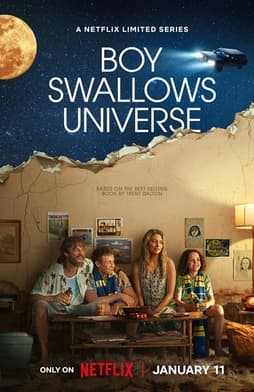
Boy Swallows Universe turned a Brisbane memoir into Netflix content and it mostly survived
The adaptation of Trent Dalton's novel is charming, violent, and uncertain about its own tone in exactly the same proportions as its source material.
Rake was never about the cases
Eight years and five seasons of Cleaver Greene taught Australian television that you can keep a man unredeemed, and that audiences will follow him anyway.

Apple Cider Vinegar knows exactly what it is
Netflix turned Australia's most notorious wellness fraud into a glossy limited series, and the smartest thing it does is admit it is part of the racket too.