Boy Swallows Universe turned a Brisbane memoir into Netflix content and it mostly survived
The adaptation of Trent Dalton's novel is charming, violent, and uncertain about its own tone in exactly the same proportions as its source material.
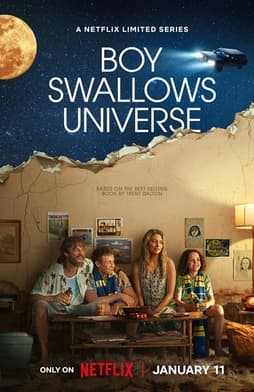
The first thing you need to understand about Boy Swallows Universe is that the novel it is based on was the best-selling Australian book of the decade and that roughly forty per cent of the people who bought it will tell you it changed their life. The second thing you need to understand is that the other sixty per cent never finished it. This is not a criticism. It is a description of the book’s fundamental quality, which is that it is two books stapled together: one is a tender, funny coming-of-age story about a kid named Eli Bell growing up in Daggera in Brisbane’s outer suburbs in the 1980s, and the other is a violent crime thriller about drug manufacturing, prison, and a man who cuts off fingers. The novel toggled between these two modes with a kind of manic energy that either swept you along or threw you off the ride entirely.
The Netflix adaptation, developed by John Collee and directed across seven episodes by Bharat Nalluri, inherits this tonal problem and (to its credit) does not try to solve it. It simply commits to both registers simultaneously and trusts the audience to hold the contradiction. Sometimes this works. Sometimes it does not. But the attempt is honest, which counts for something.
Brisbane as a character, finally
The show was filmed in Brisbane and the surrounding suburbs, and it is one of the few Australian screen productions that treats Brisbane not as a stand-in for somewhere else but as a specific, particular place with its own light and its own logic. The Queenslander houses with their tin roofs and their stumps. The jacaranda trees dropping purple flowers onto cracked footpaths. The particular quality of Brisbane heat, which is not the dry burn of a Western but a thick, subtropical weight that sits on everything. The production design, led by Felicity Abbott, gets this right in ways that matter. Eli’s house looks like a house where people live, not a set decorated to suggest economic hardship. The mess is specific. The furniture is wrong in the right ways.
This matters because Dalton’s novel is, at bottom, an act of devotion to a place that Australian literature and screen rarely pays attention to. Brisbane’s outer suburbs are not glamorous. They are not cinematic in the way that Sydney’s beaches or Melbourne’s laneways are cinematic. They are flat and hot and full of people whose lives are complicated by poverty and proximity to crime and the particular Australian mythology that says working-class people should be stoic and uncomplaining and grateful. The show does not romanticise Daggera. It does something better: it pays attention to it.
Felix Cameron and the child-actor problem
Eli is played as a child by Felix Cameron and as a teenager by Zac Burgess, and the transition between the two actors is where the show is most vulnerable. Cameron is excellent. He has a stillness that the role demands, a capacity to observe without commenting that is rare in child performances. The character of Eli is a watcher. He absorbs the chaos around him and processes it internally, and Cameron communicates this processing through small physical choices: a tilt of the head, a half-step backward, a gaze held slightly too long. It is not a showy performance. It is a precise one.
The difficulty is that child-actor-led drama places enormous structural weight on a performer who cannot, by definition, carry the full emotional complexity of the material. Cameron handles the early episodes beautifully, but the script asks him to navigate scenes involving drug use, domestic violence, and criminal conspiracy that push against the limits of what a young actor can be expected to embody. The show compensates by surrounding him with strong adult performances, particularly Bryan Brown as the drug lord Tytus Broz and Phoebe Tonkin as Eli’s mother, but there are moments where you can feel the narrative straining against its own casting.
Burgess, taking over for the later episodes, has a harder job in some ways. The transition from child Eli to teenage Eli requires the audience to accept a new face carrying the accumulated emotional weight of everything Cameron established. Burgess is good, but the shift is not seamless, and the show loses some of its intimacy in the handover.
The magical realism question
Dalton’s novel contains elements that sit somewhere between magical realism and childhood perception: a mute brother who communicates through air-writing, a mysterious phone that rings with messages from the future, a sense that the universe is speaking directly to Eli in ways that may or may not be literal. The show has to decide how to handle this, and its decision is to be ambiguous, which is the right choice but not always a satisfying one.
The air-writing works on screen. August, Eli’s older brother, traces words in the air with his finger, and the show visualises these as faint, ghostly letters that hover briefly before fading. It is a simple effect and it communicates the right amount of strangeness. The phone is harder. In the novel, the ringing phone operates as a kind of metaphysical thread running through the narrative, connecting Eli to a future version of himself. On screen, it feels more like a plot device than a cosmic principle, and the show cannot quite find the visual language to make it feel like anything other than a telephone.
Jasper Jones and the coming-of-age comparison
The obvious Australian comparison is Jasper Jones, Rachel Perkins’s 2017 adaptation of Craig Silvey’s novel, which shares DNA with Boy Swallows Universe in several important ways. Both are set in the 1960s-to-1980s period. Both centre on a young boy confronting violence and injustice in a small-town or suburban setting. Both use the coming-of-age framework to examine questions about race, class, and the distance between what adults say and what they do.
But Jasper Jones is a tighter story. It has a clearer central mystery and a more disciplined tonal register. Boy Swallows Universe is messier, wider, more willing to follow tangents and let scenes run past their natural endpoint. Whether you prefer the discipline or the mess is a matter of temperament. I lean toward the mess, honestly, because Australian screen drama tends to err on the side of restraint and the result is often work that is polished and professional and entirely forgettable. Boy Swallows Universe is not forgettable. It is sometimes clumsy, sometimes overwrought, occasionally manipulative in ways that are easy to spot. But it is also warm and strange and specific in ways that most Netflix content is not.
Whether it travels
The question that hangs over any Australian production with a global streaming deal is whether international audiences will understand the specificity. Will a viewer in Ohio know what a Queenslander house is? Will they understand the particular register of Australian working-class speech, the way a sentence can be simultaneously affectionate and brutal? Will they know that Daggera is a real place with a real history that the novel draws on and distorts?
Probably not. But the show is smart enough not to explain itself. It does not pause to translate. It trusts that the emotional logic is universal even when the cultural details are not, and this is the correct instinct. The best regional storytelling does not explain where it is from. It simply is from there, and invites the audience to catch up.
Boy Swallows Universe mostly survived the transition from page to screen. It lost some of the novel’s internal monologue, which is inevitable. It gained a visual specificity that the prose could only gesture at. It is not the book and it is not trying to be. It is a seven-episode series about a boy in a difficult suburb who pays attention to everything around him and tries, against considerable evidence, to believe that the world is good. That is enough.
Rhys watches more television than is healthy and writes about it with a dryness that tips occasionally into cruelty. His favourite ABC drama is the one the ABC just cancelled, whichever that happens to be.
MORE BY RHYS TAVITA →
Boy Swallows Universe and what Netflix actually paid for
Twenty months after Netflix dropped the Trent Dalton adaptation in January 2024, the show has aged into one of the few streamer-funded Australian dramas that didn't get cancelled out of spite.

Apple Cider Vinegar knows exactly what it is
Netflix turned Australia's most notorious wellness fraud into a glossy limited series, and the smartest thing it does is admit it is part of the racket too.

Territory wants to be Australia's Yellowstone and it gets close enough to matter
Netflix built a cattle-station dynasty drama in the Northern Territory and staffed it with enough Australian actors to fill a muster, and the result is louder and messier than anything the ABC would commission.