The five Australian film scores that shaped 2023
From horror to period drama to genre noir, Australian composers carried more of the storytelling in 2023 than anyone gave them credit for.
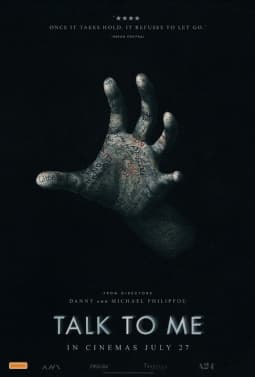
Australian screen composers had a year. Not the kind of year that generates headlines or awards-season profiles, because the industry still treats composition as a below-the-line craft rather than a creative act, but the kind of year that leaves a residue in the ear, a collection of sounds that accumulate into something like a national mood. What follows is not a ranked list. It is five scores that did something worth describing, arranged in the order I heard them, which is the order in which they built on each other in my thinking about what Australian screen music is becoming.
Cornel Wilczek, Talk to Me
The score for Danny and Michael Philippou’s horror debut has to solve a problem that most horror scores do not face: the horror in Talk to Me is social. The teenagers who summon spirits through a ceramic hand are doing it at parties, in groups, for fun. The scares are communal. The atmosphere is not isolation but peer pressure, the specific dread of watching someone you care about do something stupid because everyone is watching and nobody wants to be the one who stops it.
Cornel Wilczek scores this by keeping the palette thin and the frequencies low. The bass drones are patient, arriving well before the scare and sustaining through it, so that the score functions less as a shock mechanism and more as a barometric pressure, a physical sensation that tells the audience something is wrong before the narrative confirms it. The upper register, when it appears, is metallic and brief: scraped strings, bowed cymbal, sounds that arrive like contact burns and withdraw before they can be identified. What Wilczek avoids is as important as what he provides. There are no stingers. There are no sudden orchestral hits timed to jump scares. The score trusts the Philippou brothers’ editing to deliver the shocks and occupies itself with the slower, deeper work of making the audience uncomfortable in their bodies. This is the best Australian horror score since the Heligoland work on The Babadook, and it deserves the comparison.
Rostam Batmanglij, Shayda
Noora Niasari’s debut feature is a domestic drama about an Iranian woman (Zar Amir Ebrahimi) who has fled her abusive husband and is living with her daughter in a women’s refuge in Brisbane. The film moves between Farsi and English, between Iranian cultural memory and Australian suburban reality, and Rostam Batmanglij’s score occupies the space between these poles without resolving into either.
Rostam, known for his work with Vampire Weekend and as a solo artist, brings a pop musician’s ear to the assignment. The cues are short, textural, built from layered synthesisers and processed strings that hover at the edge of perception. The influence of Iranian classical music is present but diffused: a melodic contour here, a rhythmic pattern there, never enough to constitute a direct quotation but enough to locate the score in a cultural tradition without pinning it to a specific geographical point. The restraint is remarkable. In a film this emotionally charged, a less disciplined composer would lean into the feeling. Rostam lets the performances carry the emotion and uses the score to provide the space around them, the acoustic equivalent of the white wall in the refuge where Shayda is trying to rebuild a life.
Jed Palmer, The Royal Hotel
Kitty Green’s follow-up to The Assistant takes two American backpackers (Julia Garner, Jessica Henwick) to a pub in outback South Australia, and the slow accumulation of male menace that follows is scored by Jed Palmer with a precision that borders on cruelty. The score is built from guitar, primarily, but guitar processed and extended until it no longer sounds like an instrument played for pleasure. The notes are bent, sustained, allowed to decay into feedback that sits just below the threshold of discomfort. The harmonic language is spare: open fifths, unresolved intervals, chords that promise resolution and refuse to deliver it.
Palmer scores the outback pub the way John Carpenter scored urban spaces: as environments where the architecture determines the danger and the music maps the architecture. The low ceiling, the sticky bar, the car park after dark, each space has its own acoustic signature in Palmer’s score, and the cumulative effect is of a film whose locations are as much sonic as visual. The guitar work is especially effective in the scenes where the menace is ambiguous, where the men at the bar might be harmless or might not, where the score holds both possibilities in suspension and lets the audience sit with the uncertainty.
Cornel Wilczek (again) and Salliana Campbell, Deadloch
The ABC series Deadloch is a crime comedy set in Tasmania, and the scoring challenge is tonal: how do you score a show that is simultaneously a murder mystery, a satire of small-town Australian life, and a buddy comedy about two mismatched detectives? Wilczek and Campbell solve this by writing music that refuses to choose a genre. The score moves between noir-inflected jazz, folk-adjacent acoustic textures, and synthesiser beds that could belong to a Scandinavian crime drama, and it does this within individual episodes, sometimes within individual scenes.
The wit is in the juxtaposition. A scene that begins as a serious police procedural will acquire a musical accompaniment that subtly undercuts the seriousness, not through comedy scoring but through a tonal mismatch that makes the audience aware of the gap between what the characters think they are doing and what they are actually doing. It is scoring as irony, and it works because Wilczek and Campbell are skilled enough to play each genre straight. The noir cues sound like real noir cues. The folk textures sound like real folk. The comedy emerges from the collision, not from winking.
Mark Atkins, The Artful Dodger
Stan’s period drama reimagines Dickens’s Dodger as a surgeon in 1850s Melbourne, and Mark Atkins scores it with an anachronistic energy that matches the show’s own approach to its source material. The palette is strings and percussion, nominally period-appropriate, but the rhythms are contemporary, the tempos are faster than Victorian propriety would permit, and the overall effect is of a score that knows it is set in the past and does not care to behave as though it belongs there.
This is harder than it sounds. Anachronistic scoring can collapse into gimmick if the composer does not have the craft to make the collision feel intentional. Atkins manages it because his period writing is genuinely accomplished. The string arrangements are detailed and idiomatic enough to convince the ear that they belong to the 19th century, which makes their rhythmic misbehaviour all the more effective. The score does not break the period illusion so much as stretch it, pulling the 1850s towards the present without letting either era lose its shape.
What 2023 sounded like
The through-line, if there is one, is restraint in service of specificity. None of these scores over-write. None of them use the orchestra as a blunt instrument to tell the audience what to feel. Each one finds a sonic vocabulary that belongs to its particular film or series and commits to that vocabulary with enough discipline to make it feel inevitable. Australian screen music has always been good at this, at finding the sound of a specific place or a specific emotional register and inhabiting it fully. What 2023 demonstrated is that the range of places and registers is expanding, that Australian composers are working across horror, period drama, crime comedy, and domestic realism with equal fluency, and that the work they are doing deserves the same critical attention we give to the performances and the cinematography and the direction.
It will not get that attention, not yet. But the scores are there, in the mix, doing the work, and this column will keep listening.
Kieran writes about what films sound like. Played in a band that nearly got signed in 2012 and has been thinking about attack and decay ever since. Devoted to Warren Ellis, Amanda Brown, and the quiet work of sound editors nobody interviews.
MORE BY KIERAN BOUSTANY →
The five Australian film scores that defined 2024
From claymation grief to outback dread to a CGI chimpanzee singing Angels, Australian composers carried more weight in 2024 than the films sometimes deserved.
Nigel Westlake smuggled a cathedral into a film about a pig
The score for Babe borrows its grandeur from a French organ symphony, and the trick tells you everything about how Nigel Westlake hears the relationship between small subjects and large feelings.
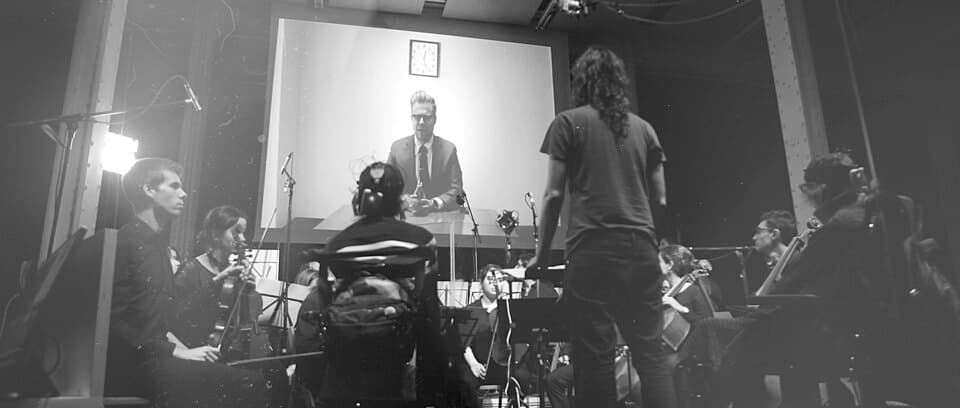
Every Australian film has a sound and most of them go unheard
This column has spent six years listening to what Australian cinema sounds like, and the answer keeps changing.