The five Australian film scores that defined 2024
From claymation grief to outback dread to a CGI chimpanzee singing Angels, Australian composers carried more weight in 2024 than the films sometimes deserved.

A good year for Australian film scores is not always a good year for Australian films. Sometimes the music arrives fully formed and the picture around it is still figuring out what it wants to be; sometimes the score is the only element in the room that seems to understand the emotional frequency the film is reaching for. 2024 was one of those years. The five scores listed here range from chamber-scale miniatures to full orchestral deployments, and what connects them is a shared conviction that Australian stories require Australian sounds, even when those sounds are difficult to categorise or sell.
1. Elena Kats-Chernin, Memoir of a Snail
Adam Elliot’s follow-up to Mary and Max is a claymation film about grief, hoarding, and the particular loneliness of being a twin who has lost her other half. Kats-Chernin scores it with an ensemble that feels handmade: accordion, piano, strings that move in careful intervals, woodwinds that enter like afterthoughts. The palette is European in its instrumentation but Australian in its emotional temperature, warm without becoming sentimental, wry without becoming arch. There is a waltz motif threaded through the score that recurs at moments of loss, and each recurrence strips away one layer of ornamentation until, by the film’s final act, the theme is bare, a single melodic line on piano, unaccompanied, holding the weight of everything the film has accumulated.
Kats-Chernin has been composing for decades across concert, ballet and film, and what she brings to Memoir of a Snail is a sense of proportion that younger composers sometimes lack. She knows exactly how much music each scene can hold. The attack is soft. The decay is long. The silence between phrases is doing as much work as the notes.
2. Better Man and the problem of the jukebox
Robbie Williams’s biopic, directed by Michael Gracey, replaces its lead actor with a CGI chimpanzee and fills its runtime with Williams’s catalogue. It is not, strictly speaking, a score-driven film; the musical numbers are the architecture. But the arrangement and orchestration work, supervised by Batu Sener and a team of Melbourne-based musicians, is remarkable in its detail. The concert sequences are built from the ground up, not sampled, not tracked, but re-recorded with live players and mixed to sit inside the film’s heightened visual register. The “Angels” sequence, in particular, achieves something I did not expect: genuine emotional weight delivered through a song I have heard several hundred times. The arrangement strips back the original’s production gloss and rebuilds it around strings and voice, and the result sounds new. In a film full of spectacle, the quietest musical moments land hardest.
3. Antony Partos and the dread of The Surfer
Lorcan Finnegan’s The Surfer, starring Nicolas Cage, is a film about territorial aggression in a beachside car park, and Partos scores it as though the car park were the floor of a furnace. Low drones, percussive metallic textures, synth pads that sit just below the threshold of discomfort. Partos has been working in this register for years, most notably with Justin Kurzel on Snowtown and Nitram, and he knows how to sustain tension without releasing it. The score never climaxes. It accumulates. The attack is constant and the decay never arrives, and this refusal to resolve is what gives the film its suffocating quality. It is not a pleasant listen in isolation. It is not meant to be. It is meant to make you feel the heat and the hostility, and it does.
4. Force of Nature: The Dry 2 and the bush that listens
Robert Connolly’s sequel to The Dry sends Eric Bana’s Aaron Falk into the Victorian bush on a corporate hiking retreat that goes wrong. The score, by Peter Raeburn, does something subtle with the landscape: it makes the bush an acoustic presence rather than a visual one. Field recordings of wind, birdcall and creek water are woven into the orchestral textures so that the boundary between score and sound design blurs, and the forest becomes something you hear as much as see. The effect is disquieting. The bush in Australian cinema is usually scored as vast, open, indifferent; Raeburn scores it as enclosed, attentive, almost watchful. The strings are close-miked and dry, the brass is muted, and the overall impression is of a landscape that is listening back.
5. Junkie XL and Furiosa
Tom Holkenborg’s score for George Miller’s Furiosa: A Mad Max Saga is the loudest entry on this list and possibly the loudest Australian film score ever committed to a mixing stage. It is also, beneath the percussion and the distortion and the sheer volume, a surprisingly sophisticated piece of thematic writing. Holkenborg builds character-specific motifs that develop across the film’s considerable runtime, and the orchestration shifts register as the narrative moves between Furiosa’s childhood, her captivity and her emergence as a tactician. The war-rig sequences are scored with a ferocity that borders on the industrial, drums and brass and distorted guitars layered until the sound itself becomes a physical force. But the quieter passages, particularly the cues associated with the Green Place and Furiosa’s mother, operate in an entirely different mode: pastoral, elegiac, scored for strings and voice with a restraint that makes the surrounding noise feel earned rather than gratuitous.
What 2024 tells us
The spread is the story. Five scores, five completely different approaches, five sets of instruments and intentions. What Australian film music does not have is a house style, a default setting, a sound that producers and directors reach for when they want something “Australian.” This absence is, I think, a strength. It means composers are building from the ground each time, responding to the specific demands of each picture rather than plugging into a pre-existing template. Kats-Chernin’s handmade warmth and Partos’s industrial dread share a country but not a vocabulary, and the distance between them is where the interesting work is happening. If 2024 proved anything, it proved that Australian film music is too various to summarise, which is another way of saying it is healthy, and growing, and listening.
Kieran writes about what films sound like. Played in a band that nearly got signed in 2012 and has been thinking about attack and decay ever since. Devoted to Warren Ellis, Amanda Brown, and the quiet work of sound editors nobody interviews.
MORE BY KIERAN BOUSTANY →
The five Australian film scores that shaped 2023
From horror to period drama to genre noir, Australian composers carried more of the storytelling in 2023 than anyone gave them credit for.
Nigel Westlake smuggled a cathedral into a film about a pig
The score for Babe borrows its grandeur from a French organ symphony, and the trick tells you everything about how Nigel Westlake hears the relationship between small subjects and large feelings.
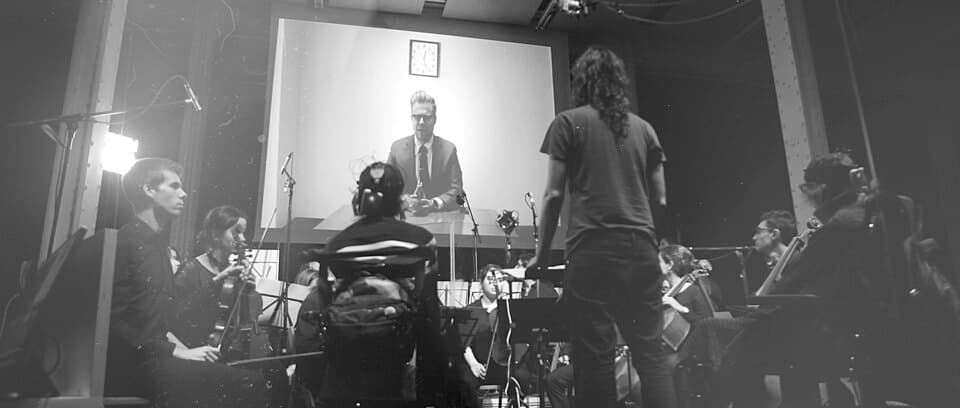
Every Australian film has a sound and most of them go unheard
This column has spent six years listening to what Australian cinema sounds like, and the answer keeps changing.