Who is Australian cinema for and does it know
The question is not whether Australian films are good enough; it is whether the industry has decided who it is talking to.

I went to see an Australian film at a cinema in Newtown last month. I will not name the film because the film is not the point. The point is the cinema. It was a Tuesday at seven thirty, which is a real session, not a matinee for retirees or a late show for nobody. The film had been reviewed. It had a trailer. It had the kind of poster that signals seriousness without signalling fun, which is its own category of design choice. There were nine people in the theatre, including me. I counted because I always count, because counting the audience at an Australian film has become a private ritual, a way of measuring the distance between the conversation the industry has about itself and the conversation the public is not having at all.
Nine people. The film was fine. It was well acted, carefully shot, structurally competent, thematically engaged with questions of identity and place. It was the kind of film that Screen Australia funds and critics review kindly and audiences do not attend. I do not say this with contempt. I say it as someone who was one of the nine, who chose to be there, who will probably write about the film at some point and contribute to the critical infrastructure that surrounds Australian cinema like scaffolding around a building that nobody is sure is being built or demolished.
The funding question that is also an audience question
Screen Australia exists to support the development, production, and promotion of Australian screen content. This is its legislative mandate. The agency does this work seriously, with annual investment in the tens of millions, spread across feature films, documentaries, television, online content, and development programs. The system produces films. The system does not, reliably, produce audiences.
This is not a new observation. People have been saying it for decades, in Senate inquiries and industry panels and opinion pieces that circulate briefly and change nothing. But I want to sit with it for a moment because I think the question is usually framed wrong. The standard framing is: why don’t Australians watch Australian films? The better framing is: who are Australian films made for, and does the industry know the answer, and does it want to?
There are several possible audiences. There is the domestic theatrical audience, which is overwhelmingly oriented toward Hollywood product and has been since the 1920s. There is the festival audience, which is small, informed, self-selecting, and geographically concentrated in inner-city postcodes. There is the international audience, which encounters Australian films through festivals, streaming platforms, and the occasional breakout. There is the critical audience, reviewers and academics and people who run film publications, who engage with Australian cinema as a cultural practice. And there is the funding body itself, Screen Australia and the state agencies, which are simultaneously the patron, the gatekeeper, and the most attentive audience for the work they commission.
The films that break through
Some Australian films find a large domestic audience. It is worth looking at which ones and asking what they share. Crocodile Dundee in 1986. The Castle in 1997. Animal Kingdom in 2010. The Sapphires in 2012. Talk to Me in 2023. The list is short enough to be troubling and varied enough to resist a single explanation.
The Castle worked because it was funny, because it was cheap, because it played like a sitcom in the best sense, because it gave Australian audiences a version of themselves that was affectionate without being aspirational. It cost $750,000 and made $10 million domestically. Nobody at Screen Australia greenlit it because nobody at Screen Australia would have greenlit it. It was too broad, too obvious, too willing to be enjoyed. It was made outside the system and the system subsequently claimed it as evidence that the system works, which is a neat trick if you can manage it.
Animal Kingdom worked differently. It was dark, violent, structurally complex, and it starred Jacki Weaver in a performance so precise that it crossed over from the festival circuit into mainstream conversation. It was an industry film, funded through the usual channels, but it had a genre engine underneath its art-house surface. It was a crime film. People know what to do with a crime film. They know how to enter it, how to watch it, what to expect from its rhythms. The genre did the work that marketing could not.
Talk to Me is the most instructive recent case. Danny and Michael Philippou made a horror film for $4.5 million that grossed over $180 million worldwide. It premiered at Sundance, was acquired by A24, and became the highest-grossing Australian horror film in history. It did this by being a genre film, fully and without apology. It was scary. It had jump scares. It had a hook, literally a severed hand, that could be communicated in a single image. It did not ask the audience to meet it on its own terms. It met the audience on theirs and then did something interesting once it had their attention.
The middle that does not hold
The films that do not find audiences tend to occupy a middle ground. They are not genre films, so they cannot ride a pre-existing audience. They are not experimental enough to generate the kind of critical intensity that draws a niche audience. They are dramas, often very good dramas, about recognisable Australian lives, and they open in five cinemas and move to streaming within eight weeks and are watched by the people who would have watched them anyway and nobody else.
I do not think this is a quality problem. Some of the best Australian films of the last decade fall into this category. Nitram, The Stranger, Shayda, June Again. These are serious, accomplished, rewarding films that were seen by tiny fractions of the available audience. The issue is not that they are bad. The issue is that the system is optimised to produce them and not optimised to deliver them to the people who might want to watch them if they knew they existed.
The distribution problem is real but it is also a convenient explanation. It lets the industry say: the work is good, the pipeline is broken. And the pipeline is broken, genuinely. The theatrical distribution model for Australian films is punishing. Release windows are narrow. Marketing budgets are thin. Cinemas prefer the reliable returns of studio tentpoles. All of this is true. But it is also true that the industry has been aware of these problems for twenty years and has not solved them, and at some point the persistence of a problem starts to look like a preference.
The audience that is not in the room
I want to say something careful here. I think Australian cinema has an audience problem it prefers to describe as a marketing problem, because marketing problems have solutions and audience problems have politics. If you acknowledge that the domestic audience is largely indifferent to the kind of films the industry prioritises, you have to ask whether the industry should change what it makes, or change who it makes it for, or accept the gap and fund the work as a cultural good that does not require a mass audience to justify its existence. All three positions are defensible. None of them is comfortable.
What I observe, sitting in half-empty cinemas and reading quarterly box-office reports and watching the same conversation loop through the same industry forums, is an unwillingness to choose. The system wants to make culturally specific, artistically ambitious Australian films and it wants those films to find large audiences and it wants this to happen without fundamentally altering either the films or the audience. This is not a strategy. It is a wish.
The nine people in that cinema in Newtown were not the problem. We were the constituency. We were the proof that the audience exists, that it is real, that it cares. But nine people in a room is not a cultural moment. It is a reading group. And the question the industry has to answer, eventually, honestly, without the usual qualifications and panel discussions and draft strategy documents, is whether it is making films for the nine people or for the nine hundred or for the nine thousand, and what it is prepared to change to reach any of them.

Mara writes essays. She came to film writing from a decade of literary criticism and still reaches, sometimes, for a novel before she reaches for a shot list. She lives in the inner north of Melbourne and does not explain which city that is.
MORE BY MARA DENG →
Australian cinema does not know what it wants to be next and that might be the whole point
Six years of writing about Australian film has taught me that the industry's identity crisis is not a bug; it is the condition under which the best work gets made.
The cinema is not dying but it is learning to share the room
The argument between cinema and streaming was never about screens; it was about who gets to decide what watching means.
Strictly Ballroom is a film about who is allowed to teach the steps
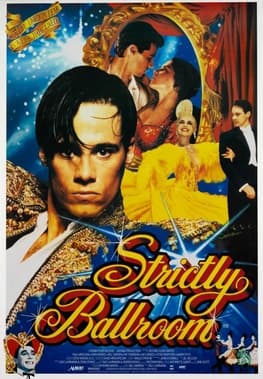
Baz Luhrmann's 1992 comedy is sold as a story about dance. It is also a story about an Australian champion who has to be taught his own steps by a Spanish-Australian family in their own house.