Australian cinema does not know what it wants to be next and that might be the whole point
Six years of writing about Australian film has taught me that the industry's identity crisis is not a bug; it is the condition under which the best work gets made.

I have been writing about Australian cinema for six years now, which is long enough to have developed opinions and not long enough to have settled them. Every time I think I know what Australian film is becoming, someone makes something that breaks the pattern. This is either a sign that the industry is incoherent or a sign that it is alive, and I have gone back and forth between those positions more times than I can count.
What I mean is: I do not have predictions. If you came here looking for a confident forecast of where Australian cinema will be in 2030, I cannot help you. What I have instead is a set of tensions that I think define the present moment, and a personal sense of what I hope for, which is worth exactly as much as any other person’s hope, which is not nothing but is also not a policy document.
The scale problem
The most visible tension is scale. On one end, you have George Miller’s Furiosa, which cost more than most Australian screen agencies distribute in a decade and was financed entirely by a Hollywood studio. On the other end, you have David Easteal’s The Plains, which is a three-hour film shot almost entirely from the back seat of a car during a man’s commute home from work. Both of these are Australian films. Both of them are excellent. They have almost nothing in common except the country they were made in.
This is not a new tension. Australian cinema has always been pulled between the international and the local, between the desire to compete on a global stage and the need to tell stories that are specific to this place. But the gap has widened. The mid-budget Australian film, the $5 to $15 million drama that used to be the backbone of the industry, has become harder to finance. The streaming platforms want either prestige television or cheap content. The theatrical market has contracted. The sweet spot that produced films like Lantana and The Castle and Romulus, My Father is shrinking, and nobody has figured out how to stop it.
What fills the gap is either very large or very small. International co-productions that use Australian locations, crews, and tax offsets but are creatively driven from Los Angeles or London. Or micro-budget independent films made by young filmmakers who cannot wait for the funding bodies and do not intend to. The middle is collapsing, and the middle is where most of the stories that defined Australian cinema used to live.
The new filmmakers
I want to talk about three filmmakers who I think represent something genuinely new, not because they are making the same kind of work but because each of them has solved the identity problem in a different way.
Danny and Michael Philippou made Talk to Me for around $4.5 million and it grossed over $180 million worldwide. They came from YouTube. Their sensibility is fast, physical, uninterested in the kind of tasteful restraint that Australian independent cinema has historically prized. The film is set in Adelaide, it uses Australian actors, and its horror mechanics are rooted in a very specific kind of Australian teenage recklessness, the house party, the dare, the pressure to perform courage in front of your mates. It is also a global commercial product that works for audiences who have never heard of Adelaide and do not care.
Noora Niasari made Shayda, which is in many ways the opposite. It is small, precise, emotionally devastating, set largely within a women’s refuge in a specific Australian city. It tells the story of an Iranian-Australian woman navigating domestic violence, and it does so with a controlled intimacy that never reaches for spectacle. The film’s power comes from its refusal to dramatise what does not need dramatising. It is the kind of film that the Australian funding system was designed to support, and it is one of the best examples of what that system can produce when it works.
Goran Stolevski is doing something else entirely. His films, You Won’t Be Alone, Of an Age, and the work that has followed, move between genres and registers and even centuries with a freedom that feels almost reckless. He is a Macedonian-Australian filmmaker who makes films about witches in 19th-century Macedonia and queer love in 1990s Melbourne and does not see a contradiction. His work insists that Australian cinema does not have to be about Australia to be Australian, that the sensibility of the filmmaker is the thing that carries the national identity, not the setting or the accent.
What I want
Here is the part where I stop pretending to be analytical and say what I actually feel. I want Australian cinema to keep not knowing what it is. I want the confusion. I want the Philippou brothers making horror films that gross $180 million and Easteal making three-hour films about commuting and Stolevski making Macedonian witch films and Niasari making quiet devastations and Miller making whatever Miller makes next, which will probably cost $200 million and involve several explosions and be, in its structural DNA, the most Australian thing on screen that year.
What I do not want is consensus. I do not want the industry to settle on a single idea of what Australian film looks like, because every time it has done that in the past, the result has been a narrowing. The 1970s revival produced extraordinary work but also codified a certain kind of literary adaptation as the default mode. The 1990s produced the larrikin comedy and then ran it into the ground. Every era that defines itself too clearly ends up excluding the work that does not fit the definition, and the work that does not fit is usually the work that matters most.
The condition, not the crisis
I started writing about Australian film in 2020, during lockdown, when the industry was shut down and nobody knew if cinemas would survive and the conversation was dominated by crisis rhetoric. Six years later, the rhetoric has not changed much. The industry is always in crisis. Funding is always under threat. The theatrical model is always dying. The identity question is always unresolved.
But the films keep getting made. That is the thing I keep returning to. Despite the funding gaps and the collapsed middle and the streaming disruption and the policy uncertainty, the films keep appearing. Somebody writes a script in a flat in Footscray. Somebody shoots a short on the weekend in Parramatta. Somebody drives a camera crew out to a dry lake bed in South Australia and comes back with something that nobody expected and nobody asked for and nobody can quite categorise.
I think that is the point. Not the crisis but the condition. Australian cinema’s identity has never been stable, and the instability is not a failure to be corrected. It is the environment in which the interesting work grows. The films I love most from this country are the ones that could not have been predicted by the funding guidelines or the industry reports or the cultural policy frameworks that are supposed to govern them. They come from somewhere else, from instinct, from stubbornness, from the particular pressure of making work in a country that is too small to sustain a self-sufficient industry and too proud to stop trying.
I do not know what Australian cinema will be in ten years. I know I want to still be writing about it when I find out.

Mara writes essays. She came to film writing from a decade of literary criticism and still reaches, sometimes, for a novel before she reaches for a shot list. She lives in the inner north of Melbourne and does not explain which city that is.
MORE BY MARA DENG →
Who is Australian cinema for and does it know
The question is not whether Australian films are good enough; it is whether the industry has decided who it is talking to.
This year I watched forty Australian films and the best ones made me nervous
The comfortable films were fine, the difficult ones were better, and the gap between the two is where Australian cinema lives.
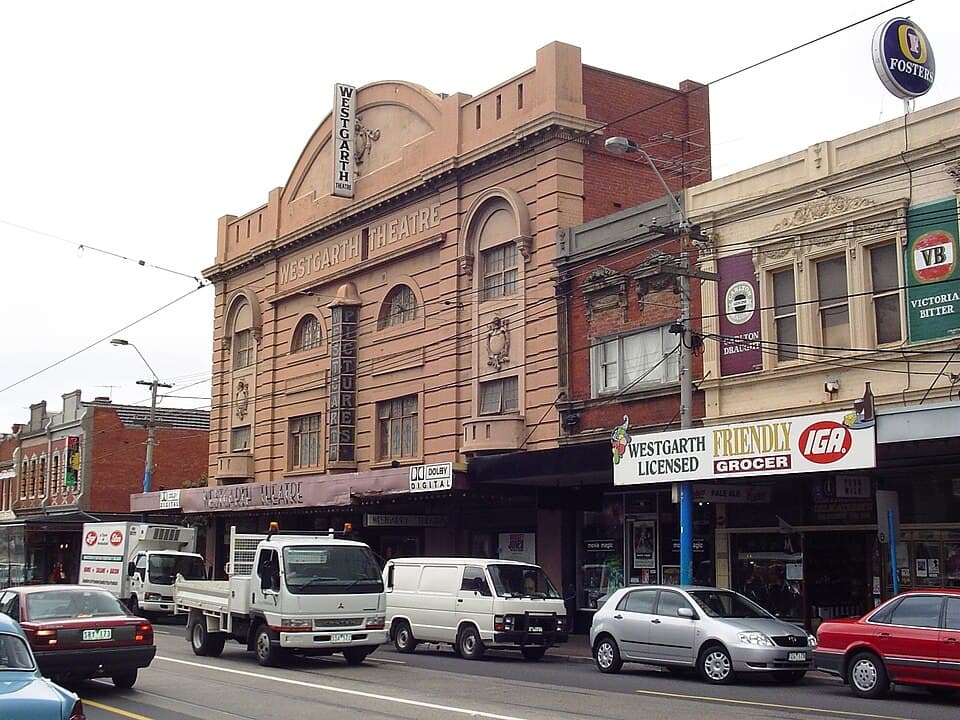
The cinema is not dying but it is learning to share the room
The argument between cinema and streaming was never about screens; it was about who gets to decide what watching means.