Troppo takes the crime novel to Far North Queensland and lets the humidity do the interrogation
Thomas Jane plays an American ex-con hiding in the tropics, and the show's best trick is treating Cairns like it is as foreign as he finds it.
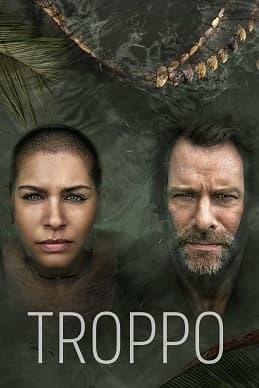
There is a particular quality to the light in Far North Queensland that does not exist anywhere else in Australia. It is not the golden hour of the south coast or the bleached white of the outback. It is thick. The humidity sits in the air and the light has to push through it, and the result is a kind of permanent soft focus that makes everything look slightly unreal. Troppo uses this light the way Nordic noir uses darkness: as atmosphere, as mood, as a visual argument that the place itself is implicated in whatever crime is about to unfold.
The show, adapted from Candice Fox’s novel Crimson Lake, ran for two seasons on Stan between 2022 and 2024. Thomas Jane plays Ted Conkaffey, an American ex-cop who fled to Far North Queensland after being accused of a crime he may or may not have committed. Nicole Chamoun plays Amanda Pharrell, a local private investigator with her own violent past and a social manner that oscillates between abrasive and feral. They become reluctant partners. They investigate crimes. The tropics sweat around them.
The odd couple, but wetter
The pairing of Jane and Chamoun is the engine of the show, and it works because neither performance asks for your sympathy. Jane plays Ted as a man who has retreated so far into himself that he has become his own hiding place. He is quiet. He is careful. He fishes. He lives in a house that looks like it is slowly being consumed by the vegetation around it, and he seems fine with that. Jane has always been good at playing men who are running out of road (look at Hung, look at his version of the Punisher), and Ted is the logical endpoint of that type: a man who has stopped running and is now just sitting still, waiting to see if the world will leave him alone.
Chamoun’s Amanda is the opposite frequency. She is loud, confrontational, impulsive, and entirely unwilling to accommodate other people’s comfort. She has a criminal record. She has a crocodile. She has a way of entering a room that suggests the room was not expecting her and will not recover. Chamoun plays the role with a physicality that is genuinely unpredictable; you are never sure whether Amanda is about to shake someone’s hand or bite them, and the show gets a lot of mileage out of that uncertainty.
The dynamic between them is not the buddy-cop formula, exactly. It is closer to what happens when two people who are both socially impossible discover that the other person’s impossibility is the only kind of company they can tolerate. The show is smart enough not to romanticise this. Ted and Amanda are not good for each other in any conventional sense. They are just less bad for each other than solitude.
Cairns is not a backdrop
The decision to set a crime drama in Far North Queensland is, on its face, an obvious one. The region has everything you need: isolation, heat, a population that includes transients and fugitives and eccentrics, and a landscape that ranges from pristine rainforest to decaying cane towns to the kind of suburban sprawl that looks temporary even when it has been there for fifty years. But Troppo does something with the setting that goes beyond location scouting.
The show treats Cairns and its surroundings as genuinely foreign territory, and it does this partly through Ted’s eyes. He is American. He has never been to the tropics. The wildlife is confusing to him. The distances are wrong. The social codes are opaque. When a local speaks to him in the particular shorthand of regional Queensland, he does not understand, and the show lets that incomprehension sit rather than smoothing it over with exposition. The result is that the audience, even an Australian audience, sees Far North Queensland as Ted sees it: as a place that operates by its own rules, that is connected to the rest of Australia by geography but not necessarily by temperament.
The cane fields are particularly well used. They appear in multiple episodes, and each time they function differently: as a place to hide, as a place to die, as a corridor that leads nowhere, as a wall of green that blocks the horizon and reduces the world to the immediate. The Daintree appears less frequently but more pointedly, as a place where the distinction between civilisation and not-civilisation dissolves completely.
Why FNQ gets crime but not comedy
There is a question worth asking about why Far North Queensland keeps appearing in Australian crime dramas but almost never in comedies. Mystery Road used the Kimberley and then the outback fringe. Troppo uses the tropics. Wanted passed through. But the region’s natural comedy potential, and it has plenty, remains largely unexplored on screen.
The answer, I think, is structural. Crime drama needs isolation, and FNQ provides it. Comedy needs community, and FNQ’s communities, at least as they are understood by southern-based production companies, are too remote to function as comic settings without the comedy becoming about the remoteness itself, which tips quickly into condescension. Troppo avoids this because its genre gives it permission to treat the setting as hostile. A crime drama can say “this place is strange and dangerous” without insulting the people who live there, because the strangeness and danger are genre conventions, not social commentary.
The comedy version of Troppo would need to find a way to make FNQ funny without making it a punchline, and that is a harder brief than it sounds. Someone will do it eventually, and it will probably be good, but it has not happened yet.
The heat as a character
Candice Fox’s novels use the heat as a narrative device, and the show translates this faithfully. Characters are visibly uncomfortable. Sweat is constant. The interiors are either over-airconditioned (the police station, the occasional restaurant) or not airconditioned at all (Ted’s house, Amanda’s office, most of the locations where crimes occur). The temperature differential between inside and outside is a recurring texture: characters move from cool to hot and back again, and each transition changes their behaviour slightly. People are sharper in the heat. They are more patient in the cold. The show notices this and uses it.
There is a sequence in the second season where Ted and Amanda conduct an interrogation in a room without aircon, and the scene plays like a slow-motion endurance test. Nobody raises their voice. Nobody threatens anyone. The heat does the work. The suspect sweats. Ted sweats. Amanda does not appear to sweat, which is either a character choice or a makeup decision, but either way it makes her seem less human than everyone else in the room, which is exactly right for the character.
Two seasons and done
Troppo ran for two seasons and appears to have concluded. Stan has not announced a third season, and the narrative arc of the second season provides enough closure that a continuation would feel optional rather than necessary. This is, honestly, the right length. The show said what it needed to say about its characters and its setting, and extending it further would risk the diminishing returns that affect most Australian crime dramas past their second season (look at Jack Irish, which was better as a set of telemovies than as an ongoing series).
What remains is a show that used its location better than almost any Australian drama of the past decade, that found two performances of real specificity in Jane and Chamoun, and that understood something fundamental about the tropics: the heat does not just surround the characters. It gets inside them. And once it is inside, it changes what they are willing to do.

Rhys watches more television than is healthy and writes about it with a dryness that tips occasionally into cruelty. His favourite ABC drama is the one the ABC just cancelled, whichever that happens to be.
MORE BY RHYS TAVITA →
Stan made a great Australian road comedy and told nobody
Dylan River directed all eight episodes of a stolen-taxi comedy set in the 1980s outback, and it went out on Stan with roughly the fanfare of a software update.

Invisible Boys never puts anyone on the bus to Perth
Nicholas Verso's ten-part Stan drama refuses the one ending Australian queer coming-of-age stories always reach for, and is far better for the refusal.
Scrublands sends a journalist to a country town and trusts the silence to do the rest
Luke Arnold drives into a drought-stricken town where a priest shot five men, and the show's best quality is that nobody wants to explain why.