Scrublands sends a journalist to a country town and trusts the silence to do the rest
Luke Arnold drives into a drought-stricken town where a priest shot five men, and the show's best quality is that nobody wants to explain why.
The journalist arrives in the country town. He is from Sydney, or Melbourne, or somewhere that has traffic and reliable mobile coverage. The town is small. The town is hot. The town has a secret, or several secrets, and the people who live there do not want to talk about any of them. The journalist asks questions. The locals give him looks. Eventually someone talks, and then someone else turns up dead, and the journalist realises the story he came for is not the story he is in.
This is the structure. You know this structure. Australian crime drama has been running this play for twenty years, from Mystery Road to The Dry to Deadloch (which sent up the formula while also using it). Scrublands, Stan’s 2023 adaptation of Chris Hammer’s novel, uses the same blueprint, and I am going to argue that it uses it better than most because it does the one thing the structure demands and that most shows in this genre are too impatient to do: it lets the silence sit.
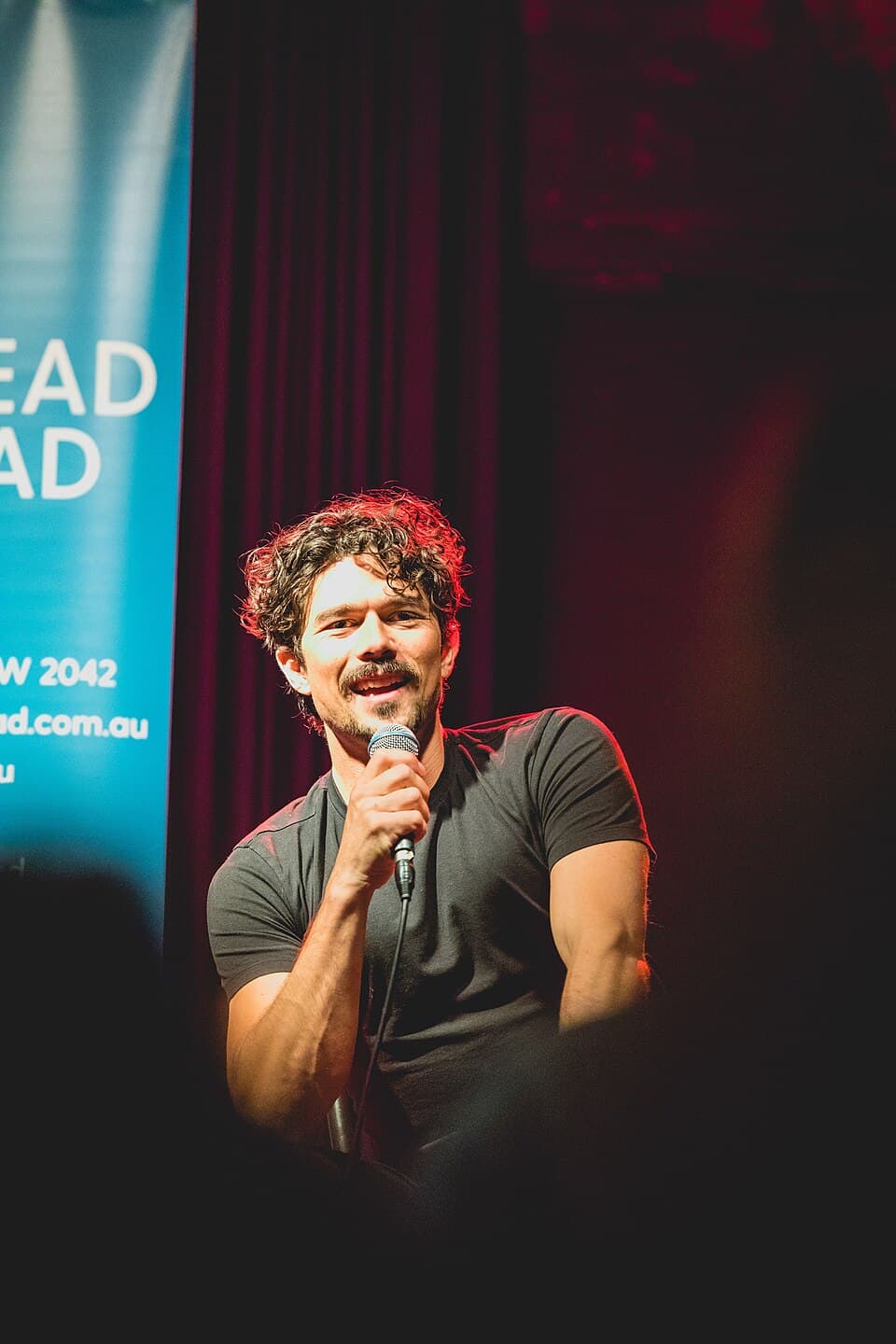
Luke Arnold drives into Riversend
Arnold plays Martin Scarsden, a journalist sent to write a puff piece about drought recovery in the fictional town of Riversend, one year after the local priest, Byron Swift (played by Jay Ryan), walked out of his church and shot five men on the steps. Swift was killed by police. The town buried its dead. Nobody wants to revisit it, least of all the people who survived.
The first episode is almost entirely setup, and it is the best episode of the series. Arnold’s Scarsden arrives, checks into a pub, walks through empty streets, and meets people who speak in half-sentences. The show does not explain who anyone is. It does not provide backstory through dialogue. It drops you into Riversend the way Scarsden is dropped into Riversend: without context, without allies, without a map. You learn the town by watching it, and the watching is the drama.
Arnold is well cast. He has the look of someone who used to be more confident than he currently is, which is exactly what Scarsden requires. The character is carrying his own trauma (a previous assignment that went wrong in a way the show parcels out slowly), and Arnold plays the damage as a low hum rather than a performance. He does not signal Scarsden’s pain. He just makes choices that a person in pain would make: drinking slightly too much, pushing slightly too hard, trusting the wrong person at the wrong moment.
Jay Ryan and the absent centre
Ryan’s Byron Swift is the absent centre of the show. He is dead before the first scene, but he occupies every conversation, every decision, every silence. The show handles this beautifully. Swift appears in flashbacks, but sparingly, and the flashbacks are designed to complicate rather than explain. Each new piece of information about who Swift was contradicts the previous piece. He was a good man. He was troubled. He was kind. He was dangerous. He was loved. He was feared. The show refuses to resolve these contradictions, which is the correct choice, because the whole point is that the town cannot resolve them either.
Ryan plays the flashback scenes with a stillness that borders on unsettling. His Swift is handsome, gentle, attentive, and almost entirely opaque. You never know what he is thinking, and the show does not cheat by giving you access. This is harder than it sounds. The temptation with a character like Swift is to reveal the interior, to give the audience a scene where the mask drops and the truth is visible. Scrublands resists that temptation consistently. When the truth finally arrives, it comes through other people’s accounts, filtered through grief and anger and self-interest, and you are left to assemble it yourself.
The drought as character
The landscape in Scrublands is doing real work. The show was filmed in regional South Australia, and the production team has chosen locations that communicate not just heat but endurance. The ground is cracked. The trees are skeletal. The sky is white. Everything in Riversend looks like it has been waiting for something, and the waiting has gone on too long.
This connects to a tradition in Australian screen storytelling that treats the outback as an active force rather than a backdrop. Picnic at Hanging Rock started it. Wake in Fright perfected it. Mystery Road (both the films and the series) continued it. The Dry, which adapted another Chris Hammer-adjacent novel (Eric Bana played the lead in Robert Connolly’s 2021 film), used drought as a visual metaphor for emotional repression. Scrublands does the same thing, but it earns the metaphor because the drought is also literal. The town is dying. The water is running out. The economy is collapsing. People are leaving. The shooting happened in a town that was already in crisis, and the show understands that the crisis did not start with the gunshots.
The mystery and its resolution
Look, I am not going to spoil it. The resolution works. It is not what you expect, and it does not arrive from the direction you are watching. The show earns its ending by being disciplined about information, by giving you exactly enough to form a theory and then pulling the ground out from under that theory at precisely the right moment.
What I will say is that the ending does something unusual for this genre: it makes the mystery feel less important than the town. By the time you learn why Swift did what he did, you have spent enough time in Riversend to understand that the answer, whatever it is, will not fix anything. The town will still be drought-stricken. The dead will still be dead. The survivors will still carry the weight. The journalist will leave, because journalists always leave, and the town will go on being a town.
Scrublands is not the flashiest show Stan has produced. It is not the most original. But it is one of the most patient, and patience is the quality that this genre rewards most. The silence does the rest.
Rhys watches more television than is healthy and writes about it with a dryness that tips occasionally into cruelty. His favourite ABC drama is the one the ABC just cancelled, whichever that happens to be.
MORE BY RHYS TAVITA →
Stan made a great Australian road comedy and told nobody
Dylan River directed all eight episodes of a stolen-taxi comedy set in the 1980s outback, and it went out on Stan with roughly the fanfare of a software update.
Invisible Boys never puts anyone on the bus to Perth
Nicholas Verso's ten-part Stan drama refuses the one ending Australian queer coming-of-age stories always reach for, and is far better for the refusal.
Nautilus built Captain Nemo in Queensland and sent him to sea without enough story
The production is gorgeous, the submarine is a set worth living in, and the scripts needed three more drafts.