The Tourist treats the outback like a character who does not speak
Jamie Dornan wakes up in a hospital in the middle of South Australia with no memory, and the show is smart enough to let that confusion do most of the heavy lifting.
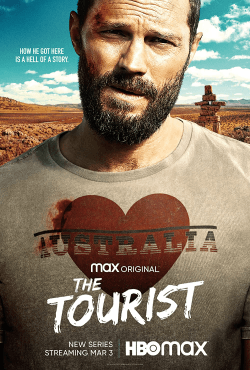
The opening sequence of The Tourist does something that most thrillers get wrong: it gives you the disorientation before it gives you the information. Jamie Dornan is driving a car on an empty road in outback South Australia. A truck appears behind him. The truck accelerates. What follows is a chase scene that is less about speed and more about the sheer, flat emptiness of the landscape and how little help it offers. There is nowhere to turn. There is nowhere to hide. The road goes forward and the truck is faster. When Dornan’s car eventually rolls, the crash feels less like an action set piece and more like the inevitable conclusion of a physics problem.
He wakes up in hospital with no memory. He does not know his name, where he was going, or why someone tried to kill him. The show is smart enough to sit in that confusion rather than rushing to resolve it. For at least the first three episodes, The Tourist is less a thriller than a study of what it feels like to be completely unmoored in a place that offers no familiar reference points, no readable social cues, and a sun that feels like it is trying to hurt you.
The landscape as hostility
Most international productions that film in the Australian outback treat it as scenery. Beautiful, dramatic, photogenic scenery that makes for good trailers and poster art. The Tourist does something more interesting: it treats the landscape as a form of hostility that is not personal. The outback is not trying to kill Dornan’s character. It is simply indifferent to whether he lives or dies, and that indifference is worse than malice because you cannot negotiate with it.
The show was created by Harry and Jack Williams (the team behind The Missing and Baptiste) and filmed primarily around Adelaide and the Flinders Ranges. The Williams brothers have talked about being drawn to the South Australian landscape precisely because it felt alien to them as British writers, and that alienation is baked into the visual grammar of the show. Everything is too bright. The colours are wrong (red dirt, white sky, blue shadows that do not fall where you expect). The towns are too small and too far apart. For a protagonist who cannot remember anything, the Australian outback is the worst possible place to be, because there is nothing to trigger a memory. No density, no texture, no crowds. Just space and heat and the occasional roadhouse.
Danielle Macdonald and the anchor performance
Honestly, the show’s secret weapon is Danielle Macdonald as Constable Helen Chambers, a small-town cop who is clearly overqualified for her posting and equally clearly stuck there for reasons the show takes its time revealing. Macdonald does something very specific with Helen: she plays her as someone who is simultaneously competent and lonely, and who recognises in Dornan’s amnesiac stranger a problem interesting enough to justify her attention. It is a generous performance. She gives Dornan’s character (and by extension, the audience) someone to hold onto, and she does it without turning Helen into a love interest or a sidekick.
Shalom Brune-Franklin is the other standout, playing Luci, a woman who claims to be the protagonist’s partner and whose reliability the show spends several episodes carefully undermining. Brune-Franklin is good at playing warmth that might be performance, which is exactly what the role requires. You want to trust Luci. You are not sure you should. The tension between those two impulses carries a lot of the middle episodes.
The fish-out-of-water tradition
Australia has a long history of fish-out-of-water thrillers, stories where an outsider arrives in a remote community and discovers that things are not as simple as they appear. Wake in Fright (1971) is the original and still the best. Picnic at Hanging Rock (1975) operates in similar territory, though with a different register. More recently, Mystery Road used the returning-outsider structure to explore Indigenous communities in the Kimberley and Outback Queensland.
The Tourist fits into this lineage but adds a layer that the others do not have: its protagonist is not just an outsider, he is an outsider to himself. He does not have the baseline of identity that would let him navigate the strangeness of the setting. Every interaction is a cold read. Every person he meets might be someone who knows him, someone who wants to help him, or someone who wants to finish what the truck started. The amnesia conceit, which in lesser hands could feel like a gimmick, works here because the show commits to it fully. It does not cheat. It does not give Dornan convenient flashes of memory at dramatically useful moments (or when it does, the flashes are unreliable, which is better). The not-knowing is the engine, and the engine runs for a surprisingly long time before it needs refuelling.
Why this is a TV show and not a film
There is a version of The Tourist that could have been a two-hour film. Amnesiac man in the outback, chased by unknown enemies, uncovers his own dark past. You can see the trailer. You can imagine the third-act reveal and the cathartic final confrontation.
The six-episode structure is better because it gives the show room to breathe in the discomfort. A film would need to keep the plot moving. The series can afford to spend an entire episode on Dornan wandering through a small town, talking to people who may or may not be lying, eating food he does not recognise, and slowly realising that he might not want to know who he was. That slowness is where the show’s best writing lives. It is not padding. It is the experience of amnesia rendered as narrative pace: long stretches of nothing punctuated by moments of sharp, frightening clarity.
The tonal tightrope
The other thing The Tourist does well (and this is harder than it looks) is manage a tonal register that sits between dark comedy and genuine menace. There are scenes that are funny in a Coen Brothers way, where violence and absurdity coexist without either one undermining the other. There are also scenes that are genuinely tense, where the threat of harm is real and the stakes feel physical. The show moves between these registers without signposting the transitions, which keeps you slightly off balance in a way that mirrors the protagonist’s own experience.
To its credit, The Tourist also knows when to stop. The first season tells a complete story, reaches a satisfying conclusion, and does not overstay its welcome. (A second season exists, set in Ireland, which I have not yet watched and which received mixed responses, so your mileage may vary.) As a standalone six hours of television, though, it is one of the sharpest things to come out of the Australian production system in recent years, made by British writers who understood something about the Australian landscape that a lot of Australian productions take for granted: it is not just a backdrop. It is a condition.

Rhys watches more television than is healthy and writes about it with a dryness that tips occasionally into cruelty. His favourite ABC drama is the one the ABC just cancelled, whichever that happens to be.
MORE BY RHYS TAVITA →
Stan made a great Australian road comedy and told nobody
Dylan River directed all eight episodes of a stolen-taxi comedy set in the 1980s outback, and it went out on Stan with roughly the fanfare of a software update.

Invisible Boys never puts anyone on the bus to Perth
Nicholas Verso's ten-part Stan drama refuses the one ending Australian queer coming-of-age stories always reach for, and is far better for the refusal.
Scrublands sends a journalist to a country town and trusts the silence to do the rest
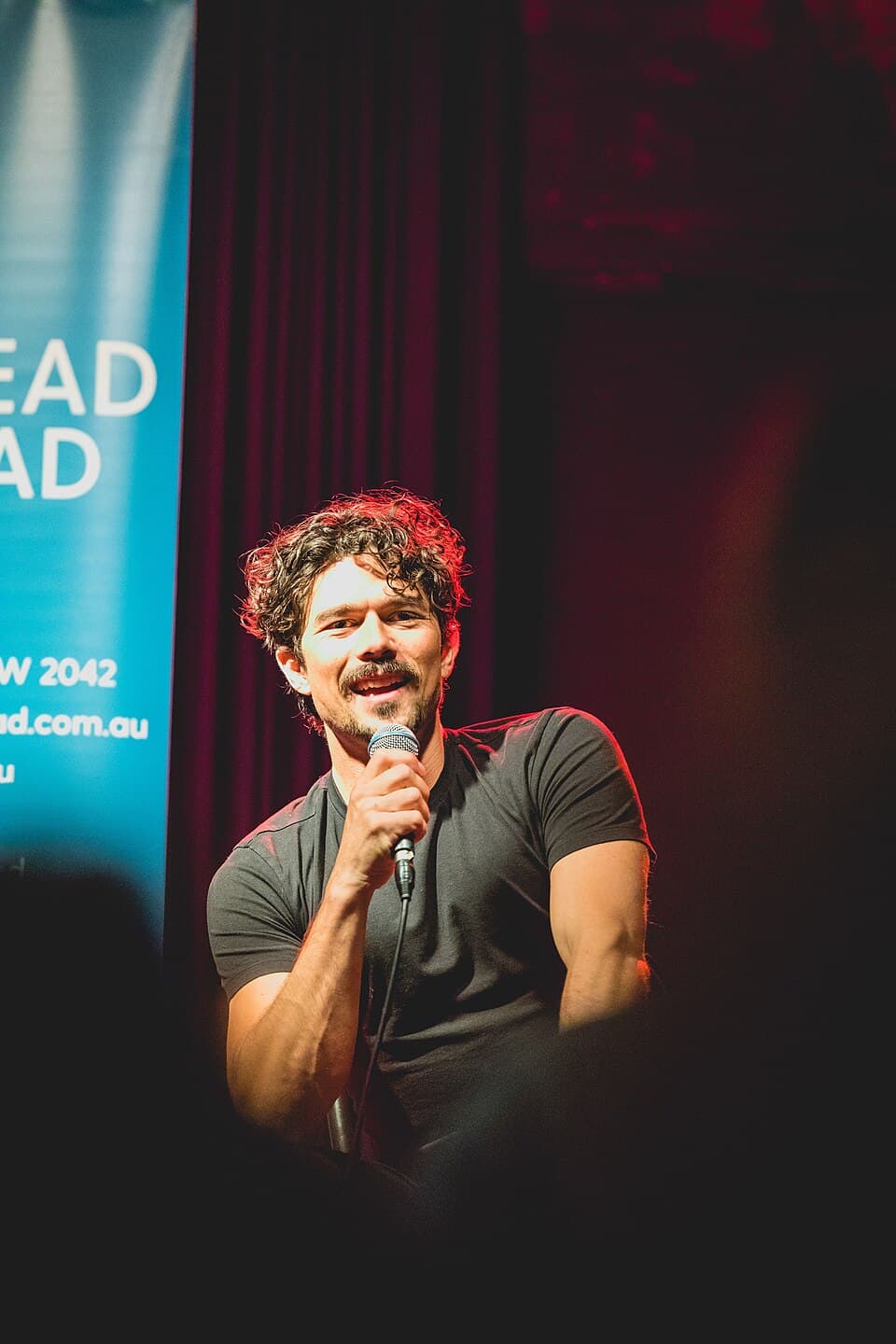
Luke Arnold drives into a drought-stricken town where a priest shot five men, and the show's best quality is that nobody wants to explain why.