The Gloaming set a murder mystery in Hobart and let the cold do the work
Stan's Tasmanian noir is slow, cold, and occasionally baffling, and the best scenes are the ones where Emma Booth just stands in the weather.
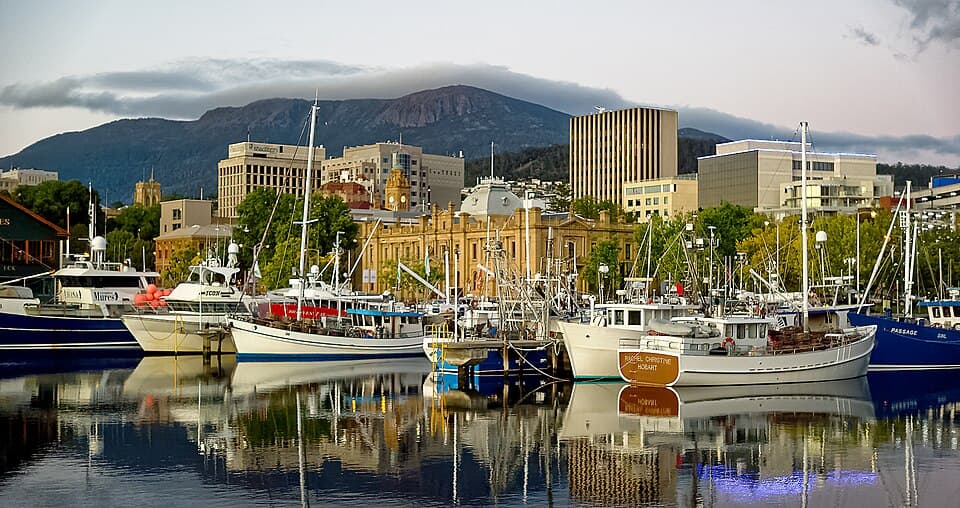
Hobart is a city that looks like it is keeping a secret. It sits at the bottom of a mountain, beside a river, under a sky that changes mood four times before lunch. The light is different down there. It arrives at a lower angle, filtered through cloud systems that roll off the Southern Ocean with the specific grey of a place that knows what cold means. If you are making a crime drama and you choose to set it in Hobart, you are making a decision about atmosphere before you have written a single line of dialogue. The city will do half your work for you.
The Gloaming premiered on Stan in January 2020, eight episodes of murder mystery that understands this fact completely. The show is set in and around Hobart, and it uses the city and its surrounding landscape as something between a character and a weapon. A woman is found dead in a park. The investigation is led by two detectives, Molly McGee (Emma Booth) and Alex O’Connell (Ewen Leslie), who share a history that the show parcels out in fragments across the season. There is a political element. There is a supernatural element. There are flashbacks to the 1980s. There is fog.
There is a lot of fog.
The city as mood
The thing The Gloaming does best is make Hobart feel like a noir city, which is not something Australian television has attempted before with this level of commitment. Australian noir tends to default to two settings: the outback (vast, flat, hostile, sun-bleached) or Melbourne (laneways, rain, organised crime). Mystery Road, which remains the benchmark for Australian crime television, built its visual language around the red dirt and empty horizons of remote Australia. The threat in Mystery Road is isolation. The landscape is indifferent. You could die out there and nobody would find you for weeks.
Hobart offers something different. The threat in The Gloaming is enclosure. The mountain presses down. The streets are narrow and steep. The buildings are colonial-era stone, heavy and permanent, the kind of architecture that absorbs history rather than shedding it. The show’s cinematographer, Mark Wareham, shoots the city in blues and greys that make it feel perpetually twilit, which is appropriate given the title. (The gloaming is the period between daylight and darkness, and the show lives in that space both visually and thematically.)
Booth in the weather
Emma Booth is the reason to watch. I want to be specific about this because the show has real structural problems that I will get to, but Booth’s performance is strong enough to carry you through them. Her Molly McGee is tired in a way that feels lived-in rather than performed. She moves through the investigation with the energy of someone who has been carrying something heavy for a long time and has stopped noticing the weight. Booth does not oversell the character’s damage. She wears it like a coat.
There are scenes where the show simply places Booth in a Tasmanian landscape and lets the camera watch her exist in the cold. These are, without qualification, the best scenes in the series. The wind moves her hair. The light does what Tasmanian light does. She stands at the edge of a cliff or beside the river or in a cemetery and the shot holds. It is not action. It is not even drama. It is presence, and Booth has enough of it to make stillness compelling.
Ewen Leslie is solid beside her. Leslie is one of those Australian actors who is always good and never quite the reason you started watching. He brings a controlled intensity to O’Connell that complements Booth’s stillness, and their shared history gives the partnership a weight that pure procedural pairing would not.
The pacing problem
Here is where it gets difficult. The Gloaming has a pacing problem that becomes more pronounced with each episode. The show is structured around multiple timelines, a present-day murder investigation, flashbacks to the detectives’ adolescence, and a political conspiracy that connects both. In theory, these threads should converge. In practice, they accumulate. New elements are introduced without prior ones being resolved. The supernatural dimension, which involves ritual objects and suggestions of something older and stranger beneath the surface, is never quite integrated into the procedural mechanics. It hovers alongside the investigation, adding atmosphere without adding clarity.
By episode five, the plot has generated more questions than any eight-episode season can reasonably answer, and the show seems to know this. The pacing slows further, as if the narrative is hoping that mood will substitute for momentum. Sometimes it does. Sometimes you find yourself watching a beautifully photographed scene of clouds moving across Mount Wellington and realising you have lost track of which suspect is connected to which conspiracy.
Stan’s Tasmania fixation
The Gloaming was not the last time Stan went to Tasmania. The Guildmaster followed, and Deadloch, which premiered in 2023, took the same basic setup (a murder in a small Tasmanian community, investigated by mismatched detectives) and ran it through a comedy filter. Deadloch is the better show, partly because Kate McCartney and Kate McLennan’s writing is sharper, and partly because comedy-noir gives the show permission to acknowledge the inherent absurdity of setting a genre piece in a place this small and this specific.
But The Gloaming got there first, and it established something that Stan has since made a recurring feature: Tasmania as a production location with a distinct visual identity, separate from the mainland, capable of supporting genre storytelling that looks and feels different from anything shot in Sydney or Melbourne. Whether this amounts to a deliberate house style or a series of independent creative decisions that happen to point in the same direction is unclear. What is clear is that Stan has found something in Tasmania, and it keeps going back.
The Gloaming is not a complete success. It is a show with a strong sense of place, a strong central performance, and a narrative that loses its way in the middle episodes and never fully recovers. But the atmosphere is real, and the version of Hobart it builds is one of the more distinctive settings Australian television has produced. If the story had been tighter, it could have been something special. As it stands, it is something cold and beautiful and slightly frustrating, which is, come to think of it, a reasonable description of Hobart itself.
Rhys watches more television than is healthy and writes about it with a dryness that tips occasionally into cruelty. His favourite ABC drama is the one the ABC just cancelled, whichever that happens to be.
MORE BY RHYS TAVITA →
Stan made a great Australian road comedy and told nobody
Dylan River directed all eight episodes of a stolen-taxi comedy set in the 1980s outback, and it went out on Stan with roughly the fanfare of a software update.
Invisible Boys never puts anyone on the bus to Perth
Nicholas Verso's ten-part Stan drama refuses the one ending Australian queer coming-of-age stories always reach for, and is far better for the refusal.
Bay of Fires and the town full of people you should not trust
An ABC dark comedy about a woman hidden in a Tasmanian town where everyone is a criminal, which is either a thriller premise or a documentary about regional Australia, depending on your mood.