Strictly Ballroom is a film about who is allowed to teach the steps
Baz Luhrmann's 1992 comedy is sold as a story about dance. It is also a story about an Australian champion who has to be taught his own steps by a Spanish-Australian family in their own house.
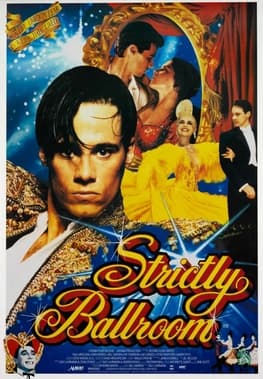
I was told, the first time, that it was a film about dancing. That is how it was explained to me and it is how it is still explained: sequins, a villain with a comb-over, a boy in a costume that would not survive a sneeze. A good time at the pictures. A national treasure, by the end.
All of that is accurate. It is also a way of not looking at the scenes in the middle of the film where the whole argument happens, and where nobody is wearing sequins.
The house
Scott Hastings is the best young ballroom dancer in his state, and he has just been told by the Federation that he will not be allowed to dance his own steps. His partner has left him. He has a mother, played by Pat Thomson, who has built her life around his trophies. Then a beginner named Fran, played by Tara Morice, who is unfashionable and bespectacled, says that she will dance with him.
The film moves from the glittering contest floor to the house where Fran lives with her father, Rico, and her grandmother, Abuela. They are Spanish. The house is crowded, ordinary and loud. The paso doble that Scott has been trying to dance in competition, and getting wrong, is the thing this family knows in their bodies. Antonio Vargas, as Rico, strips the dance of its sequins and shows him the rhythm underneath, and Armonia Benedito’s Abuela, who has barely spoken, is the keeper of it.
I want to be careful here, because the temptation is to call this the heart of the film and leave it there. It is the heart of the film. But think about what it says. Scott, the Anglo-Australian champion, has been taught a Spanish dance by the Federation, and the Federation has taught it badly. The real thing lives in a migrant household. He has to be taken there to learn the country’s own repertoire.
What the joke is about
The Federation is not a villain because it is cruel. It is a villain because it has mistaken a copy for the original and a rule for a tradition. Bill Hunter’s Barry Fife presides over a world of approved steps, and he is frightened of what Scott might do on his own, and the film understands that fear as the ordinary fear of an institution that has forgotten what its forms were for.
That is a joke about ballroom. It is also, I think, a joke about a country that was in 1992 still learning how to describe itself. Australia in the early nineties had a version of itself on the shelf, a version that had been smoothed and standardised and approved, and the people who actually held the older, richer versions of its customs were often the people the approved version left out. Strictly Ballroom takes that situation and makes it a comedy, and the comedy is kind.
It is also not a film with clean hands. The Spanish family are, at least at first, a source: the people with the authentic knowledge, the warmth, the rhythm. Anyone who has been the migrant in the room knows how that feels from the inside. It is flattering, and it is a role. Fran is allowed to be a person mainly through her transformation from an awkward girl to a dancer, and Morice makes her more than the ugly-duckling arc requires, but the script has her mostly learning to be looked at.
I am not saying this to take the film down. I am saying it because the film’s best scene depends on the same thing its limits do, and I trust a piece of work more when I can see both.
What the comedy lets us say
It was Luhrmann’s first feature, and it has the confidence of someone who has not yet been told which rules are real. Nothing in it has been sanded for a committee. The suburban dance halls, with their trophies and their fluorescent tubes and their parents on folding chairs, are filmed with affection and with the faint horror of someone who has sat on those chairs.
That affection is the reason the politics land. A harsher film would have made the Federation a symbol and the Spanish household a lesson. This one keeps everyone ridiculous, including the people it loves, and that makes the argument about belonging easier to take. You can laugh your way into a thought you would have resisted if it had arrived as a thesis.
From a student play to Cannes
The film began as a short stage piece. Luhrmann and fellow students at the National Institute of Dramatic Art put it together in 1984, an expanded version travelled to a youth drama festival in Bratislava in 1986, and a 1988 season at Sydney’s Wharf Theatre brought it to the attention of the music executive Ted Albert. By the time it reached the screen, with a screenplay credited to Luhrmann and Craig Pearce, Steve Mason behind the camera, David Hirschfelder writing the score and Catherine Martin in charge of design and costume, it had a long life in its bones.
It cost about A$3 million. At Cannes in 1992 it was received with a long standing ovation and won the festival’s youth prize for a foreign film. At home it reportedly earned about A$21.7 million and held the top spot at the Australian box office for weeks. The National Film and Sound Archive has described its reception as the start of a new era for Australian cinema.
I think it earned that, and I think part of the reason is the house.
The clap
The film’s last movement is a slow handclap. At the Pan Pacific championships the Federation has cut the music, and Scott and Fran are left on the floor with nothing to dance to. Then it is Doug, Scott’s quiet father, who has spent most of the film at the edge of the frame, who begins to clap, slowly and then in time. The hall, which has been sitting in the Federation’s silence, gradually joins him.
I had it wrong for years. I remembered it as the migrant family’s moment, and it is not; the clap belongs to the Anglo father. What the film does is more interesting than my memory. It gives the steps to the Spanish household and the permission to an ordinary man from the stalls, and it needs both. The dance has to be taught by someone who knows it, and then it has to be allowed by someone who has been afraid for a long time.
The film’s mantra is that a life lived in fear is a life half lived. I used to hear that as advice to Scott. I hear it now as advice to everyone who has been waiting for someone with the proper credentials to say the dance is allowed. The people who knew the steps were in the house the whole time, and the film, to its credit, knows that.

Mara writes essays. She came to film writing from a decade of literary criticism and still reaches, sometimes, for a novel before she reaches for a shot list. She lives in the inner north of Melbourne and does not explain which city that is.
MORE BY MARA DENG →
Looking for Alibrandi was the first Australian story handed to me as mine
It was not my family's story. It was the shape of my family's story, put on a screen in a country that had never once bothered to hold it before.

Who is Australian cinema for and does it know
The question is not whether Australian films are good enough; it is whether the industry has decided who it is talking to.
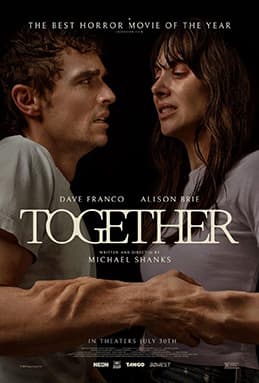
Together is an Australian horror film that learned to say trunk
Michael Shanks made a Melbourne body horror film about two people fusing into one, then sanded the Australian out of it. I keep looking for the seam.