Bruce Rowland and the tune that outgrew The Man from Snowy River
Bruce Rowland's main theme for the 1982 film won an AFI award, then went on to open the Sydney Olympics. How did one orchestral melody come to stand in for a whole idea of the bush?
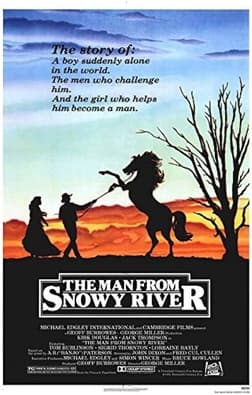
Some film themes work because they say something about the picture. Others work because the country needed a tune and this one was available. Bruce Rowland’s music for The Man from Snowy River is the second kind, and the more I listen to it, the more I think that is no insult.
The 1982 film, directed by George T. Miller from Banjo Paterson’s poem, was a phenomenon in its own right. It grossed A$17.2 million in Australia, which made it the country’s highest-grossing local film until Crocodile Dundee arrived four years later, and it went on to roughly A$50 million worldwide, including more than US$20 million in the United States and Canada. Kirk Douglas, in the dual role of two brothers, brought a name. Tom Burlinson and Sigrid Thornton brought the faces. But what people hum, when they hum anything, is Rowland.
A folk tune in an orchestral coat
The detail I find most revealing is a borrowing. Clancy’s theme in the score, played for Jack Thompson’s character, is a derivative of the convict ballad ‘Moreton Bay’, the old song about the brutality of the penal settlement under its commandant. The bush hero’s music is built from a prisoner’s lament.
The most famous theme in Australian film is a convict song in a good coat. That is not an accident of influence. It is how the Australian pastoral mythology actually works. The man on the mountain horse, the figure of free and unbroken country, rests on a history of unfree labour, and the tune is old enough to remember. Rowland does not draw attention to the borrowing. He simply writes in a warm, wide-open orchestral idiom, and lets the ballad underneath do its quiet work.
The sound of a landscape the film did not shoot
There is a small irony in how well the music fits. The production did not shoot in the Snowy Mountains at all. It filmed in the Victorian High Country near Mansfield, which was logistically easier, and the geography of the poem was approximated. The score is part of what makes the substitution work. A big orchestral sound tells you that you are in a large landscape, and the ear does not check a map.
This is what a good film composer does with a compromise. Rowland supplies a sense of place that the budget and the schedule could not guarantee, and he does it by supplying a feeling and not a description. As I hear it, the main theme moves in broad, rising shapes, the kind of music that implies distance without ever naming a valley.
What the awards said
The industry noticed. Rowland won the AFI Award for Best Original Music Score in 1982, and the APRA Award for Best Original Music Score in 1984. Neither prize is a surprise. The score is bold, tuneful and exactly as large as the picture, which is not always true of local scores of the period.
What is more surprising is what happened next. Rowland scored the 1988 sequel too, so the sound became a franchise brand. For the 2000 Sydney Olympics he composed a special version of the main title. And for the 2002 stage show, The Man from Snowy River: Arena Spectacular, he arranged more of the soundtrack. A melody written for a film about a horse chase became a national piece of ceremony.
Why the sequel could not repeat it
Rowland returned for The Man from Snowy River II, and the sound of the first film was, by then, already public property. That is a hard position for a composer. A sequel score has to sound like the original and cannot be allowed to surprise anyone, because the audience has come for the tune. It is the opposite of what most film composers are trained to want, which is to disappear into the picture and serve it. Rowland’s problem was that the picture had become a servant of the tune.
Ownership without authorship
That trajectory raises the question I cannot quite put down. Who owns a tune like this? Rowland wrote it, and he is credited, and the AFI recognised it. But the public has absorbed the theme in a way that has little to do with the film. Plenty of people who can hum it have never seen the picture, and plenty of those who have could not tell you which scene it plays under.
This is a rare kind of success. A composer’s work reaches the point where it has no author in the public mind, and it simply becomes the sound of a thing. For Australian screen music, which has produced a number of fine scores and very few tunes that ordinary people carry around, it is a remarkable outcome.
The risk of the big theme
I would not want to oversell it. A theme this successful brings a cost, and the cost is that it can flatten what it stands for. The Olympic arrangement turns a story about a young man who is underestimated into a procession of national confidence. The tune can be played at any ceremony, and that flexibility is also a weakness.
But I come back to the folk song underneath. The ballad was never really lost. It sits in the harmony of the theme the way an old stockyard sits in a paddock, unremarked and still holding something up. Whatever else the music has become, it is still carrying the memory of the hard country, which is the quietest thing about it, and the best.
Kieran writes about what films sound like. Played in a band that nearly got signed in 2012 and has been thinking about attack and decay ever since. Devoted to Warren Ellis, Amanda Brown, and the quiet work of sound editors nobody interviews.
MORE BY KIERAN BOUSTANY →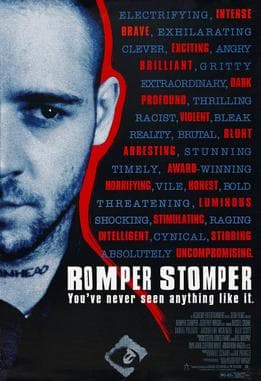
The Romper Stomper songs were written to sound real
Geoffrey Wright's 1992 film had an orchestral score and four songs in the style of Oi! punk, all by one composer and played by studio musicians. The songs then did what the film could not control.
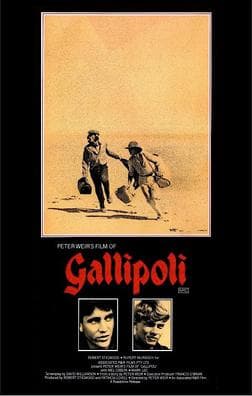
Gallipoli and the two pieces of music that are not Australian
Peter Weir's 1981 war film has no composed score to speak of. It has a French synthesiser record and a baroque lament, and between them they say everything the picture needs.
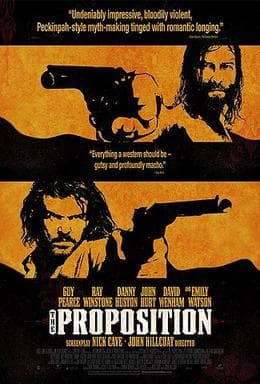
The Proposition was scored from motifs, and that is why it sounds like heat
Nick Cave and Warren Ellis wrote the music for John Hillcoat's western from motifs, not from frames, and the film's strange, hymn-like heat is the result.