The Romper Stomper songs were written to sound real
Geoffrey Wright's 1992 film had an orchestral score and four songs in the style of Oi! punk, all by one composer and played by studio musicians. The songs then did what the film could not control.
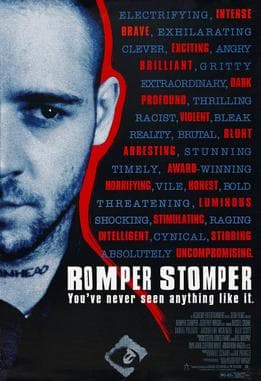
A good fake has to be better than the real thing, because the real thing has had years to go wrong in interesting ways and the fake has to get it right on the first take. That was the problem the music of Romper Stomper had to solve in 1992, and the thing that still unsettles me about it is how completely it did.
Geoffrey Wright’s debut feature, about a neo-Nazi gang in suburban Melbourne, needed a sound. Not a score in the usual sense, though it has one; it needed the music the gang would listen to, would march to, would put on in the warehouse. The songs were not licensed from any scene. They were written for the film, by one man, John Clifford White, and played by studio musicians: White on vocals, John Hewett on guitar, Chris Pettifer on bass and Phillip Beard on drums, with Peter Pales singing the German vocals on “Pulling on the Boots.” The record was produced by Doug Brady and released by Picture This Records.
Two scores in one
The soundtrack album tells you the film is built from two kinds of sound. There is the orchestral score, conducted by John Hawker, whose cues, judging by the album’s track list, follow the story’s progress: “Night Drive,” “On the Beach,” “Bubs Dead/Gabe Finds Davey.” And there are four tracks of energetic punk in the manner of Oi!, the working-class British street-punk genre the gang would plausibly have known, with names like “Fourth Reich Fighting Men” that I will not dress up.
The pairing is clever in principle. An orchestral score stands outside the characters and tells us how to feel about them; a set of songs belongs to the characters and tells us how they feel about themselves. Put both in one film and you have the film’s argument about self-image in the soundtrack itself: one voice from outside, one from inside, never quite agreeing.
(There is a small formal joke buried in the credits, too. Every song on the record was ‘composed and written by John Clifford White’, which means the gang’s whole musical culture was the work of a single imagination. That is how culture works in a film. It is also, more quietly, how a movement’s culture works when its leaders insist it came from nowhere.)
The room the mic is in
I keep returning to the sound of the thing, as distinct from the idea. The Oi! songs were performed by a group of studio musicians, which is to say professionals imitating a scene rather than members of one. That should have made them a costume. A fake of this kind succeeds only if nothing in it winks. There is no ironic distance in the vocal, no lightness in the playing, nothing that tells the listener the people on the record are only acting. The film needed the songs to commit to the pose, and the pose, committed to, becomes a recording that could have been made by the people it describes.
That is the whole risk, and the film’s makers did not get to choose how it came out.
What the songs did next
In 2014 Vice interviewed the bassist, Chris Pettifer, about the soundtrack, and what he expressed was disappointment: that genuine neo-Nazi groups had embraced the Oi! songs. They had taken a piece of invented music, made to dramatise a hate group, and adopted it as their own.
I do not think that is anyone’s fault in the narrow sense. The musicians did their job; the job was to be convincing. But it is a lesson in what convincing means. A film can aim a performance at the audience and have it land somewhere else. Music is especially vulnerable to this, because a song has no frame. A scene is bounded by its edit. A record, once it is on a record, goes wherever records go.
The reception, and the awards
The picture opened in Australia on 12 November 1992, at number one, with $819,736 from 49 screens, replacing Strictly Ballroom; it went on to gross about $3.2 million, the second-highest Australian film of the year behind that same film. At the Australian Film Institute Awards it was nominated nine times and won three: Best Achievement in Sound, Best Actor in a Lead Role, and Best Original Music Score. At the APRA Music Awards of 1993 the soundtrack won Television or Film Score of the Year.
That recognition is worth sitting with, because it is a measure of how good the work was and how awkward the work’s position remains. The music was admired as craft. It is also the part of the film most easily lifted out of context.
Why it still matters to a film-music person
For anyone who cares about how scores are made, Romper Stomper is a study in a problem we rarely discuss: what an author owes the audience for a piece of music that could be misused. A composer writing for a drama about cruelty has two obligations that pull against each other. Make it true, or the film is false. Make it bearable, or the film becomes an advertisement.
The film’s makers made it true. Whether they made it bearable depends on the room you hear it in. In the cinema, with the orchestra and the picture around it, I think it does. On its own, on a speaker, in the wrong hands, it does not, and the bassist who played it said as much. I find that honesty more useful than any defence of the film’s intentions. The sound was convincing. The sound escaped. Both things are on the record.
Kieran writes about what films sound like. Played in a band that nearly got signed in 2012 and has been thinking about attack and decay ever since. Devoted to Warren Ellis, Amanda Brown, and the quiet work of sound editors nobody interviews.
MORE BY KIERAN BOUSTANY →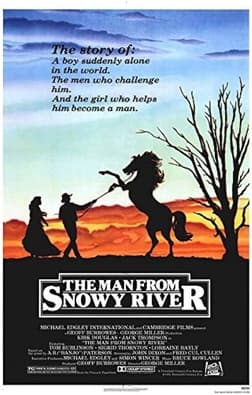
Bruce Rowland and the tune that outgrew The Man from Snowy River
Bruce Rowland's main theme for the 1982 film won an AFI award, then went on to open the Sydney Olympics. How did one orchestral melody come to stand in for a whole idea of the bush?
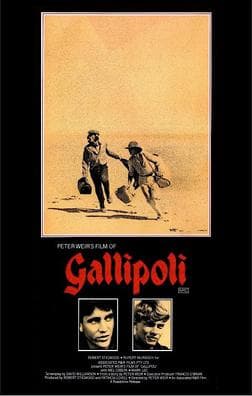
Gallipoli and the two pieces of music that are not Australian
Peter Weir's 1981 war film has no composed score to speak of. It has a French synthesiser record and a baroque lament, and between them they say everything the picture needs.
The Proposition was scored from motifs, and that is why it sounds like heat
Nick Cave and Warren Ellis wrote the music for John Hillcoat's western from motifs, not from frames, and the film's strange, hymn-like heat is the result.