Gallipoli and the two pieces of music that are not Australian
Peter Weir's 1981 war film has no composed score to speak of. It has a French synthesiser record and a baroque lament, and between them they say everything the picture needs.
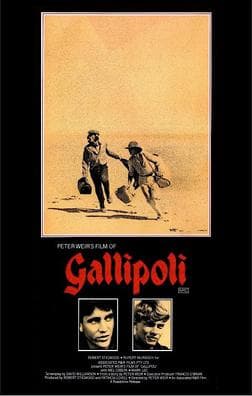
Ask anyone who has seen Gallipoli what they remember and you will hear about the end: the running, the whistle, the freeze on a young man’s open arms. Ask what they remember hearing and the answer takes longer. Some will hum something slow and stricken. Others will say a pulse, a machine-like thing, a rhythm under a footrace. Almost nobody names a composer, because there is not one.
Peter Weir’s 1981 film, written by David Williamson and shot by Russell Boyd, uses two pieces of existing music at its two poles. For its early passages of youth, training and Egypt, it reaches for the cool synthesiser repetition of Jean-Michel Jarre’s Oxygène, the 1976 record that had by then become a fixture of European radios. For its grief, it uses the piece that has become shorthand for it: the Adagio in G minor attributed to Tomaso Albinoni. Neither is Australian. Neither was written for the film. Both are exactly right.
The pulse of youth
The Jarre excerpts accompany Archy (Mark Lee) and Frank (Mel Gibson) in the stretches where they are still unaware of what they have signed up for. The use is almost provocative. The year is 1915 and the cue is an electronic hum from the 1970s. A conventional period film would have put brass or folk tunes under these scenes; Weir chose a sound that did not exist in the world he was depicting.
The result is that the early film feels contemporary. The athletes running through the desert, the boys playing with the idea of war, belong as much to 1981 as to 1915. The sequencer pulse is the sound of a body in motion, a metronome for the young men’s legs. It makes the audience complicit in the energy that the film is about to destroy.
The lament
The Albinoni piece does the reverse. It is slow, minor-key, and heavy with strings, and Weir uses it at the moments when the film stops pretending that the story has an exit. The attribution has a curious history: the Adagio as we know it was assembled in the 1950s by the Italian musicologist Remo Giazotto, who said he built it from a surviving fragment of a sonata by Albinoni. Whether or not the fragment existed in the way described has been contested for decades. So the film’s emotional core is carried by a piece of music whose own origin is somewhat in doubt, a lament for the fallen that may not be what it says it is.
I do not think this is incidental. A film about a nation inventing a story about itself at a distant beach is well served by a score whose authorship is a story people told.
The structure the music sets
It helps to see how the film is built around the two cues. The first third, set in Western Australia, is a film of open air and sprinting, a coming-of-age picture with a war waiting at the end of it. The middle, in Egypt, trades the horizon for the pyramids and a loose, tourist comedy that lets the Jarre pulse carry the boys’ sense of being on holiday inside history. The last section, at the front, drains the colour and the sound until the lament is the only thing left that has a voice.
Seen this way, the soundtrack is not decoration laid over a structure. It is the structure. The synthesiser belongs to the part of the film in which the future is still open. The strings belong to the part in which it has closed.
What is missing
It is worth noting what Weir did not do. Australia in the late 1970s and early 1980s had composers who could have scored the picture; Bruce Smeaton, among others, had made a body of work in the new wave. The decision to use found music is deliberate and reads, in retrospect, as a choice about scale. The film wanted a sound larger than the national, a vocabulary of youth and mourning that any audience would recognise before they had learned a single detail of the campaign.
That choice has costs. The picture’s soundscape does not belong to Australia in the way that its landscape does, and a local composer’s score would have rooted it more firmly. But it is hard to wish for. The Albinoni cue, laid over the final trench, is one of the most precise matches of music and image in the country’s cinema, and it works because it brings nothing local to a story that the film insists is bigger than any place.
Listening again
Watch it with attention to the gaps. The sequences of dialogue and silence, the wind, the sound of the trenches, are the connective tissue between the two musical poles. Weir built the film so that the music arrives rarely and means a lot when it does.
That economy is the lesson. In a moment when film music has a tendency to fill every available second, Gallipoli is a reminder that two well-chosen pieces, placed with nerve, can carry a whole picture. The pulse tells you what the boys are. The lament tells you what they cost.

Kieran writes about what films sound like. Played in a band that nearly got signed in 2012 and has been thinking about attack and decay ever since. Devoted to Warren Ellis, Amanda Brown, and the quiet work of sound editors nobody interviews.
MORE BY KIERAN BOUSTANY →
Bruce Smeaton and the scores you were never meant to notice
He won four AFI awards for original score, and the most famous cue in his most famous film belongs to a Romanian pan flute player.
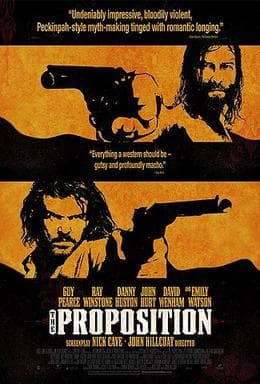
The Proposition was scored from motifs, and that is why it sounds like heat
Nick Cave and Warren Ellis wrote the music for John Hillcoat's western from motifs, not from frames, and the film's strange, hymn-like heat is the result.
Burkhard Dallwitz wrote the score everyone credits to Glass
Eleven of the twenty tracks on The Truman Show soundtrack are by a Melbourne composer, and almost nobody outside the credits has ever said his name out loud.