Bruce Smeaton and the scores you were never meant to notice
He won four AFI awards for original score, and the most famous cue in his most famous film belongs to a Romanian pan flute player.

Ask anyone in this country to hum something from Picnic at Hanging Rock and you will get the pan flute. Everybody has it. It is the sound of that film, the sound of the rock, the thing that gets played over a hundred documentaries about the Australian New Wave and half the ads that want to make a paddock feel uncanny.
It is not Bruce Smeaton’s.
The pan flute is Gheorghe Zamfir, playing traditional Romanian doina material, with Marcel Cellier on organ, selected by Peter Weir and dropped into the picture. Smeaton wrote the original compositions around it. He is credited alongside Zamfir on the film, and he has spent fifty years watching a Romanian folk melody take the credit for the atmosphere he was hired to build.
I want to argue that this is not a slight against him. It is the clearest possible illustration of what he actually does, and why he is the least discussed important composer this industry has produced.
The cues that do not want to be found
Smeaton was born in Brighton, Victoria, on 5 March 1938, taught school music in Fawkner in the mid-sixties, and came into film at exactly the right moment, which is to say just before there was an industry to come into. Libido in 1973. The Cars That Ate Paris in 1974, which won him the AFI award for original score. The Great Macarthy the following year, which won him another. Picnic at Hanging Rock the same year. The Devil’s Playground in 1976. The Chant of Jimmie Blacksmith in 1978, which won him a third.
Four AFI wins for original music, the last of them shared, for Street Hero in 1984. That is a haul. And yet the received account of Australian film music tends to start somewhere around Brian May and Mad Max and then jump to the nineties, with Smeaton treated as a name on a list.
The reason is in the writing. Listen to the Devil’s Playground material, or the Jimmie Blacksmith cues, and you notice something that is genuinely unusual for the period: the music almost never tells you how to feel about a scene before the scene has told you itself. Smeaton writes underneath. He scores the pause after the line rather than the line. He is fond of small ensembles, of a woodwind on its own, of leaving a texture unfinished so it does not close the shot off.
A score that never gets ahead of the picture is a score nobody remembers separately from the picture. That is the trade he made, and it was the right one for the films he was making, and it has cost him a reputation.
What restraint sounded like in 1976
Take The Devil’s Playground, Fred Schepisi’s seminary film. The obvious approach is choral. You have boys, a religious institution, guilt, water. Every instinct in the score-writing trade says put voices on it and let the sacred do the work.
Smeaton mostly does not. He keeps the ensemble small and secular and a little awkward, so that when the institutional sound does arrive it registers as the institution rather than as God. The film is about the difference between those two things. The score understands the film better than a bigger score would have.
Then look at what happens two years later on The Chant of Jimmie Blacksmith. Same director, vastly larger canvas, a story that could not be more loaded, and Smeaton declines the epic. The cues are sparse, often in the low register, and they resist the temptation to score the violence. He lets the violence be quiet. In 1978 that was close to heretical; the international model was still Jarre and Barry, and the Australian industry was desperate to sound like it had a symphony orchestra and a mandate.
The middle period, and the drift
He was busy through the eighties and increasingly abroad. Barbarosa in 1982. Iceman in 1984. Plenty and Eleni in 1985. Roxanne in 1987, which is the one most of the world has actually heard, and which is a good comic score by a man who was clearly not being asked for what he was best at. Then Evil Angels in 1988, back home with Schepisi and back on the material where his instincts belong, and a synthesiser score for Wendy Cracked a Walnut that picked up an ARIA nomination in 1991.
There is a version of this essay that treats the international work as a decline. I do not think that is fair. It is more that his method, which is to disappear into a picture, travels badly. A composer who builds his identity around not being noticed does not accumulate the kind of profile that gets him hired for the films that would suit him. The market rewards a signature. Smeaton’s signature is the absence of one.
Why it matters now
He lives at Binalong in New South Wales. The catalogue has been kept in circulation largely through small specialist labels rather than through the sort of anniversary reissue campaign that a comparable American figure would have had three times over.
If you want to hear what the Australian New Wave actually sounded like, as opposed to what we remember it sounding like, he is the one to go back to. The pan flute is the memory. The memory is Romanian. The cinema underneath it, the part that made those films feel like they came from a specific place with a specific unease, was very often being built by a man from Brighton who did not want you to hear him doing it.
Kieran writes about what films sound like. Played in a band that nearly got signed in 2012 and has been thinking about attack and decay ever since. Devoted to Warren Ellis, Amanda Brown, and the quiet work of sound editors nobody interviews.
MORE BY KIERAN BOUSTANY →
Burkhard Dallwitz wrote the score everyone credits to Glass
Eleven of the twenty tracks on The Truman Show soundtrack are by a Melbourne composer, and almost nobody outside the credits has ever said his name out loud.
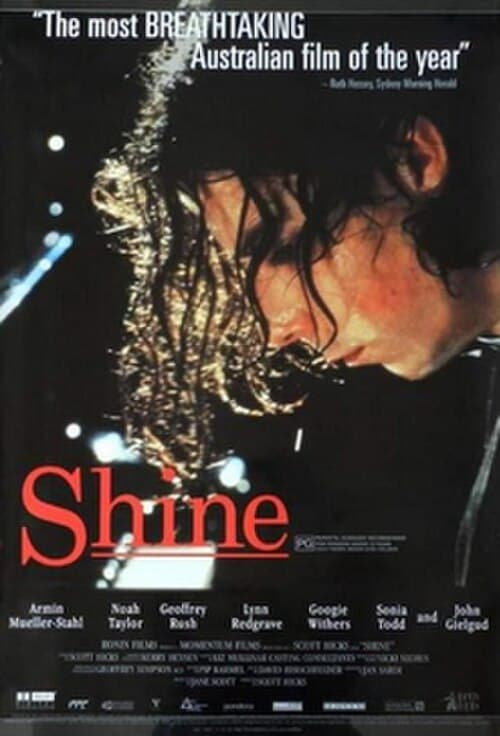
Shine and the score hiding under the Rachmaninoff
David Hirschfelder had to write original music that lives under the loudest warhorse in the piano repertoire, and the quiet writing is what carries the film.
Nigel Westlake smuggled a cathedral into a film about a pig
The score for Babe borrows its grandeur from a French organ symphony, and the trick tells you everything about how Nigel Westlake hears the relationship between small subjects and large feelings.