The Philippou brothers came from YouTube and brought the algorithm's pacing with them
Danny and Michael Philippou learned to direct by keeping strangers watching for three more seconds, and that instinct is the engine underneath Talk to Me.
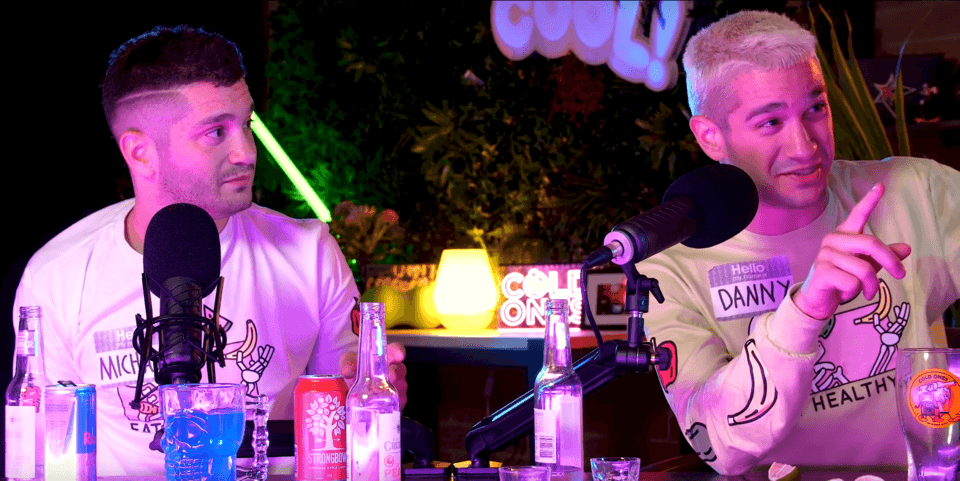
I want to say something careful about the Philippou brothers because the easy version of this essay writes itself and I do not trust the easy version. The easy version goes like this: two Adelaide kids built a YouTube channel called RackaRacka, accumulated billions of views through hyperviolent slapstick, and then translated that audience into a feature film that grossed over $180 million worldwide on a $4.5 million budget. The easy version treats Talk to Me as a success story, which it is, and leaves it there, which is not enough.
What interests me is the mechanism. Not the biography but the craft that the biography produced. Danny and Michael Philippou spent a decade making short-form content for a platform whose entire economic logic is retention. YouTube does not care whether your video is good. It cares whether people keep watching. The algorithm measures this with a granularity that would make a television executive weep: average view duration, click-through rate, the precise second at which a viewer drops off. The Philippous learned to direct inside this system. They learned that the first five seconds determine everything. They learned that dead air is death. They learned that the audience’s thumb is always hovering over the next thing, and your job, your only job, is to make them not press it.
This is a particular kind of education, and it produces a particular kind of filmmaker.
The RackaRacka years
RackaRacka’s videos are, if you have not seen them, difficult to describe to people who did not grow up on the internet. They are essentially action-comedy sketches in which the Philippou brothers and their friends enact elaborate fight sequences, stunts, and physical gags, usually involving fake blood, household objects used as weapons, and a cheerful disregard for personal safety. The production values are surprisingly high. The choreography is genuinely skilled. The content is relentlessly, almost aggressively juvenile.
I watched about thirty of their videos before writing this, and what struck me was not the violence, which is cartoonish and largely consequence-free, but the pacing. There is no moment in a RackaRacka video where nothing is happening. Every cut advances the action. Every shot contains movement. The camera does not rest because resting is what you do when you have a captive audience, and the Philippous never had a captive audience. They had teenagers with short attention spans and unlimited options, and they built their visual grammar around that constraint.
This is worth taking seriously, even if the content itself does not demand serious critical engagement. The Philippous were not film students learning composition and mise-en-scene. They were empiricists. They made a video, watched the analytics, saw where viewers dropped off, and adjusted. Thousands of iterations. Millions of data points. By the time they sat down to make a feature film, they had more practical knowledge about audience attention than most graduates of the Australian Film Television and Radio School, and the knowledge was different in kind, not just in degree. It was knowledge about the nervous system, about the involuntary mechanisms that keep a person watching.
What Talk to Me learned from the algorithm
Talk to Me (2022) is a horror film about a group of Adelaide teenagers who discover that a preserved, embalmed hand allows them to communicate with the dead. The hand becomes a party trick, then an addiction, then something worse. The premise is simple and the execution is precise, and the film’s pacing is where the YouTube education announces itself most clearly.
Watch the opening scene. A house party, loud music, disorientation, and then a stabbing, sudden and awful, within the first two minutes. The film gives you no establishment, no orientation, no gentle entry into its world. It drops you into violence and chaos because the Philippous know, from a decade of analytics, that you will leave if they do not hook you immediately. This is not a criticism. It is an observation about where the instinct comes from.
The film sustains this velocity throughout. Scenes are short. Transitions are hard cuts. The possession sequences, in which teenagers allow spirits to enter their bodies for exactly ninety seconds, are structured like the best RackaRacka sketches: escalating physical intensity, precise comedic timing that curdles into horror, and a cut away at the exact moment of maximum impact. The Philippous know when to end a scene the way a stand-up comedian knows when to end a joke, not by instinct alone but by thousands of hours of watching audiences react in real time.
The question I keep circling
Here is where my ambivalence begins. I admire Talk to Me. I think it is one of the best Australian horror films of the past decade, possibly longer. The performances are excellent, particularly Sophie Wilde, whose physical commitment to the possession sequences is genuinely extraordinary. The film’s metaphor, grief as a kind of addiction, the desire to stay connected to the dead even when the connection is destroying you, is handled with more subtlety than the premise suggests. The Philippous are talented. This is not in dispute.
What I keep circling is whether the skill they developed on YouTube is additive or substitutive. Whether they brought something new to cinema or whether what they brought replaced something that was already there and might have been worth keeping.
The retention-driven sensibility produces films that never bore you. It also produces films that never let you sit with anything. Talk to Me moves so fast that its emotional beats, and there are real emotional beats, arrive and depart before they can fully settle. The relationship between Mia and her dead mother, which is the film’s emotional core, is communicated in efficient fragments rather than sustained scenes. You feel it, but you feel it the way you feel something on a screen you are scrolling past: a flash of recognition, a pang, and then the next thing.
Compare this to Jennifer Kent’s The Babadook, another Australian horror debut, which builds its dread through patience and duration and long, uncomfortable domestic scenes in which nothing supernatural is happening but everything is wrong. Kent’s pacing is theatrical. It trusts the audience to stay even when the screen is quiet. The Philippous’ pacing does not trust the audience to stay, because YouTube taught them that the audience will not stay, and this lesson, once learned, is very difficult to unlearn.
A new kind of filmmaker or the oldest kind
I do not think the Philippous are an aberration. I think they are the first clear example of something that will become common: filmmakers whose primary training was not in cinema but in algorithmic content creation, and who carry that training into their feature work the way earlier generations carried the influence of theatre or painting or television. The question is not whether these filmmakers are legitimate. Of course they are. The question is what assumptions about audiences they bring with them, and whether those assumptions, which were formed in a medium designed to monetise attention, will reshape the grammar of cinema in ways we have not fully reckoned with.
I keep thinking about a phrase Danny Philippou used in an interview: “We never wanted to give the audience a chance to look at their phone.” This is a perfectly reasonable goal for a filmmaker. It is also, if you think about it for more than a moment, a concession. It concedes that the audience is always on the verge of leaving. It concedes that attention is not given but extracted. It concedes that the filmmaker’s relationship to the viewer is adversarial, a competition for cognitive resources against every other stimulus in the room.
The older model of cinema, the one I grew up loving, assumed something different. It assumed that if you bought a ticket and sat in a dark room, you had already committed your attention, and the filmmaker’s job was not to retain it but to reward it. To build slowly. To let silence do work. To trust that the audience would follow you into difficulty if the difficulty was earned.
I do not know which model is right. I suspect both are, in different contexts and for different audiences. But I notice that I admire Talk to Me more than I love it, and I think the distinction matters. The Philippous made a film that never lets you go. What I keep wondering is whether letting go, even briefly, is part of what cinema is for.
Mara writes essays. She came to film writing from a decade of literary criticism and still reaches, sometimes, for a novel before she reaches for a shot list. She lives in the inner north of Melbourne and does not explain which city that is.
MORE BY MARA DENG →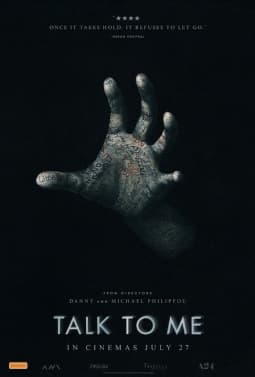
Talk to Me found Australian horror's nerve and held it
The Philippou brothers built a horror film out of YouTube pacing and Adelaide geography, and the combination should not work as well as it does.
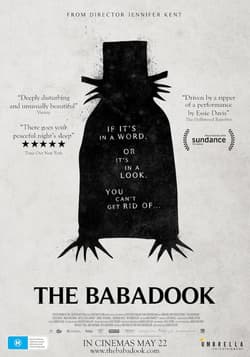
Australian horror found its voice by refusing to be polite
From The Babadook to Relic to Talk to Me, Australian horror keeps returning to the house, the family, and the thing that should not be let in.
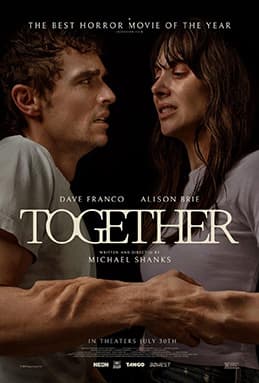
Together is an Australian horror film that learned to say trunk
Michael Shanks made a Melbourne body horror film about two people fusing into one, then sanded the Australian out of it. I keep looking for the seam.