Australian horror found its voice by refusing to be polite
From The Babadook to Relic to Talk to Me, Australian horror keeps returning to the house, the family, and the thing that should not be let in.
I did not grow up with horror. My parents did not watch it, did not keep it in the house, did not consider it a genre so much as a category of noise they preferred to avoid. Horror was something other families did, the way other families kept dogs or ate dinner at five thirty. I came to it late, in my twenties, through a flatmate in Marrickville who owned a projector and a hard drive full of films sorted into folders with names like GOOD ONES and ACTUALLY SCARY and DO NOT WATCH ALONE. I watched them all, alone, on a wall in a share house that smelled of damp carpet and burnt toast, and what I discovered was not what I expected. I expected to be frightened. What I got instead was a genre that was thinking harder about domestic life than most of the dramas I had been told were important.
I want to say this is where Australian horror starts for me, in that share house, but that is not quite right. Australian horror starts, for most of us who care about it, in a house. That is the thing. Other horror traditions send you into the woods, the cabin, the backroad, the corn. American horror loves the threshold between civilisation and wilderness, the place where the cell signal drops out and the rules change. Australian horror keeps you inside. It locks the front door and asks you to sit with whatever is already in the room.
The house that would not let go
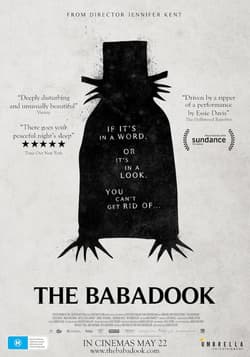
The Babadook arrived in 2014 and the conversation around it moved quickly from “good horror film” to “is it even horror” to “it is obviously about grief” to a kind of consensus that flattened the film into a metaphor and left it there. I understand why this happened. Jennifer Kent made a film so legible in its symbolism that it almost invited the reduction. Amelia is a single mother. Her son is difficult. There is a book on the shelf that should not be there. The creature in the book becomes the creature in the house, and the creature is grief, or depression, or the part of motherhood that nobody is allowed to talk about, and once you have decoded it the film seems to resolve into a tidy thesis.
But this reading misses what the film actually does to you when you sit in a dark room and watch it. The Babadook is not a puzzle to be solved. It is an experience of confinement. Kent keeps the camera inside the house for almost the entire running time. The walls are close. The light is grey. The sound design is oppressive, full of thumps and scrapes and the particular silence of a house where someone is trying not to make noise. Amelia’s exhaustion is not a metaphor. It is the texture of every scene, the way she moves through rooms as though the air has thickened, the way she flinches at her own son’s voice. The house is not standing in for her psychological state. Her psychological state is the house. They are the same thing.
Inheritance and the thing in the walls
Three years later, Cargo took the zombie film and relocated it to the Australian landscape, which should have been a move outward, away from the domestic, into the open country. And the film does use the bush, beautifully and terrifyingly, as a space of exposure rather than shelter. But the engine of Cargo is not survival in the wild. It is a father trying to get his daughter to safety before he stops being her father. Martin Freeman carries the child across a landscape that is indifferent to both of them, and the horror is not the zombies. The horror is the countdown. The horror is paternal love operating on a deadline, the knowledge that the body you are using to protect your child is the same body that will eventually threaten her. The domestic unit, father and infant, persists even when the house is gone. The house is portable. You carry it with you.
Relic, in 2020, brought the house back, literally and figurally. Natalie Erika James set her debut in a family home in regional Victoria, the kind of weatherboard place that holds three generations of accumulated silence. Emily Mortimer plays Kay, who returns to the house because her mother Edna (Robyn Nevin) has gone missing, or rather, has gone strange, which is worse than missing because it means she is still there but not quite. The house is rotting. Edna is rotting. The film makes these processes indistinguishable. Walls grow black mould. Edna’s skin bruises and peels. The corridors shift and narrow until the house becomes a body, or the body becomes a house, and the distinction stops mattering.
The share house and the open mouth
What I mean is that Australian horror keeps finding the scary thing not in the landscape but in proximity. In the obligation to stay. In the inheritance you did not ask for and cannot refuse. The house is the site of horror because the house is where Australians perform the rituals of family, of belonging, of pretending that everything is fine. We are a culture that prizes the domestic. Home ownership is the national obsession. The house is the unit of aspiration, the proof that you have made it, and Australian horror keeps opening the front door and showing you what is living under the floorboards.
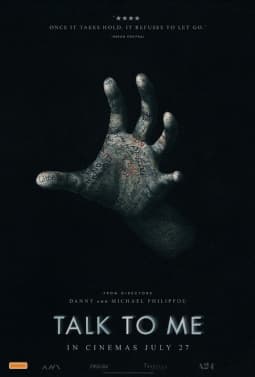
Talk to Me, the Philippou brothers’ 2023 debut, shifts the setting from the family home to the share house, the party, the teenage bedroom with the door closed. The horror object is an embalmed hand that lets you commune with the dead, and the teenagers pass it around like a bong at a house party, filming each possession on their phones, uploading the footage, turning the supernatural into content. The genius of Talk to Me is that it understands the share house as the new Australian domestic space, the place where young people perform intimacy without the structures of family to hold it in place. Mia (Sophie Wilde) is grieving her mother. She is living between houses, between families, between the person she was and the person the grief is making her become. The hand offers contact with the dead and the film does not pretend this is purely dangerous. It is also, briefly, a relief. The worst thing about grief is not the pain. It is the silence. The hand breaks the silence, and the cost of breaking it is the film’s subject.
What the house knows
I think the reason Australian horror has found such precise form in the last decade is that the country’s anxieties have moved indoors. The housing crisis, the ageing population, the fracturing of the nuclear family, the rental market that keeps young people in share houses well into their thirties. These are domestic anxieties. They are about who gets to live where, and what you inherit, and what happens when the structure that was supposed to protect you starts collapsing from the inside. The Babadook knew this in 2014. Relic knew it in 2020. Talk to Me knows it in the specific register of a generation that documents everything and processes nothing.
I still do not watch horror comfortably. I still pause films and walk around the kitchen and come back. But I keep coming back to these particular films because they are not asking me to be scared of the dark or the woods or the stranger. They are asking me to be scared of the house, the family, the obligation to stay and care and cope and not make a scene. They are asking me to be scared of politeness, of the Australian insistence on keeping it together, of the thing we do where we close the door and smile and pretend the walls are not shifting. The films know that the scariest thing in Australia is not what comes from outside. It is what was already inside, waiting for someone to be honest enough to let it out.
Mara writes essays. She came to film writing from a decade of literary criticism and still reaches, sometimes, for a novel before she reaches for a shot list. She lives in the inner north of Melbourne and does not explain which city that is.
MORE BY MARA DENG →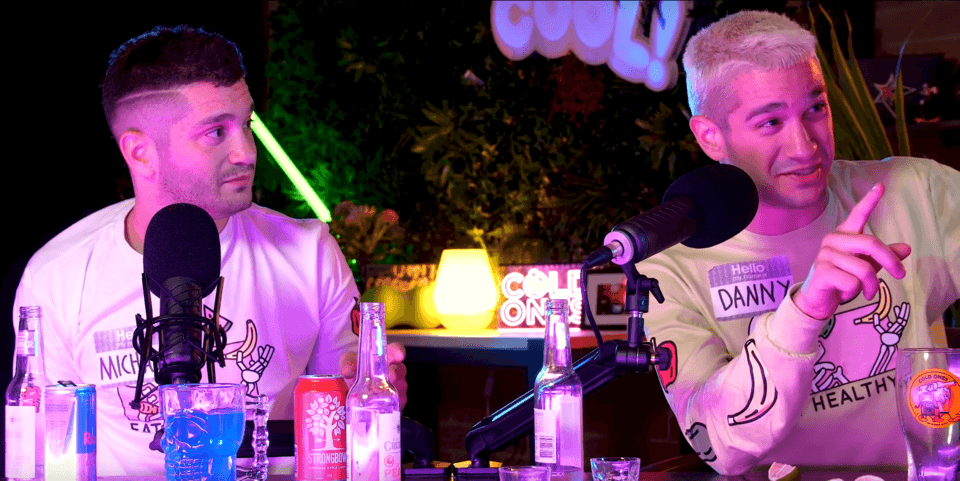
The Philippou brothers came from YouTube and brought the algorithm's pacing with them
Danny and Michael Philippou learned to direct by keeping strangers watching for three more seconds, and that instinct is the engine underneath Talk to Me.
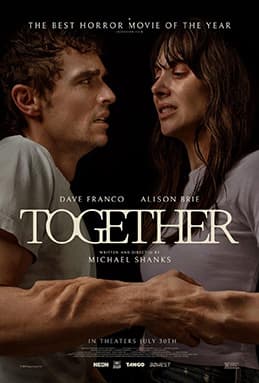
Together is an Australian horror film that learned to say trunk
Michael Shanks made a Melbourne body horror film about two people fusing into one, then sanded the Australian out of it. I keep looking for the seam.
Australian horror found an audience and now it has to decide what to do with it
Talk to Me proved Australian horror could sell globally, and the pipeline behind it is filling with directors who watched that and took notes.