Australian horror found an audience and now it has to decide what to do with it
Talk to Me proved Australian horror could sell globally, and the pipeline behind it is filling with directors who watched that and took notes.
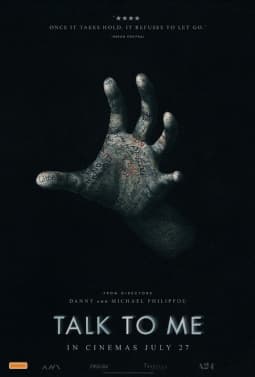
There is a version of this piece that begins with box office numbers, because the numbers are significant. Talk to Me grossed over $180 million worldwide on a reported budget of $4.5 million, making it one of the most profitable Australian films ever produced. Danny and Michael Philippou became the most commercially successful Australian debut directors in the country’s history, and they did it in a genre that the local funding ecosystem has spent decades treating as a lower priority than social realism and literary adaptations. The numbers matter. But they are not the story.
The story is what happens after the numbers. Because what Talk to Me did, beyond making money, was demonstrate a proof of concept that the Australian horror pipeline had been circling around for a decade without quite reaching. The Babadook in 2014 proved that an Australian horror film could achieve critical prestige. Relic in 2020 proved that one could secure international distribution and festival credibility simultaneously. Talk to Me proved that one could do all of this while also filling multiplexes in markets that do not typically care about Australian cinema at all. That is a different kind of proof, and it has changed the calculations being made by every production company, funding body and sales agent with an interest in Australian genre film.
The pipeline is filling. I have spoken to producers, development executives and distributors across the past six months, and the consistent observation is that horror projects are moving through the system at a pace that would have been unusual three years ago. Screen Australia’s recent funding rounds reflect this. The state agencies are more receptive. International buyers, particularly those working the genre festival circuit from Sundance Midnight to Fantastic Fest, are actively seeking Australian horror in a way that was not the case before 2023.
The generation taking notes
What interests me more than the volume is the kind of horror being developed. The directors entering the pipeline now are not imitating the Philippous. They are, broadly, part of a generation that grew up watching The Babadook and Relic and understood those films as permission slips: evidence that Australian horror did not need to look or sound like American horror to function. Jennifer Kent and Natalie Erika James both made films that were domestic in the architectural sense, set inside houses, built around family structures, concerned with what happens when the private space of a home becomes uninhabitable. This is a distinctly Australian contribution to the genre. American horror tends toward the institutional or the cosmic. Japanese horror locates dread in the technological. Australian horror, at its most distinctive, finds it in the house you grew up in.
The directors I am watching are Zak Hilditch, whose These Final Hours (2013) showed a talent for sustained tension within contained settings, and who has been developing a new feature that reportedly pushes further into psychological territory. There is Alexis Levi, whose short film work has circulated at genre festivals and whose approach to sound design suggests someone thinking about horror as an auditory experience first. And there is a cohort of directors coming through the Philippous’ own production orbit who have the advantage of proximity to a team that has already navigated the international market once.
The A24 question
A24 distributed Talk to Me internationally, and their involvement reshaped how the film was perceived. This is worth being honest about. A24’s brand, which functions as a quality signal for a particular audience demographic, gave Talk to Me a context that an Australian genre film would not normally receive. The question is whether that context extends to the next Australian horror film, and the one after that, or whether it was specific to the Philippous and their particular combination of YouTube celebrity, formal discipline and first-feature energy.
My read is that A24’s interest in Australian horror is real but conditional. They are not going to distribute every Australian genre film that comes along. They will distribute the ones that fit their brand, which means films that have a formal identity, a distinctive visual and tonal register, and enough commercial hook to justify the marketing spend. That is a narrow window. It is also the right window for the kind of horror that Australia does best, because the domestic, intimate horror that defines the Australian tradition is precisely the kind of genre filmmaking that A24 has built its identity around.
The tension nobody talks about
Here is what concerns me. The success of Talk to Me creates a commercial incentive to make more horror, and commercial incentives, in any national cinema, tend to flatten the very qualities that made the original films distinctive. The thing that made The Babadook extraordinary was not that it was a horror film. It was that Jennifer Kent made a film about grief and single motherhood and used the horror genre as a delivery mechanism for something that mainstream Australian drama would not have allowed her to say so directly. The genre was not the point. The genre was the permission.
If the pipeline fills with films that treat horror as the point rather than the permission, the results will be competent and forgettable. We have seen this cycle before in other national cinemas. South Korea went through it after Train to Busan. The UK went through it after 28 Days Later. The initial breakthrough produces a wave of imitations that capture the surface and miss the structure, and by the time the cycle is over, the original films look lonelier than they did before.
What I want to see
I want to see Australian horror that is willing to be slow. The Philippous made a fast film, rhythmically closer to a music video than a traditional horror picture, and it worked brilliantly for what they were doing. But the tradition they came from, the Kent and James tradition, is built on patience. The Babadook takes its time. Relic takes its time. The dread in those films accumulates rather than detonates, and the domestic settings become claustrophobic not because the rooms are small but because the camera stays in them long enough for the walls to start closing in.
I want to see horror that uses Australian suburban architecture, the weatherboard houses, the fibro cottages, the brick veneer homes with their narrow hallways and their backyards that end at a fence line. There is an entire vocabulary of spatial anxiety in the Australian suburb that horror cinema has barely touched. The house in The Babadook was a character. The house in Relic was a metaphor. The next step is a film where the house is simply a house, and the horror comes from how ordinary it is, how completely it resembles the house you grew up in, and how that resemblance is the thing that makes it unbearable.
I want to see directors who understand that the audience Talk to Me found is not an audience for Australian horror specifically. It is an audience for horror that feels specific, that comes from somewhere, that carries the weight of a particular place and a particular set of anxieties. The audience will stay if the films keep being specific. They will leave if the films start being generic. The window is open. What matters now is what gets built inside it.
Bronte writes long-form criticism of Australian cinema and the international art films that feed into it. She was on the ground at Cannes in 2019 and has not entirely forgiven the festival for 2020. Patient with slow films; impatient with tidy ones.
MORE BY BRONTE HAUGHEY →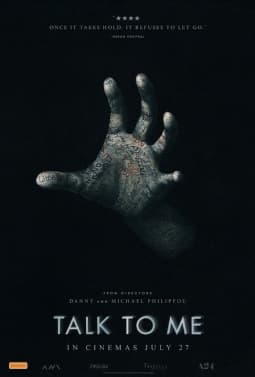
Talk to Me found Australian horror's nerve and held it
The Philippou brothers built a horror film out of YouTube pacing and Adelaide geography, and the combination should not work as well as it does.
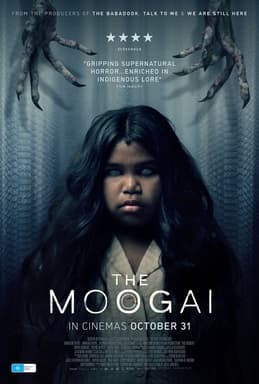
What The Moogai asks you to believe about a mother
Jon Bell's horror film splits its audience along a single question, and the split at Sundance and at Sydney tells you exactly what the film is doing.
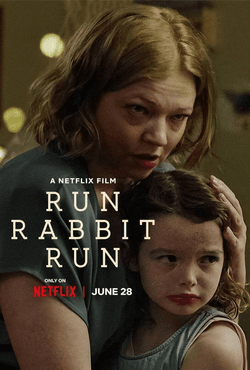
Run Rabbit Run gives Sarah Snook a haunted house and not enough script to fill it
Snook carries the film on performance alone, and the film knows this, which is both its strength and the reason it never finds a second gear.