Run Rabbit Run gives Sarah Snook a haunted house and not enough script to fill it
Snook carries the film on performance alone, and the film knows this, which is both its strength and the reason it never finds a second gear.
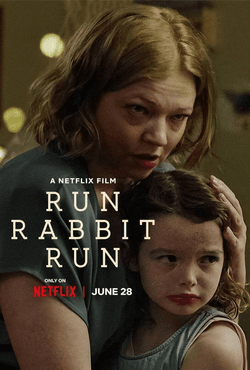
There is a moment early in Run Rabbit Run where Sarah Snook, playing a fertility doctor named Sarah, stands in her kitchen holding a birthday cake and the camera catches something in her face that the screenplay has not yet earned. It is fear, but not the performed fear of a genre set piece; it is the kind of fear that lives below the performance, the kind an actor brings to a scene when they understand something about the character that the script has only gestured toward. Snook does this throughout the picture. She is constantly operating at a depth the material cannot match, and the result is a film that is fascinating to watch for the wrong reasons. You are not watching a horror film. You are watching an actor work.
Daina Reid, directing her feature debut after extensive television work including The Handmaid’s Tale, makes a series of choices that are individually defensible and collectively insufficient. The house is well-chosen: a mid-century Melbourne property with the kind of clean lines and large windows that look elegant in daylight and claustrophobic after dark. The colour palette shifts from warm neutrals to cold blues as the story darkens. The sound design foregrounds domestic noise, the hum of a refrigerator, the click of a latch, in a way that signals Reid’s understanding of how horror operates at the level of texture. All of this is competent. None of it is enough.
The inheritance problem
The story belongs to a lineage that Australian horror has explored with increasing frequency over the past decade: the domestic space as a site of inherited trauma. The Babadook (2014) did this with a single mother and a children’s book. Relic (2020) did it with three generations of women and a house that was literally decomposing. Both of those films understood something that Run Rabbit Run does not, or does not fully commit to: the horror has to be structural, not incidental. The house, the family, the history have to be woven into each other so tightly that the audience cannot separate the psychological from the supernatural, the metaphor from the mechanism.
In Run Rabbit Run, the pieces are present but the weaving is loose. Sarah’s daughter Mia (Lily LaTorre) begins behaving strangely after her birthday, insisting that she is someone else, someone connected to Sarah’s estranged mother Joan (Greta Scacchi). There is a dead sister in the backstory. There is a rural property with a history. There are rabbits, which the film deploys as a recurring motif without ever quite deciding what they signify. The screenplay, by Hannah Kent, whose novel Burial Rites demonstrated a formidable capacity for atmosphere and historical specificity, feels here as though it has been compressed, as though a longer, more detailed narrative has been reduced to its plot points without retaining the connective tissue that would give those points emotional weight.
The child-performance problem
LaTorre, as Mia, is asked to do something that very few child actors can do convincingly: oscillate between normalcy and possession, between being a seven-year-old and being a vessel for someone else’s unresolved grief. The performance is not bad; it is simply not calibrated to the same frequency as Snook’s. There are scenes in which the two of them occupy the same frame and appear to be in different films: Snook grounded and specific, LaTorre reaching for an intensity that the direction does not quite support. This is not the child’s fault. It is a problem of staging, of the film’s inability to build the kind of sustained, incremental tension that would make Mia’s transformation feel inevitable rather than episodic.
Compare this to Essie Davis and Noah Wiseman in The Babadook, where Jennifer Kent directed the child performance with a specificity that made the boy’s behaviour unbearable in exactly the right way. Wiseman’s Samuel was not creepy in the genre sense; he was exhausting in the domestic sense, and the horror came from the mother’s proximity to a breaking point that the audience could feel approaching. Run Rabbit Run wants Mia to be unsettling, but it does not invest enough screen time in the ordinary rhythms of Mia-as-Mia for her transformation to register as a disruption. You cannot lose something you never fully had.
The house that does not commit
The house is the other problem. In the strongest entries in the Australian domestic-horror tradition, the house is not a backdrop; it is an argument. The house in Relic was disintegrating, its walls revealing rot and darkness beneath the plaster, and the decay was inseparable from the film’s meditation on dementia and generational obligation. The house in The Babadook was small and dark and cluttered in a way that made the single mother’s isolation feel physical. These were houses that meant something, structurally and thematically.
The house in Run Rabbit Run is too nice. This could have been deliberate; the contrast between the clean, well-lit domestic space and the darkness seeping in from the family’s past. But the film does not lean into this contrast hard enough. The house never becomes hostile. It never feels as though the architecture itself is participating in the horror. It remains a set, a location, a place where frightening things happen but which is not itself frightening. Reid shoots it capably, but the camera’s relationship to the space is observational rather than adversarial.
Snook between worlds
The reason to watch the picture, and there is a reason, is Snook. She was between seasons of Succession when she made this film, and what she brings from that show is a capacity for micro-expression that most screen actors do not possess. She can signal three contradictory emotions in the time it takes to blink, and Reid, to her credit, gives her enough close-ups to exploit this. There is a scene in which Sarah visits her mother’s aged-care facility and Snook’s face performs an entire archaeology of resentment, guilt, love and revulsion in the space of a single conversation. It is remarkable work. It is also work that the film around it does not know how to use.
This is the particular frustration of Run Rabbit Run. It has a lead performance that belongs in a better film, and it knows this, and its knowledge makes it cautious rather than bold. The picture defers to Snook constantly, giving her long takes and quiet scenes that function as showcases for her ability, but it does not give her enough to push against. A great horror performance needs resistance; it needs a world that is closing in, a structure that is tightening, a set of circumstances that force the actor into corners. Snook is never cornered. She is watched, admired, and underserved, and the film ends not with a climax but with a slow deflation, the air going out of a premise that never fully inflated.
What the tradition demands
The Australian domestic-horror cycle is still young enough that each new entry is measured against its predecessors, and Run Rabbit Run does not survive the comparison well. It is a film with good instincts and insufficient nerve, a film that understands the genre’s conventions without finding anything new to do with them. Kent’s screenplay gestures toward depths it does not plumb. Reid’s direction is controlled without being commanding. And Snook, brilliant and committed and visibly more prepared than the material requires, gives a performance that will be remembered longer than the film that contains it, which is both a compliment to the actor and an indictment of the production. The tradition demands more. It has received more, from filmmakers working with smaller budgets and less prominent casts, and the gap between what Run Rabbit Run promises and what it delivers is, in the end, its own kind of horror: the horror of potential unmet.
Bronte writes long-form criticism of Australian cinema and the international art films that feed into it. She was on the ground at Cannes in 2019 and has not entirely forgiven the festival for 2020. Patient with slow films; impatient with tidy ones.
MORE BY BRONTE HAUGHEY →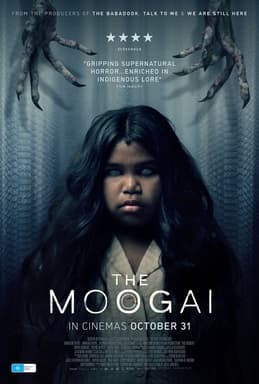
What The Moogai asks you to believe about a mother
Jon Bell's horror film splits its audience along a single question, and the split at Sundance and at Sydney tells you exactly what the film is doing.
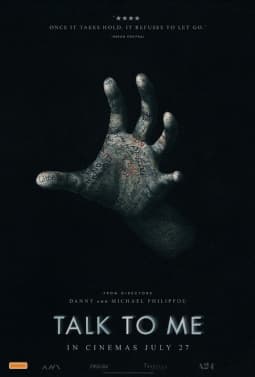
Australian horror found an audience and now it has to decide what to do with it
Talk to Me proved Australian horror could sell globally, and the pipeline behind it is filling with directors who watched that and took notes.
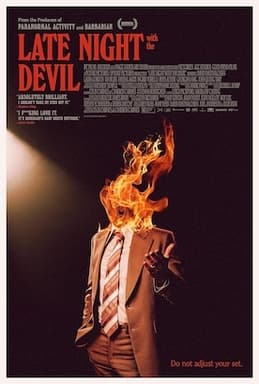
Late Night with the Devil put Australian horror on a talk-show set and the audience did not see it coming
The Cairnes brothers built a 1977 talk show, filled it with a demon, and proved that Australian horror works best when the set is cheap and the writing is not.