Late Night with the Devil put Australian horror on a talk-show set and the audience did not see it coming
The Cairnes brothers built a 1977 talk show, filled it with a demon, and proved that Australian horror works best when the set is cheap and the writing is not.
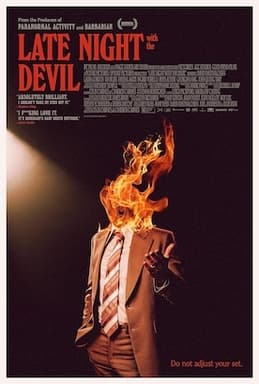
The conceit of Late Night with the Devil is so precise that it takes a few minutes to register that you are watching a horror film at all. The picture opens with a narrator delivering a brief history of American late-night television in the 1970s, the format wars, the ratings, the cultural stakes, and introduces Jack Delroy (David Dastmalchian), the host of a fictional talk show called Night Owls that has been chasing Johnny Carson in the ratings for years. The tone is documentary. The footage looks period-accurate: the warm, slightly overexposed palette of 1970s broadcast television, the studio audience visible in their seats, the graphics and bumpers carrying the specific visual weight of an era when television was still made of cardboard and confidence. By the time the first guest sits down, you have forgotten that none of this is real. The show feels like a show. The host feels like a host. The audience feels like an audience. And then something goes wrong on air, and the distance between format and content collapses, and you realise the Cairnes brothers have built a trap and you walked into it willingly.
Cameron and Colin Cairnes are from Melbourne. Their previous feature, 100 Bloody Acres (2012), was a low-budget horror comedy about a fertiliser business that sources its product from human remains; it was funny, efficient, and largely unseen. Late Night with the Devil is a different proposition entirely, not because it is more ambitious in scope but because it is more disciplined in execution. The brothers wrote the script, directed the picture, and maintained a tonal control across ninety-three minutes that is remarkable for a film operating in the found-footage register, a genre that tends toward chaos and relies on the camera’s apparent loss of control for its scares. This picture does the opposite. The camera never loses control. The studio cameras keep rolling. The floor manager keeps calling shots. The horror happens inside a system that continues to function, and the functioning is what makes it frightening.
The talk-show set as horror architecture
The genius of the single set is that it eliminates everything a horror film usually depends on. There are no dark corridors. There are no locked doors. There are no spaces off-screen where threat can accumulate in the audience’s imagination. The talk-show set is fully lit, fully visible, designed to be seen from every angle. The guests sit in chairs. The host sits behind a desk. The audience sits in rows. Every element of the space is engineered for legibility, for the elimination of ambiguity, and when the supernatural enters this space it has nowhere to hide.
The Cairnes brothers understand that the real menace of the picture is not the demon; it is the format. Jack Delroy keeps hosting. The show keeps going. The commercial breaks still happen. The guests are introduced with the same patter and the same applause cues even as the situation on set deteriorates from unsettling to dangerous to catastrophic. The format has its own momentum, its own logic, and that logic does not accommodate the supernatural; it simply absorbs it, processes it as content, keeps the cameras rolling because that is what the cameras are for. The most disturbing moments in the film are not the scenes of demonic manifestation but the moments immediately after, when Delroy smiles at the camera and delivers his next line as though nothing has happened, because the show must go on, because that is the rule, because the format is a machine and the machine does not stop.
Dastmalchian and the host’s register
David Dastmalchian’s performance is the structural foundation of the picture, and it works because he plays Delroy not as a man concealing fear but as a man who has been performing for so long that performance has replaced whatever was underneath. The character’s backstory, delivered in the opening narration and parcelled out through the episode, involves a dead wife, a ratings crisis, and a desperate gamble to save his show by devoting an entire episode to the occult on the night before Halloween. Dastmalchian does not play the desperation. He plays the professionalism. The smile is real; the warmth is real; the timing is impeccable. He is a good host. He is perhaps a great host. And the film’s horror is rooted in the recognition that being a great host and being a decent human being are not the same skill, and that the former can persist long after the latter has been consumed.
The supporting cast operates in carefully differentiated registers. Ian Bliss plays Carmichael Haig, a sceptical mentalist who serves as the episode’s rationalist anchor; his performance is all control and precision, a man who believes he can debunk anything and whose confidence becomes its own kind of vulnerability. Laura Gordon plays June Ross-Mitchell, a parapsychologist who has brought a young girl, Lilly (Ingrid Torelli), to the show as evidence of genuine possession. Torelli’s performance is the most physically demanding in the film and she commits to it without reservation; the possession sequences are visceral, unsettling, and filmed with the flat, unsparing light of a television studio that does not know how to look away.
The Australian production that plays American
There is something worth noting about the picture’s nationality, which is that it does not advertise it. Late Night with the Devil is set in New York. The characters are American. The cultural references are American. The period detail is American. Nothing in the film’s text identifies it as Australian, and this is deliberate; the Cairnes brothers are not making a statement about Australian identity or Australian horror or the Australian industry’s relationship with genre. They are making a horror film, full stop, and they have set it in the world that best serves their premise.
This is a strategy that Australian genre filmmakers have employed with varying degrees of success for decades, and it raises questions about visibility that the industry has never resolved. When an Australian film performs its nationality, it is legible as Australian product; when it conceals its nationality, it competes on the open market but disappears from the national conversation. Late Night with the Devil was made in Melbourne with an Australian crew and Australian financing, and it grossed over $30 million worldwide, making it one of the most commercially successful Australian films of 2024. But the audience that drove that success largely does not know it is Australian, and the question of whether that matters depends on what you think national cinema is for.
The second consecutive breakout
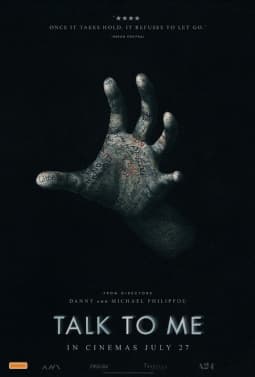
The timing is significant. In 2023, the Philippou brothers’ Talk to Me became a global horror phenomenon, grossing over $90 million on a micro-budget, distributed by A24, built from YouTube instincts and Adelaide geography. In 2024, Late Night with the Devil repeated the pattern on a smaller scale: micro-budget, Australian-made, genre-literate, commercially successful, invisible as Australian product to most of its audience. Two years, two Australian horror films, two breakouts. The coincidence invites the conclusion that something structural has shifted, that Australian horror has found a formula or a pipeline or a moment.
The truth is probably less tidy. Both films work because their premises are original and their execution is disciplined, not because they emerged from a movement or a wave or a scene. The Philippou brothers and the Cairnes brothers do not share a style or a sensibility or, as far as I can tell, a phone number. What they share is an understanding that horror is a precision instrument, that the genre rewards specificity over spectacle, and that a limited budget is not a limitation if you are smart enough to make the constraint the concept. The talk-show set costs almost nothing. The hand costs almost nothing. The scares cost craft, and craft is what both pictures have in surplus, and craft is the one thing that does not require a production budget or a distribution deal or a national identity. It just requires knowing what the camera is for and keeping it rolling.
Bronte writes long-form criticism of Australian cinema and the international art films that feed into it. She was on the ground at Cannes in 2019 and has not entirely forgiven the festival for 2020. Patient with slow films; impatient with tidy ones.
MORE BY BRONTE HAUGHEY →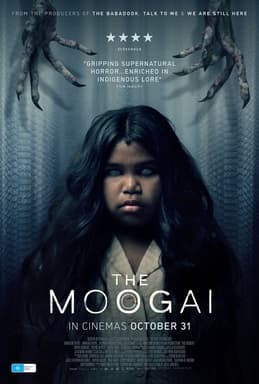
What The Moogai asks you to believe about a mother
Jon Bell's horror film splits its audience along a single question, and the split at Sundance and at Sydney tells you exactly what the film is doing.
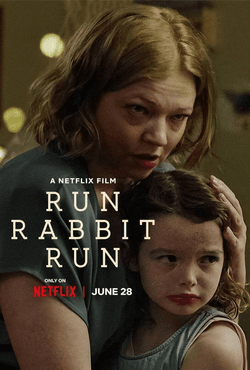
Run Rabbit Run gives Sarah Snook a haunted house and not enough script to fill it
Snook carries the film on performance alone, and the film knows this, which is both its strength and the reason it never finds a second gear.
Australian horror found an audience and now it has to decide what to do with it
Talk to Me proved Australian horror could sell globally, and the pipeline behind it is filling with directors who watched that and took notes.