Late Night with the Devil designed its horror in the hiss of a live broadcast
The sound design recreates 1977 television so precisely that the horror arrives in the frequencies you forgot existed.
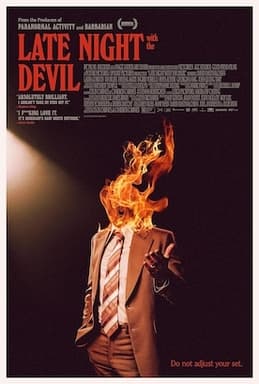
Before anything goes wrong on screen, the sound tells you. There is a hiss, the particular hiss of magnetic tape running through a broadcast chain, and it sits beneath the opening frames of Late Night with the Devil like a low fever. You know this sound. You have heard it in old recordings, in archival footage, in the gap between channels on a television set that no longer exists. The Cairnes brothers, Cameron and Colin, built their film on this frequency. They understood that 1977 does not live in the image alone. It lives in the air between the sounds.
The film presents itself as recovered footage of a live late-night talk show broadcast that collapsed into something supernatural. The host, Jack Delroy, played by David Dastmalchian, is a Carson-era entertainer whose ratings are slipping, and the episode in question features a parapsychologist, a sceptic, and a young girl who may be possessed. The premise is a found-footage conceit, and found footage lives or dies on the fidelity of its illusion. If the audience stops believing they are watching an artefact, the horror evaporates. The Cairnes brothers knew this, and they placed the burden of belief not on the image but on the sound.
The texture of broadcast
The sound design, supervised by Emma Bortignon, recreates the acoustic signature of late 1970s American network television with a specificity that borders on obsessive. The studio audience is not a generic crowd ambience. It is a room of roughly two hundred people seated in tiered rows, and you can hear the architecture in the reflections, the slight slap of sound off hard surfaces, the way laughter arrives in waves rather than as a single mass. The applause has a quality that digital recordings do not capture and modern ADR cannot replicate: the particular looseness of hands clapping without self-consciousness, without the performative enthusiasm of a contemporary studio audience coached by a warm-up act.
The studio monitors click when feeds switch. This is a detail that almost nobody in the audience will consciously register, but its absence would be felt. In a 1970s live broadcast, the transition between camera feeds was accompanied by a faint electrical artefact, a click or a soft thud in the audio chain, caused by the physical switching of video signals. Bortignon and her team reproduced this click, and it appears throughout the first act of the film, regularising the rhythm of the broadcast, establishing a mechanical heartbeat that the audience absorbs without identifying.
From broadcast-normal to broadcast-wrong
The horror of Late Night with the Devil is constructed as a deviation from this established normal. The first act is played almost entirely straight. The talk show operates as a talk show. The audience laughs. The host banters. The band plays stings. The sound design is so committed to the period recreation that you forget you are watching a horror film, which is the entire strategy. The Cairnes brothers are spending screen time to earn the moment when the normal breaks.
When it breaks, it breaks in the sound first. The tape hiss, which has been a constant presence, thickens. The studio ambience develops a low-frequency component that was not there before, a subsonic pressure that the audience feels in the chest rather than hears in the ear. The click of the monitor switches becomes irregular. The audience murmur, which has been a warm, patterned presence, begins to thin, to develop silences in places where silences should not be. The film is teaching your ear that something is wrong before it shows you anything wrong, and the gap between the sonic warning and the visual confirmation is where the dread lives.
What VFX cannot do
There has been discussion, some of it contentious, about the film’s use of AI-generated imagery in certain interstitial sequences. Whatever the merits of that debate, it obscures a more important formal point: the horror in Late Night with the Devil is not visual. The supernatural sequences, the possession, the manifestations, are effective not because of what they show but because of what they sound like. The moment when the young girl’s voice drops into a register that a child’s vocal cords cannot produce is built on vocal processing that layers multiple recordings at fractionally different pitches, creating a sound that is recognisably human and recognisably impossible at the same time.
This is the territory where sound design does work that visual effects cannot. A demon rendered in pixels can be impressive or unconvincing, and the audience evaluates it against decades of visual reference points. A sound that should not exist in a human throat has no such reference. It bypasses the critical apparatus and goes directly to the nervous system, and the fact that it arrives through the same speakers that have been delivering ordinary talk-show audio for the previous forty minutes makes it worse, because the context has primed the ear for normalcy.
The final broadcast
The film’s climax unfolds in a sound environment that has become completely unmoored from the broadcast reality of the first act. The tape hiss is no longer hiss but a roar. The audience is silent in a way that silence is not normally silent, an active absence of sound rather than a passive one. The studio acoustics, which were warm and contained, have opened into something cavernous, as though the room has expanded beyond its physical dimensions. None of this is explained. None of it needs to be. The sound design has done the work of world-building that exposition would only diminish.
Cameron and Colin Cairnes made a horror film in Melbourne, set it in a 1977 American television studio, and built the entire architecture of its fear on sound frequencies. The tape keeps hissing. The monitors keep clicking. And somewhere beneath both, in the frequencies you forgot existed, something is listening back.
Kieran writes about what films sound like. Played in a band that nearly got signed in 2012 and has been thinking about attack and decay ever since. Devoted to Warren Ellis, Amanda Brown, and the quiet work of sound editors nobody interviews.
MORE BY KIERAN BOUSTANY →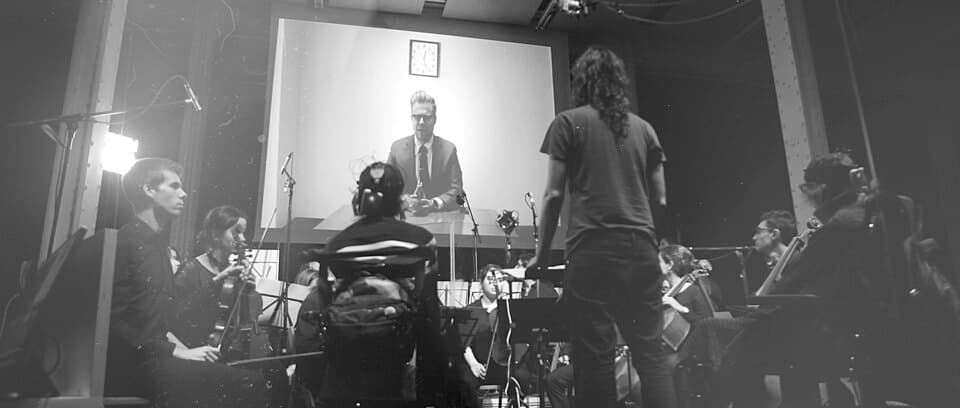
Every Australian film has a sound and most of them go unheard
This column has spent six years listening to what Australian cinema sounds like, and the answer keeps changing.
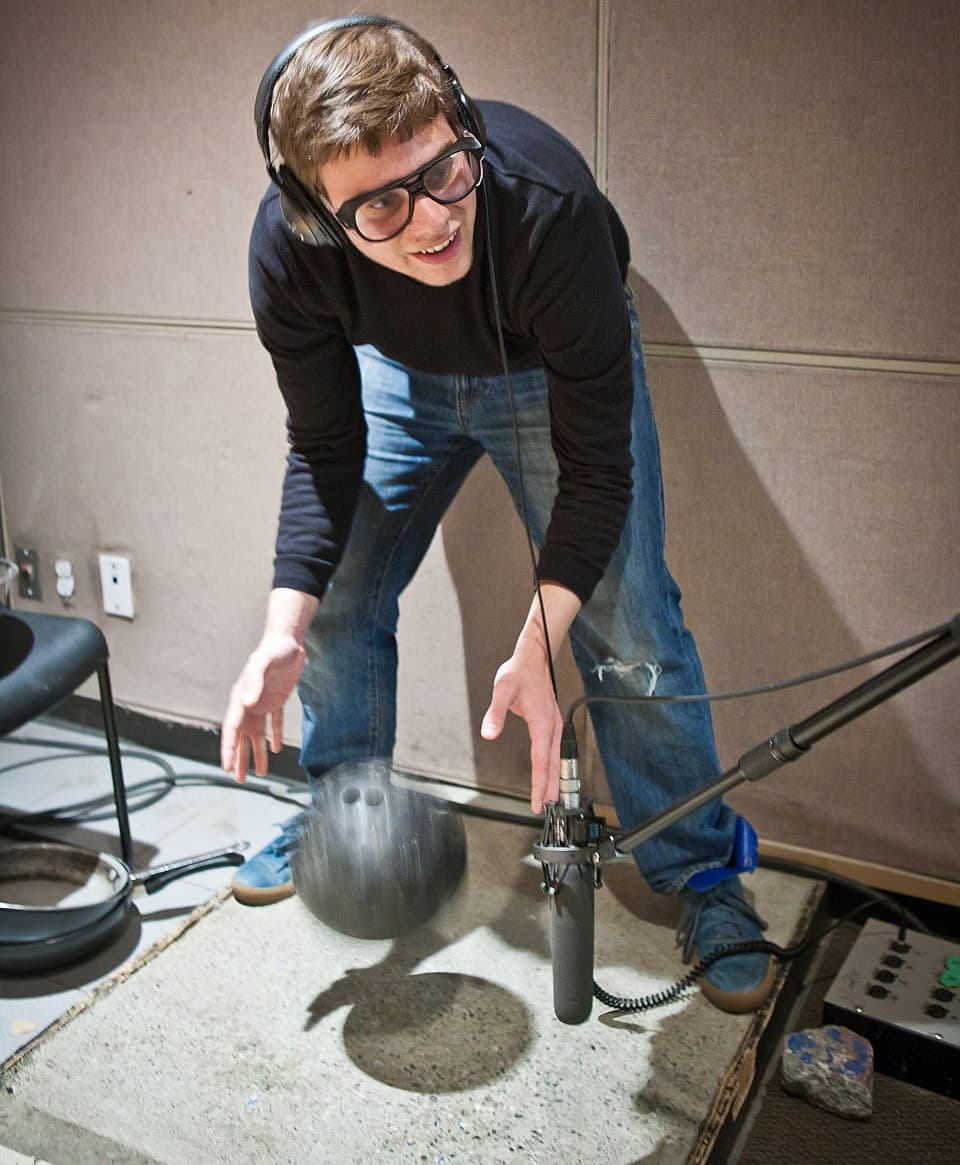
Australian sound designers do the work nobody hears and that is the whole point
The best sound work in Australian film is designed to be invisible, which makes it the hardest craft to praise and the easiest to overlook.
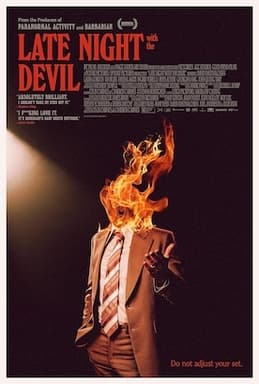
Late Night with the Devil put Australian horror on a talk-show set and the audience did not see it coming
The Cairnes brothers built a 1977 talk show, filled it with a demon, and proved that Australian horror works best when the set is cheap and the writing is not.