Streaming killed the film score budget and Australian composers adapted first
When the scoring budget dropped, Australian composers did what they have always done: made do, made less, and made it work.
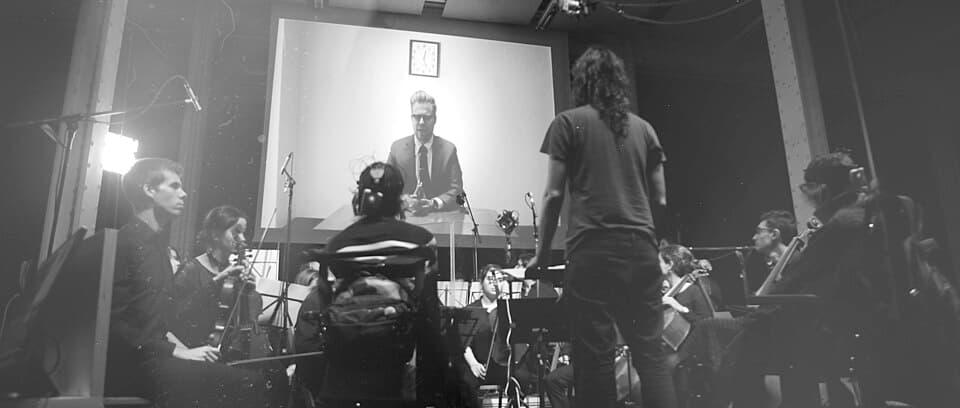
The orchestral film score is not dead, but it is on a payment plan. Streaming platforms commission more original content than the studio system ever did, and they pay for music the way they pay for everything else: in volume, at speed, for less per unit than the previous model allowed. The 60-piece orchestra recording over three weeks at Abbey Road is still available to franchise tentpoles and prestige awards contenders. For everything else, the budget has contracted, and the contraction has changed what film music sounds like, how it is made, and who makes it.
Australian composers have been working inside this contraction for decades. Not because they anticipated streaming, but because the Australian film industry has never had the money to score films the way Hollywood does. The average Australian feature operates on a fraction of an American independent budget, which is itself a fraction of a studio budget. Scoring has always been the line item that gets cut last and cut deepest, and Australian composers have responded by developing a set of practices that the rest of the industry is only now being forced to learn.
The one-person score
Ivan Sen writes, directs, shoots, edits, and scores his own films. Mystery Road (2013), Goldstone (2016), Limbo (2023): all of them carry scores composed by the director himself, working alone, using synthesisers and processed guitar and ambient textures that sit inside the landscape rather than on top of it. The economic logic is obvious. If you cannot afford a composer, become one. But the aesthetic result is something more interesting than mere economy. Sen’s scores are inseparable from his images because they come from the same sensibility. There is no translation layer between what the director sees and what the audience hears. The music is the direction.
Warwick Thornton does something similar, though his musical palette is different. Thornton, who shot and directed Samson and Delilah (2009) and Sweet Country (2017), approaches sound design and score as a single discipline rather than two separate departments. His films do not have clear borders between ambient sound, source music, and composed score. The wind, the radio playing in a distant room, the hum of an engine, the composed drone underneath: all of it blends into a continuous sonic field that serves the same function as a traditional orchestral score but costs a fraction of the price and, in many cases, achieves a greater intimacy.
Laptop orchestras and kitchen-table studios
The physical infrastructure of film scoring in Australia tells its own story. In Los Angeles, composers work in purpose-built studios with treated rooms and banks of outboard gear. In Sydney and Melbourne, they work in spare bedrooms, converted garages, and home studios assembled from secondhand equipment and software subscriptions. Jed Kurzel, who has scored films for his brother Justin (The Snowtown Murders, Macbeth, Nitram) as well as international productions (Assassin’s Creed, Alien: Covenant), has spoken about the difference between scoring at Abbey Road and scoring at home, and the difference is not primarily about quality. It is about speed, flexibility, and the willingness to use whatever is to hand.
This resourcefulness has produced a particular sonic character. Australian film scores tend toward the textural rather than the melodic, the ambient rather than the thematic, the found rather than the composed. Strings are sampled or played by a single performer rather than a section. Percussion is environmental: rocks, metal, field recordings processed beyond recognition. Electronics sit alongside acoustic instruments without hierarchy, because hierarchy requires a budget to establish and maintain. The result is a music that sounds intimate not as a stylistic choice but as a material condition, and the intimacy has become the style.
What the world is learning
The global shift toward smaller scoring budgets has created a market for exactly the skills Australian composers have been developing in isolation. Streaming platforms need scores that can be produced quickly, cheaply, and by small teams. They need composers who are comfortable working alone, who can deliver a finished score from a laptop, who do not require a scoring stage or a contractor or a 40-piece string section to produce work that sounds complete. Australian composers have been doing this for forty years. The model that necessity invented has become the model that commerce demands.
This is not entirely a positive development. What gets lost when the orchestra disappears is real, and pretending otherwise is dishonest. A sampled string section does not breathe the way a live one does. A synthesised brass line does not carry the harmonic complexity of sixteen horns playing in a treated room. The weight, the physical presence, the sense of air moving through a large space: these are qualities that no amount of processing can fully replicate, and they are qualities that cinema has relied on since the earliest sound films. When a score loses its orchestra, it loses a dimension, and the loss is audible even when the replacement is skilful.
What is gained
But something is gained, too, and the gain is worth naming. When a composer works alone, at small scale, with limited resources, the music becomes personal in a way that large-scale orchestral scoring rarely achieves. You can hear the hand in it. You can hear the choices being made in real time, the limitations being navigated, the moments where a conventional solution was unavailable and an unconventional one had to be invented on the spot. Sen’s scores sound like Sen because nobody else was in the room. Thornton’s sound design sounds like Thornton because the boundary between directing and composing dissolved under the pressure of budget and the result was something neither discipline would have produced alone.
The streaming era has not created this approach. It has validated it. Australian composers were already there, working in spare rooms, scoring features on laptops, treating limitation as a creative constraint rather than a professional embarrassment. The rest of the industry is catching up, and what it is catching up to is not a compromise. It is a tradition, built over decades of making do, and the music it produces has a grain and a warmth that no amount of money can buy, because the grain comes from the absence of money, and the warmth comes from the human hand that filled the gap.
Kieran writes about what films sound like. Played in a band that nearly got signed in 2012 and has been thinking about attack and decay ever since. Devoted to Warren Ellis, Amanda Brown, and the quiet work of sound editors nobody interviews.
MORE BY KIERAN BOUSTANY →
Nigel Westlake smuggled a cathedral into a film about a pig
The score for Babe borrows its grandeur from a French organ symphony, and the trick tells you everything about how Nigel Westlake hears the relationship between small subjects and large feelings.
Every Australian film has a sound and most of them go unheard
This column has spent six years listening to what Australian cinema sounds like, and the answer keeps changing.
The newest Australian score worth hearing is the one nobody is talking about
The film opened in twelve cinemas, the score opened in none of the conversations about it, and both deserve better.