Baz Luhrmann re-scored Australia and called it Faraway Downs
Luhrmann re-edited his most contested film into a six-part series, swapped half the score, and the musical logic changed everything.

The simplest way to describe what Baz Luhrmann did with Faraway Downs is this: he took a film that moved like a river and broke it into tides. Australia (2008) was a single, continuous, two-hour-forty-minute flood of orchestral score, needle drops, cattle drives and wartime spectacle. It poured forward without pause, and if the current carried you, you went; if it did not, you drowned in it. Fifteen years later, Luhrmann returned to the material, re-edited it into six episodes for Hulu, swapped or replaced roughly half the musical cues, added new footage, changed the ending, and released it under a new name. The result is not a director’s cut. It is a rescore disguised as a re-edit, and the distinction matters, because what changed most profoundly between the two versions is not the story but its musical metabolism.
The breathing room
A feature film’s score operates under continuous pressure. Every cue must justify its presence against what came before and what follows; the composer builds tension across a single arc, and if the energy drops in the wrong place, the whole structure sags. A series score breathes differently. Each episode has its own shape, its own climax, its own silence at the boundaries. The end credits provide a reset. The viewer returns to the next episode with their emotional clock wound back to something close to neutral, and the score can begin again.
Felix Meagher, who contributed additional orchestral cues for the series version, understood this distinction. His new material is airier than David Hirschfelder’s original score, less saturated, more willing to leave space around a melody before developing it. Where the 2008 film’s orchestral passages tended to swell toward fullness, pushing the strings and brass to the top of their dynamic range, the series cues hold back, allowing individual instruments to emerge and recede. A solo oboe over sustained strings. A piano figure repeated three times and then abandoned. The effect is not subtlety for its own sake; it is a recalibration of scale, fitting the score to a form that asks for arrival rather than momentum.
Needle drops as structural joints
The most conspicuous change between the two versions is the introduction of Elton John recordings, principally “Sorry Seems to Be the Hardest Word” and “Your Song,” which appear at episode transitions and key dramatic turns. Luhrmann has always been an aggressive user of needle drops, and his logic is consistent: a pre-existing recording carries its own emotional history into the scene. You do not hear “Your Song” fresh. You hear it with the accumulated weight of every context in which you have previously encountered it, every car ride, every wedding, every memory the melody has been pressed into. Luhrmann exploits this residue deliberately, using the song’s familiarity as a shortcut to emotional depth that an original cue would need minutes to build.
In the series format, this technique gains a structural function it did not have in the feature. The Elton John tracks land at the seams between episodes, marking transitions the way a recurring motif marks transitions in a symphony. They become architectural rather than decorative. “Sorry Seems to Be the Hardest Word” recurs at three points across the six episodes, and each recurrence shifts its meaning: first romantic, then elegiac, then something closer to resigned. The repetition is the point. Luhrmann is not scoring individual scenes; he is scoring the intervals between them, and the needle drops are the joints that hold the intervals together.
What the rescore reveals
Luhrmann has always treated music as a structural element rather than an atmospheric one, and the Faraway Downs rescore makes this habit visible in a way that the original film obscured. In Australia, the score was so continuous, so relentless in its emotional instruction, that it was difficult to hear the individual choices. One cue bled into the next. The orchestration was thick. The dynamic range was narrow, everything loud, everything full, everything urgent. The series version, by introducing silence at the episode boundaries and replacing several continuous orchestral passages with discrete needle drops, exposes the architecture underneath. You can hear the decisions. You can hear where Luhrmann wanted a scene to breathe and where he wanted it to push. The rescore is, in this sense, an act of annotation: Luhrmann marking up his own work, showing you where the load-bearing walls are.
The question it does not answer
Whether Faraway Downs is better than Australia is a question the rescore cannot settle, because the two versions are operating in different temporal registers. A film asks you to hold your breath for nearly three hours. A series asks you to take six smaller breaths across six sittings. The story is the same. The performances are the same. The cattle still cross the horizon in golden light, and Nicole Kidman still stands on a ridge with her jaw set against the landscape, and Hugh Jackman still exists in the specific way that Hugh Jackman exists in period costume. What changes is the score’s relationship to time, and time is the one variable that music controls more directly than any other element of cinema.
Luhrmann, by breaking his film into episodes and rescoring the joints, has made explicit something that was always implicit in his method: the music is not serving the narrative. The narrative is serving the music. The story of Lady Sarah Ashley and the Drover and the boy called Nullah is a vehicle for a particular sequence of sonic events, and the sequence can be rearranged, re-weighted, re-timed without altering the story’s substance, because the story’s substance was always musical. The cattle drive is a crescendo. The bombing of Darwin is a sforzando. The quiet scenes in between are rests, and rests in music are not silence. They are silence with a pulse, silence that knows what came before and what is coming, and the pulse is the score, ticking underneath, waiting to begin again.
Kieran writes about what films sound like. Played in a band that nearly got signed in 2012 and has been thinking about attack and decay ever since. Devoted to Warren Ellis, Amanda Brown, and the quiet work of sound editors nobody interviews.
MORE BY KIERAN BOUSTANY →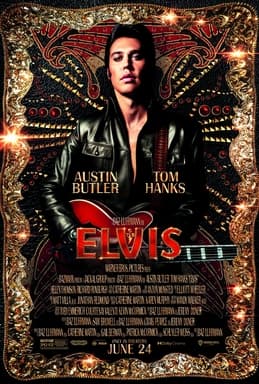
Baz Luhrmann uses music the way other directors use architecture
The soundtrack is not accompaniment; it is the load-bearing wall of every scene Luhrmann builds.
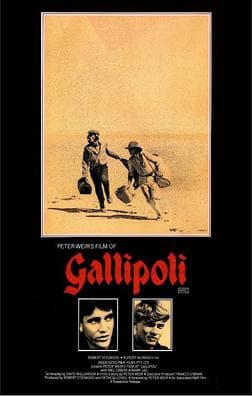
Gallipoli and the two pieces of music that are not Australian
Peter Weir's 1981 war film has no composed score to speak of. It has a French synthesiser record and a baroque lament, and between them they say everything the picture needs.
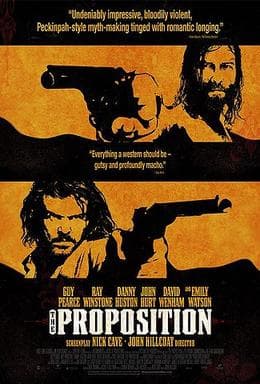
The Proposition was scored from motifs, and that is why it sounds like heat
Nick Cave and Warren Ellis wrote the music for John Hillcoat's western from motifs, not from frames, and the film's strange, hymn-like heat is the result.