Baz Luhrmann uses music the way other directors use architecture
The soundtrack is not accompaniment; it is the load-bearing wall of every scene Luhrmann builds.
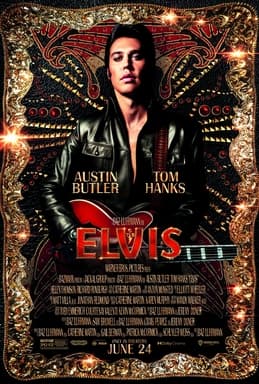
Watch any Baz Luhrmann film with the sound off and something structural collapses. Not the plot, not the performances, but the architecture. Scenes that felt propulsive become inert. Transitions that seemed inevitable become arbitrary. The emotional logic, which in the theatre felt irresistible and almost physical, disappears entirely, because it was never in the image. It was in the music. Luhrmann does not use soundtracks the way most directors do, as atmosphere or emotional underlining or period flavour. He uses them the way a builder uses load-bearing walls. Remove them and the building falls down.
Elvis (2022) is the fullest expression of this method, a film in which the soundtrack does not accompany the narrative but constitutes it. The story of Elvis Presley’s rise, captivity under Colonel Tom Parker, and slow destruction is told almost entirely through musical set pieces. Dialogue scenes exist, but they function as connective tissue between performances; the performances are the spine. This is an inversion of the standard biopic structure, where musical numbers punctuate a dramatic arc. In Luhrmann’s Elvis, the dramatic arc is the musical numbers. Everything else is scaffolding.
The anachronism engine
Luhrmann has always been an anachronist. Romeo + Juliet dropped Shakespeare into a neon-soaked Verona Beach. Moulin Rouge! rebuilt fin-de-siecle Paris from Bowie, Elton John and Nirvana. The Great Gatsby gave 1920s Long Island a Jay-Z soundtrack. In each case, the anachronism served a specific purpose: it prevented the audience from retreating into period-piece distance, forcing them to experience the emotional content of the story in the present tense.
Elvis applies this method with new precision. When the young Elvis (Austin Butler) first hears blues music on Beale Street, Luhrmann does not recreate the historical sound of 1950s Memphis R&B. He layers it with contemporary production, thickening the bass, adding electronic textures, creating a sound that feels both period and present. The effect is not historical accuracy but emotional accuracy: we hear what Elvis heard, not as it sounded to the room but as it sounded to him, as revelation, as the thing that cracked his world open. Later, when Elvis performs “Trouble” on a television special and the audience erupts, Luhrmann cuts the performance with a ferocity borrowed from concert films and music videos, jump-cutting between angles, smashing continuity, letting the rhythm of the editing sync to the rhythm of the music rather than to any spatial logic. The camera does not observe the performance. It becomes the performance.
Butler’s voice as instrument
Austin Butler’s commitment to singing Elvis’s material (at least in the early sequences; later performances blend Butler’s voice with Presley’s recordings) raises a question that the film is smart enough not to answer directly: what does it mean to inhabit another person’s voice? Butler does not do an impression. His vocal tone is lighter than Presley’s, less resonant in the lower register, and he compensates by leaning into physicality, letting his body complete what his voice approximates. This is precisely right for Luhrmann’s purposes, because the film is not interested in reproduction. It is interested in the feeling of a voice entering a room and changing the temperature.
The vocal performance also serves a structural function. As Elvis ages and falls deeper under Parker’s control, Butler’s voice changes: it becomes more controlled, more polished, further from the raw energy of the early performances. Luhrmann tracks this decline through the soundtrack itself. The early cues are chaotic, layered, full of competing textures. The Vegas-era cues are cleaner, more produced, more contained. The music mirrors the cage, and Butler’s voice is the bird inside it.
Music as narrative grammar
What separates Luhrmann from other directors who use big soundtracks (Michael Bay, Zack Snyder, the later Fast and Furious entries) is that his musical choices are grammatical, not decorative. Each song or cue in Elvis occupies a syntactic position: it introduces, develops, complicates or resolves a narrative idea. The Doja Cat track “Vegas,” built around a sample of Big Mama Thornton’s “Hound Dog,” does not appear because it is a catchy single that will drive Spotify streams (though it is, and it did). It appears because it links Presley’s music to its Black origins in a way that dialogue could not achieve without becoming a lecture. The Eminem and CeeLo Green track “The King and I” plays over the end credits, and its placement transforms it from a promotional tie-in into a commentary on how popular culture metabolises its icons.
This is music doing narrative work. Other directors assign that work to dialogue, cinematography, production design. Luhrmann assigns it to the soundtrack, and the result is a film that feels less like a biography and more like an opera, or a concept album, or a cathedral built from sound. The comparison to architecture is not metaphorical. Luhrmann constructs his films the way a baroque architect constructs a church: the ornamentation is not applied to the structure, it is the structure. Remove the gilt and the columns and the painted ceiling and you do not have a simpler building. You have a ruin.
The risk of the method
The obvious critique of Luhrmann’s approach is that it substitutes sensation for substance, that the musical bombardment prevents the audience from thinking critically about what they are watching. This is a fair concern, and Elvis does not entirely escape it; Tom Hanks’s performance as Colonel Parker, buried under prosthetics and a cartoon accent, belongs to a broader, less rigorous film than the one Butler is giving. But the critique misidentifies the target. Luhrmann is not trying to prevent thought. He is trying to locate it in a different place, in the body rather than the mind, in rhythm rather than reason. The soundtrack asks you to feel the story before you analyse it, and if you resist that ask, the film will not work for you. That is the risk of building with music. The walls hold, or they do not. There is no halfway.

Kieran writes about what films sound like. Played in a band that nearly got signed in 2012 and has been thinking about attack and decay ever since. Devoted to Warren Ellis, Amanda Brown, and the quiet work of sound editors nobody interviews.
MORE BY KIERAN BOUSTANY →
Boy Swallows Universe soundtracks Brisbane in the 1980s with precision and one deliberate lie
The needle drops are forensically accurate to 1985 Brisbane except for the one song that is not, and that exception tells you everything about what the show thinks nostalgia is for.

The Deadloch soundtrack freezes the crime scene and then plays indie rock over it
The needle drops are cold, the score is colder, and the temperature is the joke.

Baz Luhrmann re-scored Australia and called it Faraway Downs
Luhrmann re-edited his most contested film into a six-part series, swapped half the score, and the musical logic changed everything.