The Deadloch soundtrack freezes the crime scene and then plays indie rock over it
The needle drops are cold, the score is colder, and the temperature is the joke.
Tasmania sounds like a place where the wind has opinions. Not gentle opinions. Blunt ones, delivered at volume, arriving sideways through gaps in weatherboard. Deadloch understands this. Kate McCartney and Kate McLennan’s eight-part comedy-noir, set in a fictional south Tasmanian town during its winter arts festival, uses its soundtrack the way the best crime shows use their weather: as an accomplice. The score is sparse, the needle drops are pointed, and the overall sonic texture is so cold you can almost see your breath condensing over the opening credits.
The show follows Detective Dulcie Collins (Kate Box), a local cop whose quiet competence gets steamrolled when homicide detective Eddie Redcliffe (Madeleine Sami) arrives from the mainland with a louder energy and a different set of assumptions. Bodies accumulate. Suspects proliferate. The comedy is bone-dry and the crime is real, and the distance between the two registers is where the show lives. The soundtrack has to serve both registers simultaneously, which is harder than it sounds and harder than the show makes it look.
Attack and decay
The original score operates in the low frequencies. Drones, sustained synthesiser pads, bass notes that arrive without clear origin and fade without resolution. The attack is almost absent. The decay is everything. A body is discovered on a beach and the music does not spike or swell; it simply lowers the temperature another degree, adding a layer of harmonic cold to the visual cold of grey sand and grey sky and a detective crouching in a parka.
This approach works because it mirrors the show’s comedic rhythm. McCartney and McLennan write jokes that arrive late and stay long. Their comedy depends on the pause after the line, the held shot of a face processing what has just been said, the silence where a laugh track would go if this were a different kind of show. The score fills those pauses with weather. Not music, exactly. Atmosphere. Sonic pressure. The feeling of being inside a building where the heating is not quite adequate and nobody wants to mention it.
The needle drops
Against this ambient bed, the show drops Australian indie rock with the precision of someone placing ice cubes into an already cold drink. The song selections lean toward a particular strain of local guitar music: angular, mid-tempo, slightly sardonic. Nothing anthemic. Nothing warm. The songs arrive in transitional moments, over establishing shots of the town or montages of police procedure, and they carry a tonal weight that is difficult to pin down. They are not ironic, exactly. They are not sincere, exactly. They occupy the same ambiguous register as the show itself, which treats murder as genuinely terrible and also as the occasion for some very specific small-town comedy about arts festivals and community politics.
The effect is cumulative. By the third or fourth episode, the soundtrack has established its own climate. You know what Deadloch sounds like: cold guitars, colder drones, wind in every exterior shot, and a persistent low hum that might be the score or might be the town’s inadequate electrical grid. The music does not distinguish between these possibilities, and neither does the show.
The Tasmanian sonic environment
Place matters here in a way that goes beyond setting. Tasmania has its own acoustic signature, distinct from the mainland, and Deadloch captures it with a specificity that feels earned rather than decorative. The wind is constant. The ocean is present in nearly every exterior scene, not as a visual feature but as a sound, a low roar that sits beneath dialogue and score alike. Pubs are small and echoey. Streets are empty enough that footsteps carry. The town itself is a resonant space, and the show’s sound design treats it as such, allowing the environment to participate in the mix rather than simply providing a backdrop.
This is where the comparison to Mystery Road becomes useful, though the two shows are doing different things with similar tools. Mystery Road uses landscape sound to build pressure: the outback as a vast, silent witness to human violence, the distance between towns functioning as a kind of acoustic isolation. Deadloch uses landscape sound for comedy. The wind is funny because it is relentless, because it treats the arts festival and the murder investigation with equal indifference, because it does not care about the detectives’ jurisdictional tensions or the town council’s reputation management. The wind is the show’s most consistent comic voice, and the score knows enough to get out of its way.
Temperature as tone
What Deadloch achieves with its soundtrack is something that looks simple and is not: it makes temperature audible. The cold of the town is not just visual. It is present in the timbre of the score, in the choice of needle drops, in the way the sound design foregrounds wind and ocean and the particular creak of buildings resisting weather. Every sonic element points in the same direction, and that direction is down, toward the ground, toward the body on the beach, toward the frozen earth that the town is built on and the cold ocean that surrounds it.
The joke, finally, is the temperature itself. Deadloch is a show about a town that is too cold for an arts festival and too cold for a murder investigation and too cold, really, for anyone to be doing anything at all, and the soundtrack embodies this with a commitment that is itself a kind of comedy. The music shivers. The songs shiver. The drones shiver. And somewhere underneath all of it, the wind keeps going, indifferent and horizontal, carrying the sound of Tasmania being exactly as cold as it has always been.
Kieran writes about what films sound like. Played in a band that nearly got signed in 2012 and has been thinking about attack and decay ever since. Devoted to Warren Ellis, Amanda Brown, and the quiet work of sound editors nobody interviews.
MORE BY KIERAN BOUSTANY →
Boy Swallows Universe soundtracks Brisbane in the 1980s with precision and one deliberate lie
The needle drops are forensically accurate to 1985 Brisbane except for the one song that is not, and that exception tells you everything about what the show thinks nostalgia is for.
Baz Luhrmann uses music the way other directors use architecture
The soundtrack is not accompaniment; it is the load-bearing wall of every scene Luhrmann builds.
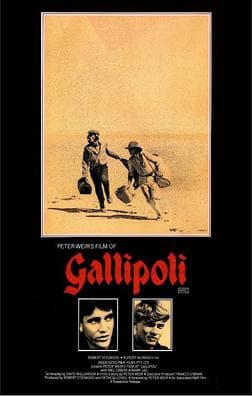
Gallipoli and the two pieces of music that are not Australian
Peter Weir's 1981 war film has no composed score to speak of. It has a French synthesiser record and a baroque lament, and between them they say everything the picture needs.