Bring Her Back builds its horror around what Piper cannot see
The Philippou brothers made a $15 million grief picture in the Adelaide suburbs and organised its entire visual scheme around a fourteen-year-old who can only see shapes.
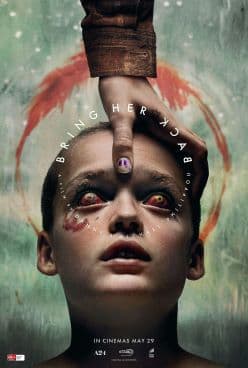
Danny and Michael Philippou made Talk to Me for a figure that has been variously reported and never confirmed above the low millions, and it took better than $90 million worldwide; the picture that follows a result like that is usually the one where a production company hands somebody a franchise and asks them to please not be strange again. Causeway Films did the opposite. They gave the brothers $15 million, kept the production in Adelaide and Lightsview, and let them make a film about a bereaved woman feeding a dead child’s ghost, which is a sentence no marketing department in the world wants to work with.
Bring Her Back opened here on 29 May 2025 and in the United States the following day, and it returned $39.1 million. The AACTAs in February gave it ten awards, including Best Film, Best Direction, and Best Lead Actress for Sally Hawkins. Fifteen months on it looks less like a horror film that happened to be good and more like the moment Australian genre production stopped needing to explain itself.
The camera adopts Piper’s limits
The formal decision that organises the picture is Piper. She is fourteen, she is vision-impaired, and she is played by Sora Wong, who had never acted professionally and who has limited vision herself; the production ran an open casting call specifically for a vision-impaired performer and Wong’s mother found it on Facebook. That casting is not a piece of production trivia. It determines the film’s entire optical scheme.
Aaron McLisky, who shot it and who took the AACTA for cinematography, photographs a great deal of Bring Her Back at a register that approximates partial sight without ever announcing itself as a point-of-view device. Shallow focus, but not the fashionable kind; focus that falls off at the wrong distance, so that a figure five feet from Piper is a mass rather than a face. Doorways full of unresolved shape. Light sources that bloom past their edges. The film does not cut to a blur filter to tell you she cannot see. It simply declines, repeatedly, to give the audience information that Piper does not have.
The consequence is that the horror is structural rather than staged. What is happening to Piper’s stepbrother Andy, played by Billy Barratt with a wariness that keeps curdling into panic, is largely happening at a distance she cannot resolve, and the audience is placed in the position of hearing something and not being permitted to look at it properly.
Hawkins against her own register
Sally Hawkins has spent twenty years being cast for warmth. That is the instrument every director since Happy-Go-Lucky has reached for, and the Philippous have hired it and then refused to let it curdle on schedule. Laura is warm for a very long time. She is warm past the point where the audience has understood what she is doing, and the discomfort of the middle hour comes from the gap between what we know and what her face is still offering.
It would have been easy to play the reveal as a change of key. Hawkins does not change key. She plays a woman who believes, entirely, that grief is a procedure with a correct outcome, and the performance never grants the audience the relief of watching a mask come off, because there is no mask. That is the harder choice and it is why the AACTA is not a sentimental award.
Jonah Wren Phillips has the role that will get talked about in the reviews and the least interesting one to write about, because Oliver’s function is physical. What holds him is Geoff Lamb’s cutting, which is patient in a way genre editing rarely is: Lamb lets shots run past the beat where the audience wants out, and the withholding of the cut does more work than any of the effects.
The Wilczek score and the Causeway lineage
Cornel Wilczek scored this, as he scored Talk to Me, and his cues here are drier and lower. There is very little melody. The dominant sound is a sustained low tone that thickens under scenes rather than rising through them, and it does the thing a good horror score does, which is to make you aware you have been holding a posture for two minutes.
Causeway’s lineage matters when you look at this picture in sequence. Kristina Ceyton and Samantha Jennings produced The Babadook, The Nightingale, and Talk to Me, and there is a through-line in that catalogue that is not really about horror at all. It is about grief conducted at close range in domestic Australian interiors, filmed with more craft than the budget implies. Bring Her Back belongs to that lineage precisely.
What it settled
The received wisdom about the Australian genre wave was that it was an export strategy: make horror because horror travels, recover a modest budget offshore, keep the industry ticking. That reading was always a little condescending and this picture retires it. $39.1 million on $15 million is a good result and not a spectacular one. What is spectacular is that a South Australian production with a first-time lead and no recognisable property took ten AACTAs, and that a jury looking at a year of Australian filmmaking concluded that the best-directed and best-photographed picture in the country was the one with the ghost in it.
The second look confirms the first. Bring Her Back is not a horror film that transcends its genre, a formulation that always insults both parties. It is a horror film that uses the apparatus correctly: the withheld image, the delayed cut, the sound that arrives before the shot. The Philippous understood that a film about a child who cannot see clearly is already a horror film, and then had the discipline to shoot it that way.
Bronte writes long-form criticism of Australian cinema and the international art films that feed into it. She was on the ground at Cannes in 2019 and has not entirely forgiven the festival for 2020. Patient with slow films; impatient with tidy ones.
MORE BY BRONTE HAUGHEY →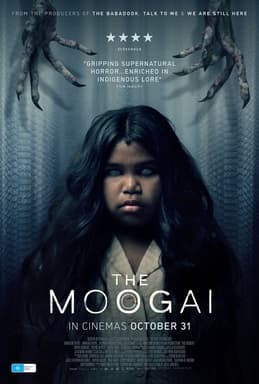
What The Moogai asks you to believe about a mother
Jon Bell's horror film splits its audience along a single question, and the split at Sundance and at Sydney tells you exactly what the film is doing.
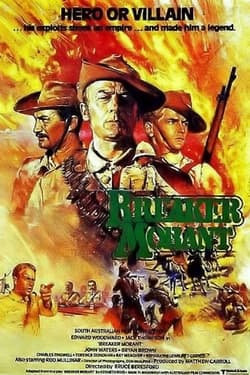
Breaker Morant and the country that adopted its scapegoat
Bruce Beresford's 1980 courtroom drama made an English-born soldier into an Australian martyr, and the picture's argument about empire has outlived its historical certainties.
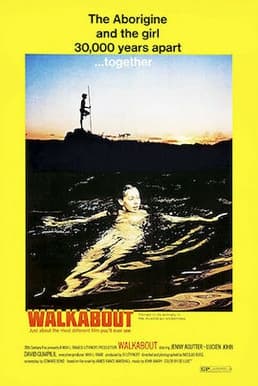
Walkabout is a British film about a country it never claims
Nicolas Roeg's 1971 picture is claimed as an Australian classic, though it was made by a Londoner, financed by two Americans and sold by 20th Century Fox. Its best argument is how little it pretends otherwise.