The score for Blaze chases the animation and catches it in a different key
When a film splits between live action and fantasy animation, the score has to bridge two visual languages without flattening either.
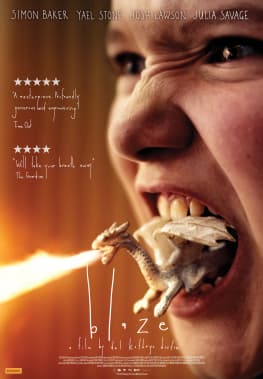
The problem is architectural. Blaze (Del Kathryn Barton, 2022) exists in two visual registers that share a story but not a physics. In the live-action sequences, a twelve-year-old girl named Blaze (Julia Savage) witnesses a violent assault in the Australian bush and retreats into a fantasy world to process what she has seen. In the animated sequences, that fantasy world materialises as a dense, hallucinatory wilderness of colour and creature, rendered in Barton’s signature style: organic forms, botanical precision, a palette that operates somewhere between Ernst Haeckel and a fever dream. The two registers alternate. They share characters, or versions of characters. They share emotional through-lines. They do not share a reality, and the score, by Caitlin Yeo, has to decide whether to unify them or to hold them apart.
Yeo’s answer is neither, exactly. She writes two distinct musical vocabularies and allows them to bleed into each other at the edges, so that the transition between live action and animation is bridged not by a single continuous score but by a gradual shift in texture, as though the instruments themselves are dissolving from one state into another.
Strings for the real, synthesis for the imagined
The live-action sequences are scored primarily with strings: cello, violin, the occasional low-register viola. The writing is spare, tonal, grounded in harmonic language that the ear recognises as conventional enough to feel stable. These are the scenes where Blaze is in the physical world, where gravity applies, where the consequences of what she witnessed are real and immediate. The strings hold the weight of that reality. They do not sentimentalise the violence, but they acknowledge its gravity through sustained notes and slow harmonic movement that sits beneath the drama like a held breath.
The animated sequences shift the palette to electronic and synthesised textures: granular synthesis, processed field recordings, tones that hover between pitched and unpitched, rhythmic patterns built from organic sounds (leaves, water, breath) run through digital processing until they become something between nature and machine. The effect is disorienting in a way that matches the animation. Barton’s visual style in these passages is overwhelming, every frame dense with detail, with eyes and tentacles and flowers and teeth, and Yeo’s score matches that density without competing with it. The electronic textures fill the sonic space the way the animation fills the visual space: completely, but with enough internal variation that the density does not collapse into noise.
The border zone
The most interesting moments in the score are the transitions. When Blaze moves from the real world into the animated fantasy, Yeo does not cut from one palette to the other. She layers them. The strings begin to acquire electronic processing: a reverb that extends beyond natural decay, a pitch drift that destabilises the tonal centre, a rhythmic stutter that breaks the legato line into fragments. Simultaneously, the electronic textures begin to acquire tonal content: a drone resolves into a recognisable interval, a granular cloud coalesces into something that might be a melody. The two vocabularies reach towards each other, and the transition happens in the space where they overlap.
This is a scoring strategy that takes the film’s central metaphor seriously. Blaze is about a child whose inner life erupts into her outer experience, whose trauma generates a fantasy world that is not an escape from reality but an intensification of it. The score mirrors this by refusing to treat the two registers as separate. The strings are always slightly unstable, as though the electronic world is pressing against them from below. The electronic textures are always slightly melodic, as though the tonal world is trying to assert itself from within.
What the animation demands
Scoring animation is a specific discipline. Animated images, because they are entirely constructed, carry no ambient sound of their own. A live-action scene in a forest gives you wind, birds, the crunch of leaves underfoot, and the score can work with or against this ambient bed. An animated scene in a forest gives you silence until someone fills it. Every sound is a choice. Every silence is a choice. The score bears more structural weight in animation than in live action because it is, in many cases, the only sonic presence in the frame.
Yeo handles this by making the score for the animated sequences more rhythmically active, more texturally varied, and more spatially dynamic than the live-action scoring. The sounds move through the stereo field. They emerge from specific positions and travel. This spatial movement compensates for the absence of ambient sound by giving the animated world an acoustic architecture that the images alone cannot provide. The fantasy forest has depth and distance and weather because the score provides them.
The question of unity
Does the score unify the film? Not entirely, and I think this is the right decision. Blaze is a film that resists unity. Its two visual languages exist in productive tension, and a score that smoothed the difference between them would diminish both. What Yeo provides is not unity but correspondence: two musical languages that recognise each other, that share certain materials (a rhythmic cell, a harmonic interval, the sound of breath), and that allow the listener to feel the connection between the real and the imagined without resolving the tension between them.
The film itself is imperfect. Barton’s debut as a feature director is ambitious beyond its structural means, and the live-action sequences sometimes lack the visual authority of the animated passages. But the score holds the two halves in productive relation, and its refusal to choose between them is, I think, the most sophisticated thing about it. Yeo understood that a film split between two worlds needs a score that lives in the border between them, that belongs fully to neither, and that makes the crossing back and forth feel like what it is: not a rupture but a modulation, a change of key that preserves the underlying harmonic logic while transforming everything about how it sounds.
Kieran writes about what films sound like. Played in a band that nearly got signed in 2012 and has been thinking about attack and decay ever since. Devoted to Warren Ellis, Amanda Brown, and the quiet work of sound editors nobody interviews.
MORE BY KIERAN BOUSTANY →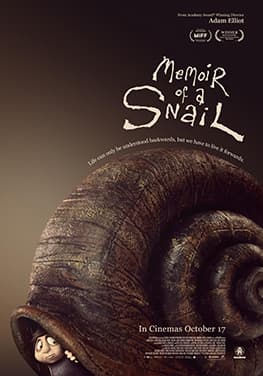
The score for Memoir of a Snail moves at the speed of grief
Elena Kats-Chernin's score for Adam Elliot's claymation opus is patient, fragile, and refuses to tell the audience when to cry.
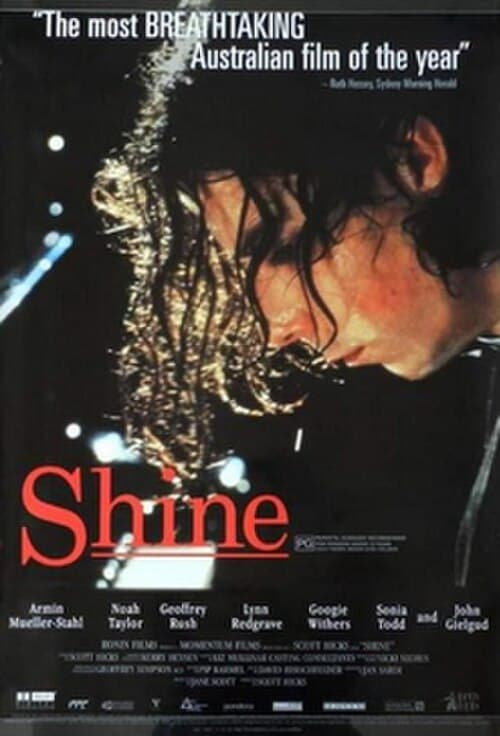
Shine and the score hiding under the Rachmaninoff
David Hirschfelder had to write original music that lives under the loudest warhorse in the piano repertoire, and the quiet writing is what carries the film.
Nigel Westlake smuggled a cathedral into a film about a pig
The score for Babe borrows its grandeur from a French organ symphony, and the trick tells you everything about how Nigel Westlake hears the relationship between small subjects and large feelings.