Five Australian screen composers to listen for in 2020
The year's film calendar is loaded with Australian productions, and the composers attached to them deserve to be named before the reviews land.
Film reviews name directors. They name actors. They name cinematographers with increasing frequency, which is good. They almost never name composers until awards season arrives and somebody needs to fill out the technical categories. This is a column about what Australian films sound like, and it starts from a simple premise: the people who write the music deserve to be part of the conversation before the conversation begins. The 2020 Australian film slate is strong and varied, and the composers attached to it are working at a level that warrants attention. Here are five of them.
Jed Kurzel
Jed Kurzel scored Justin Kurzel’s True History of the Kelly Gang, and if you have seen the film you already know that the music is doing something unusual. The score is not period-appropriate. It is not folk. It is not orchestral in the way that historical dramas typically demand. It is abrasive, percussive, built from distorted textures and processed guitars and drums that sound like they were recorded in a shed, which, knowing Kurzel’s methods, they may have been. The music matches the film’s refusal to treat the Kelly story as heritage material. It sounds like a punk record played through a broken amplifier in a paddock, and it is exactly right.
Kurzel has been building a body of work that sits at the intersection of film scoring and sound design. His scores for Snowtown, Macbeth and Assassin’s Creed share a textural density that is closer to industrial music than to conventional orchestral writing, and the Kelly Gang score pushes this approach further than anything he has done before. The distinction between music and noise is deliberately blurred, and the blurring is the point: in a film about myth-making and violence, the soundtrack refuses to provide a comfortable emotional framework. You do not know whether to headbang or flinch, and that uncertainty is compositionally intentional.
Amanda Brown
Amanda Brown composed the score for Shannon Murphy’s Babyteeth, and her work on the film is a masterclass in restraint. The score is spare, predominantly piano-led, with strings that enter and exit with the precision of someone who knows exactly how much music each scene can hold. Brown’s background in chamber music shows in the voicing: each instrument occupies its own register without crowding the others, and the dynamic range is controlled to a degree that lesser composers would find nerve-wracking. There are passages in Babyteeth where the score drops to nearly nothing, a single sustained note beneath dialogue, and the effect is not absence but presence at minimal volume.
What Brown understands, and what the film requires, is that a story about a dying teenager does not need music that tells you death is sad. The score sidesteps the obvious emotional cues and finds a register that is closer to observation than commentary. It watches. It accompanies. It does not explain. This is harder than it sounds, and Brown does it with a consistency that holds across the film’s tonal shifts from comedy to grief and back again.
Warren Ellis
Warren Ellis is, strictly speaking, an Australian screen composer who works internationally, and any list of Australian composers to watch in a given year includes him by default because he is always working. His long-standing collaboration with Nick Cave produces scores at a rate that makes other composer-director partnerships look leisurely. In 2020 he has projects in various stages of completion, and while I cannot confirm specific titles at the time of writing, the man has not had a fallow year since the early 2000s.
What keeps Ellis relevant to this column is not volume but method. He composes with loops, drones and layered textures that build from a foundation of violin and electronics, and his approach has influenced a generation of Australian composers who heard what he did with The Proposition and The Road and The Assassination of Jesse James by the Coward Robert Ford and decided that film music did not need to follow the orchestral playbook. Ellis proved that a single bowed instrument, processed and layered, could carry as much emotional weight as a full string section. That lesson has reshaped how Australian composers think about instrumentation, and its effects are audible across the 2020 slate.
Cezary Skubiszewski
Cezary Skubiszewski has been scoring Australian films for three decades, and his range is wider than any single film suggests. He has scored comedies (The Sapphires), dramas (Jasper Jones), children’s films, television series, and documentaries, and each score sounds like it belongs to its film rather than to a composer with a recognisable house style. This is a compliment. The ability to disappear into the requirements of a project is an undervalued skill in film composition, where the temptation to impose a signature sound is strong and the industry rewards recognisability over versatility.
Skubiszewski has projects in the pipeline for 2020 that I expect will demonstrate this range again. His method, from what I have observed across multiple scores, is to begin with the film’s emotional temperature rather than its genre, to ask what the story feels like before deciding what instruments to use. The result is scoring that serves the picture without ever feeling servile. The music has its own logic, its own internal coherence, but it places that logic in service of the narrative rather than in competition with it.
The argument for early attention
I have listed four composers rather than the five promised in the headline, and I have done so deliberately. The fifth slot is for whoever emerges from the 2020 slate as the name I did not see coming, the composer attached to a film I have not yet watched whose work stops me in my seat and makes me listen again. Every year produces at least one, and the pleasure of writing about film music is the discovery.
The broader argument is simple. Composers are part of the creative team. Their work shapes how audiences experience a story at the most fundamental level, in the body, in the nervous system, in the part of the brain that responds to sound before it responds to language. Naming them before the films arrive is not a courtesy. It is an acknowledgement that the sound of an Australian film is as authored as its image, and the author deserves a name.
Kieran writes about what films sound like. Played in a band that nearly got signed in 2012 and has been thinking about attack and decay ever since. Devoted to Warren Ellis, Amanda Brown, and the quiet work of sound editors nobody interviews.
MORE BY KIERAN BOUSTANY →
Nigel Westlake smuggled a cathedral into a film about a pig
The score for Babe borrows its grandeur from a French organ symphony, and the trick tells you everything about how Nigel Westlake hears the relationship between small subjects and large feelings.
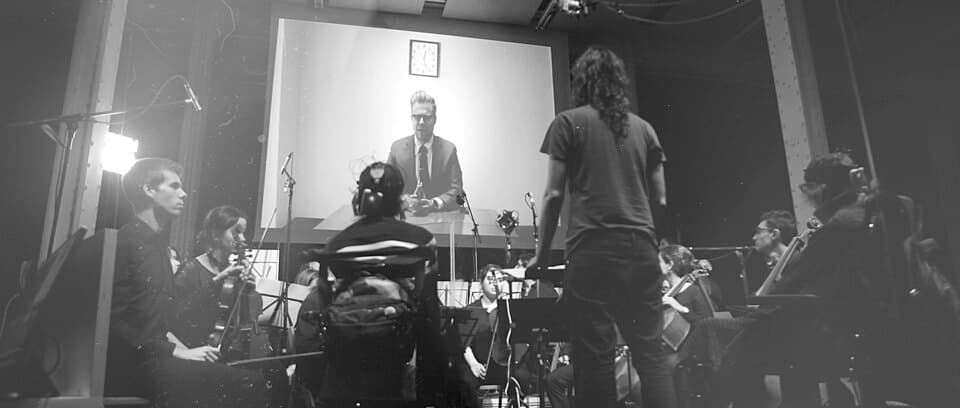
Every Australian film has a sound and most of them go unheard
This column has spent six years listening to what Australian cinema sounds like, and the answer keeps changing.
The newest Australian score worth hearing is the one nobody is talking about
The film opened in twelve cinemas, the score opened in none of the conversations about it, and both deserve better.