The Sapphires proved that feel-good Australian cinema can be political without announcing it
Wayne Blair made a crowd-pleaser about four Aboriginal women singing soul music in Vietnam, and the politics are in every frame without ever being in the dialogue.
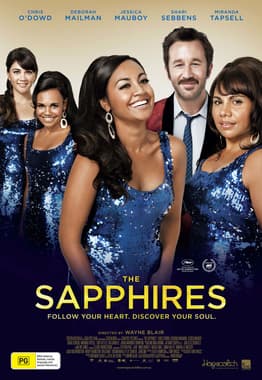
There is a particular kind of Australian film that gets made and gets praised and gets seen by about four thousand people. It is serious. It is about something that matters. It screens at festivals where the audience sits in respectful silence and claps at the end and then goes home and tells their friends about it, and their friends nod and say they will get around to it and never do. I have reviewed several of these films. I admire them. I do not think they change very much.
The Sapphires is not one of those films. Wayne Blair’s 2012 feature made fourteen million dollars at the Australian box office, which is more than almost any other Australian film that year, which is more than most Australian films make in a lifetime. It played in multiplexes. It played in regional cinemas. People brought their mothers. People brought their kids. People laughed and clapped and walked out humming the songs and told their friends about it, and their friends actually went.
I want to think about what that means, because the usual critical response to a crowd-pleaser is either to celebrate it uncritically or to treat its popularity as evidence of compromise. Neither response is adequate for what The Sapphires does. The film is a crowd-pleaser, yes. It is also, in ways that do not announce themselves, one of the most politically loaded Australian films of its decade.
What the film is about and what the film is about
On the surface, the story is a musical comedy. Four Aboriginal women from a small town in Victoria form a singing group, get discovered by a talent scout played by Chris O’Dowd, travel to Vietnam to entertain troops during the war, and become stars. There are setbacks and arguments and a romance and a final triumphant performance. The beats are familiar because they are the beats of every underdog-makes-good musical since the genre was invented.
But underneath those beats, the film is about the Stolen Generations. It is about racism in rural Australia. It is about the precise and particular ways that Aboriginal women were excluded from public life, from stages, from recognition, from the basic dignity of being allowed to sing the music they loved in the places where that music was played. These subjects are not subtext. They are text. They are stated clearly and directly, in specific scenes, with specific dialogue. But they are woven into the fabric of a film that is also funny and warm and full of music, and so the audience absorbs them the way you absorb the flavour of something that has been cooked slowly. You do not taste the individual ingredients. You taste the whole dish.
The character of Kay, played by Shari Sebbens, is the structural key to this. Kay is a member of the Stolen Generations. She was taken from her family as a child, raised by a white family, and is lighter-skinned than her cousins. Her story is handled without melodrama. The film does not build to a big revelation scene. It lets the information arrive in fragments, in the way that Kay moves through the world, in the spaces between her and the others, in the things she does not say. Sebbens plays this with a restraint that makes the moments when Kay’s pain does surface feel earned rather than performed.
The performers and what they carry
Deborah Mailman plays Gail, the eldest sister, and Mailman is one of those actors who makes you forget you are watching a performance. Gail is bossy and protective and funny and terrified that something will go wrong, and Mailman plays all of these things at once without any of them cancelling the others out. There is a scene where Gail argues with Dave about the group’s song choices, and the argument is about music but it is also about who gets to decide what Aboriginal women sing and how they sing it, and Mailman plays both layers simultaneously without ever winking at the camera to let you know she is doing it.
Jessica Mauboy plays Julie, the youngest, whose voice is the group’s secret weapon. Mauboy is a singer first and an actor second, and the film is smart enough to know this and to build her performance around her singing. When Julie opens her mouth, the film stops being about plot and starts being about the sound of a human voice doing something extraordinary. This is not a criticism. It is a structural choice. The singing is the argument. The fact that this voice exists, that it comes from this woman, from this community, from this country that tried to silence it, is the most political thing in the film, and it is delivered as pure pleasure.
Miranda Tapsell plays Cynthia, the flirtatious one, the comic relief, and Tapsell is very good at being very funny. But there is a toughness underneath the comedy that the film lets you see in glimpses. Cynthia knows what the world thinks of her. She has decided to enjoy herself anyway. This is not naivety. It is strategy.
The crowd-pleaser question
I keep coming back to the question of whether a feel-good film can do serious political work, and I keep concluding that the question is badly framed. It assumes a hierarchy in which seriousness lives at the top and pleasure lives at the bottom, in which the film that makes you cry with guilt is doing more important work than the film that makes you cry with joy. I do not think this is true. I think it might be the opposite of true.
The prestige Stolen Generations film reaches the audience that already cares. It preaches, as the saying goes, to the converted. The people who need to hear the story, who need to understand what was done and what continues to be done, are not at the arthouse screening on a Tuesday night. They are at the multiplex on a Saturday. They are the people who bought tickets to The Sapphires because it looked like a fun night out and walked out knowing something they did not know before, feeling something they had not felt before, having spent two hours inside the lives of four Aboriginal women and having liked being there.
This is what a crowd-pleaser can do that a prestige film cannot. It can reach the unconverted. It can put serious content inside a pleasurable experience and let the audience metabolise it at their own pace. It does not demand that you feel bad. It lets you feel good, and then it lets you think about why you feel good, and the thinking is where the politics live.
The commercial success and what it signals
The Sapphires is one of the most commercially successful Australian films with a predominantly Indigenous cast and creative team. Wayne Blair is Nyoongah. Tony Briggs, who wrote the play the film is based on and co-wrote the screenplay, based the story on his own mother and aunts, who really did sing for troops in Vietnam. The film is not a white filmmaker’s interpretation of an Indigenous story. It is an Indigenous story told by Indigenous artists in a form that the widest possible audience could access.
The commercial success matters because money is infrastructure. A film that makes fourteen million dollars creates opportunities for the next film. It proves to financiers that Indigenous stories can be profitable, which should not need proving but does. It creates a precedent that the next Indigenous filmmaker can point to when someone in a funding meeting says, but will anyone watch it?
Whether this is enough is a different question. Whether commercial success within a system that was designed to exclude you constitutes genuine self-determination or simply a more comfortable form of assimilation is a question the film does not answer and probably cannot. But I would rather have the question exist inside a film that fourteen million dollars’ worth of Australians actually watched than inside a film that only critics and academics and people who already agree with you will ever see.
What stays
I saw The Sapphires when it came out, in a cinema in Sydney, on a weekend, with a full house. The audience was mixed in every way an audience can be mixed. When the group sang “I Heard It Through the Grapevine,” a woman a few rows ahead of me started singing along, quietly, and the woman next to her joined in, and by the end of the song half the cinema was humming. This does not happen in prestige cinema. This happens when a film has done something that the vocabulary of film criticism is not very good at describing. It has made people feel together. And feeling together is, I think, the first step towards thinking together, which is the first step towards doing something.
The Sapphires is a feel-good film. It is also a political film. It proved that these two things are not a contradiction. They are a strategy.

Mara writes essays. She came to film writing from a decade of literary criticism and still reaches, sometimes, for a novel before she reaches for a shot list. She lives in the inner north of Melbourne and does not explain which city that is.
MORE BY MARA DENG →
Leah Purcell rewrote the bush myth and then set fire to it
Purcell took a Henry Lawson story, stripped it to the frame, and rebuilt it as a story about the women Lawson's Australia was built to forget.
I watched Samson and Delilah for the first time at thirty-two and I am still not sure I was ready
Thornton made a film about two teenagers in love in Central Australia, and the tenderness is so specific it bypasses every defence you have.

Ivan Sen stripped Limbo of colour and found everything underneath
Sen shot in black and white because the outback already has too many colours to lie behind.