Relic lets the house do the talking
The house in Relic creaks, drips, and breathes on a frequency that sits just below the one you can name.
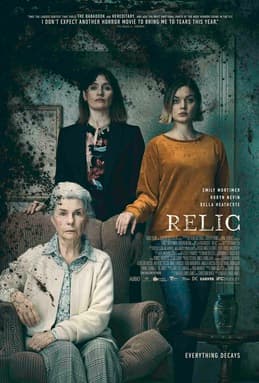
The house in Relic does not creak the way houses creak in horror films. It creaks the way houses creak when they are old, when the joists have shifted and the plaster has separated from the lath, when the weight of the structure has settled unevenly into soil that was never quite right. Natalie Erika James and her sound team, led by supervising sound editor Robert Mackenzie, recorded the house as an organism: respiratory, wet, failing. The first time you hear it, in the opening minutes of the film, the sound sits so low in the mix that you might register it as room tone, as the ambient hum of a building simply existing. It is not. It is the sound of decay made audible, and the film will spend the next eighty minutes teaching you to hear it.
Relic (2020) is a film about three generations of women: Edna (Robyn Nevin), who is disappearing into dementia; Kay (Emily Mortimer), her daughter, who has come to find her after she vanishes from the family home; and Sam (Bella Heathcote), Kay’s daughter, who still has the openness to love what is being lost. The house in rural Victoria is the fourth character, and the sound design is the instrument through which the house speaks. Not metaphorically. The film constructs the house as a sonic body, with its own respiration, its own pulse, its own slow, terminal decline.
The frequency beneath the floor
Brian Cachia’s score operates in a register that sits just below the threshold of identifiable music. The drones are long, shapeless, harmonically ambiguous. They do not resolve. They do not develop. They hold a single emotional position, a sustained unease that never tips into panic, and they do this by occupying the sub-bass frequencies where sound stops being something you hear and becomes something you feel. Below 80 Hz, the body responds before the ear does. The chest tightens. The stomach shifts. You know something is wrong before you can name what it is, and this is precisely the condition the film describes: the recognition of decline before the language for it arrives.
The sub-bass work in Relic is not unusual for horror. What distinguishes it is the specificity of its source. Cachia and Mackenzie built the low-frequency palette from recordings of the house itself: pipes contracting as they cooled, the groan of timber under load, the particular resonance of a wall cavity when air pressure changes. These sounds were pitched down, layered, processed into drones that retain the textural quality of their origin. The music does not sound like a synthesiser. It sounds like architecture under stress, and the effect is that every low-frequency cue reinforces the film’s central metaphor without ever making it explicit. The house is the grandmother. The grandmother is the house. The decay is the same decay.
Drips, clicks, and the sound of something wet
Above the sub-bass, the film’s sound design is built from small, specific, domestic sounds deployed at wrong intervals. A tap dripping. A light switch clicking. A door handle turning with a resistance that suggests the mechanism has seized. These are sounds you would expect to hear in an old house, and their familiarity is what makes them effective. James does not need to invent alien textures; she needs to take the sounds you already know and place them where they do not belong. A drip in the kitchen is normal. A drip inside a wall is not. A creak on the stairs is normal. A creak that comes from a part of the house where nobody is standing is not. The horror is in the displacement, the sound arriving from the wrong direction, at the wrong time, and the ear catching the wrongness before the conscious mind can process it.
The wet sounds deserve particular attention. As the film progresses and the house begins to change, to grow new corridors, to develop a geography that does not correspond to its exterior, the sound design shifts toward moisture. Surfaces that should be dry produce damp, adhesive sounds. Walls that should be solid sound hollow and soft. There is a sequence in the final act where Sam moves through the house’s impossible interior, and the dominant texture is organic: the sound of skin against something that gives, of surfaces that are closer to membrane than plaster. Mackenzie has spoken about layering recordings of wet cloth, animal tissue, and overripe fruit to build these textures, and the result is a sonic environment that is unmistakably bodily. The house is not rotting. It is decomposing, in the biological sense, and the sound tells you this before the image does.
The room the mic is in
Australian horror has a strong tradition of environmental sound design, and Relic sits within it while pushing the discipline in a new direction. In The Babadook (Jennifer Kent, 2014), the sound of the house, a creaking Adelaide terrace, was used to externalise the mother’s psychological state: the louder the house, the closer she was to breaking. In Snowtown (Justin Kurzel, 2011), the ambient sound of suburban Adelaide, dogs barking through thin walls, television sets playing to empty rooms, was used to establish a social ecology in which violence could grow unnoticed. Both films treated the house as an extension of the people inside it. Relic goes further. It treats the house as a body that is dying on its own schedule, independent of the characters’ emotional arcs, and the sound design tracks this independent decline with a precision that gives the house its own narrative.
What dementia sounds like
The film’s deepest accomplishment is the way it uses sound to describe dementia from the inside. There are sequences where the ambient texture shifts without any visual cue, where the room tone changes pitch or the reverb characteristics of a space alter mid-scene, as though the acoustic properties of the world are becoming unreliable. These shifts are subtle enough that you may not consciously notice them, but they produce a disorientation that is closer to the experience of cognitive decline than any visual effect could achieve. The world has not changed. Your perception of it has, and the gap between the two is where the terror lives.
Mackenzie’s approach here is the opposite of the jump scare. There is no sudden sting, no loud burst designed to trigger a startle reflex. The sound design moves slowly, incrementally, the way dementia moves. It takes things away. It replaces familiar sounds with versions of themselves that are slightly off, slightly wrong, and it does this so gradually that you cannot identify the moment the change began. The house was always making these sounds. You were always hearing them. You just did not know what they meant.
Relic is a small film with a precise understanding of what sound can do that images cannot. It can describe an interior state. It can make a building breathe. It can take the domestic sounds of a house you would recognise, a house your grandmother might have lived in, and bend them until they describe something that is falling apart from the inside, slowly, irreversibly, on a frequency you can feel but cannot name. The house does the talking. The film has the patience to listen.
Kieran writes about what films sound like. Played in a band that nearly got signed in 2012 and has been thinking about attack and decay ever since. Devoted to Warren Ellis, Amanda Brown, and the quiet work of sound editors nobody interviews.
MORE BY KIERAN BOUSTANY →
Every Australian film has a sound and most of them go unheard
This column has spent six years listening to what Australian cinema sounds like, and the answer keeps changing.
Australian sound designers do the work nobody hears and that is the whole point
The best sound work in Australian film is designed to be invisible, which makes it the hardest craft to praise and the easiest to overlook.
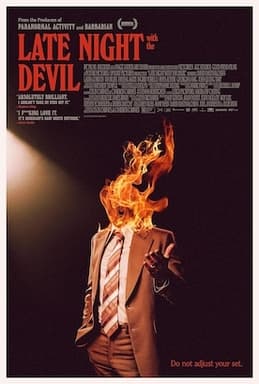
Late Night with the Devil designed its horror in the hiss of a live broadcast
The sound design recreates 1977 television so precisely that the horror arrives in the frequencies you forgot existed.