The score for Rams sounds like two men who share a fence line and nothing else
The score sits in the paddock between two brothers, and the distance is measured in sustained notes that never quite resolve.
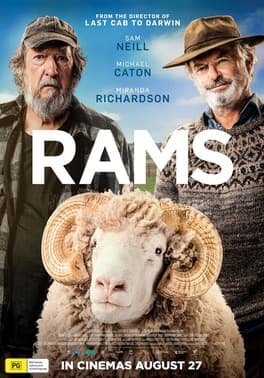
The first thing the score for Rams does is establish a key and then refuse to settle into it. A single acoustic guitar line opens the film over a wide shot of Western Australian farmland, and the melody moves toward resolution the way a person walks toward a gate they are not sure they want to open. It arrives at the tonic, holds it for a breath, and then drifts sideways into a suspension that hangs in the air for longer than it should. This is a small compositional choice that tells you everything you need to know about the film before a word of dialogue is spoken. These are people who live in a state of almost-resolution. The score knows this before the audience does.
Jeremy Sims’s 2020 film is a remake of the Icelandic original, relocated from the volcanic farmland of northern Iceland to the wheat-and-sheep country of the Western Australian wheatbelt. Sam Neill and Michael Caton play brothers who live on adjacent properties, share a boundary fence, and have not spoken to each other in years. The premise is a comedy-drama about estranged siblings forced to cooperate when their merino flocks are threatened by a disease outbreak. The execution is gentler and sadder than that description suggests, and the score is one of the reasons why.
Two lines that do not meet
The central compositional device is simple and effective. The score assigns each brother a melodic motif. The motifs are related, built from similar intervals, moving in similar rhythmic patterns. They are recognisably from the same musical family. But they never play simultaneously. When the score is in Colin’s territory (Neill’s character), the guitar line carries his theme. When it shifts to Les (Caton), a second melodic idea enters, slightly lower in register, slightly different in phrasing. The two themes coexist in the same tonal space the way the brothers coexist on the same road: adjacent, aware of each other, never overlapping.
This device could be schematic in lesser hands, a music-theory exercise rather than an emotional strategy. Here, it works because the composer resists the obvious payoff. In a conventional film about estranged family members, the score would bring the two themes together at the moment of reconciliation, layering them into a harmony that tells the audience the brothers have healed. Rams does not do this, or not cleanly. The themes edge closer in the film’s final act, sharing more harmonic ground, occasionally occupying the same bar. But the full convergence, the moment of unambiguous musical reunion, does not arrive. The score, like the brothers, gets close enough to suggest that closeness is possible without committing to the fiction that the distance has been fully closed.
The sound of the wheatbelt
The WA wheatbelt has a particular sonic character that the score incorporates without drawing attention to itself. The landscape is flat and open and the acoustic environment reflects this: sounds carry further, the silence between them is wider, and the ear has time to register overtones and sympathetic vibrations that a denser soundscape would mask. The score uses this openness. The arrangements are sparse. Guitar, strings in small configurations, occasional piano. The instrumentation breathes. Notes are given room to decay naturally, and the spaces between phrases are as considered as the phrases themselves.
This is the opposite of how most Australian pastoral scores operate. The tendency, particularly in films set in visually dramatic landscapes, is to match the scale of the image with the scale of the music: big country, big orchestration, big emotional cues that tell the audience how to feel about the horizon. Rams goes the other way. The country is big and the music is small, and the contrast creates an intimacy that anchors the film in the specific emotional lives of its two characters rather than in the grandeur of their setting.
Comedy, drama, and the score between them
Rams is a comedy-drama, and the tonal balance is delicate. The comedy is dry, observational, rooted in character rather than situation. The drama is genuine, involving real stakes for people whose livelihoods and identities are bound up with their animals. The score navigates this balance by staying in a middle register that could tip either way. The guitar lines are warm enough to support the film’s gentler moments and spare enough to carry the weight of its sadder ones. There is no separate comic palette. There is no shift to a minor key when the drama arrives. The score maintains a single emotional temperature and lets the performances and the editing determine whether a given moment lands as funny or painful.
This is harder than it looks. Film scores that try to serve both comedy and drama often end up serving neither, defaulting to a blandness that supports every scene equally and distinguishes none. The Rams score avoids this by committing to a specific sound, the acoustic guitar and restrained strings, and letting that sound carry whatever meaning the scene requires. When Colin discovers his brother has been secretly maintaining a small flock in defiance of the quarantine, the music does not shift. It holds its course, and the emotional charge of the scene comes from the collision between the score’s steadiness and the character’s distress.
Comparison with dry-country scoring
The obvious comparison point is the score for The Dry, which also uses restraint and acoustic instrumentation to evoke the Australian rural landscape. Both scores understand that less is more in open country. But where The Dry’s score operates in the register of suspense, holding tension through sustained low strings and delayed resolutions that mirror the film’s mystery structure, the Rams score operates in the register of melancholy. The sustained notes in The Dry ask: what happened? The sustained notes in Rams ask: what was lost?
The distinction matters because it tells you something about how Australian screen composers are thinking about rural space. The country is not a single thing. It is not a single mood. The wheatbelt is not the Wimmera and neither of them is the channel country, and a score that treats them as interchangeable is a score that has not listened. The Rams score has listened. It knows what this particular landscape sounds like, or rather, it knows what the silence between its sounds feels like, and it builds its music in that silence, note by careful note, never quite resolving, never quite letting go.

Kieran writes about what films sound like. Played in a band that nearly got signed in 2012 and has been thinking about attack and decay ever since. Devoted to Warren Ellis, Amanda Brown, and the quiet work of sound editors nobody interviews.
MORE BY KIERAN BOUSTANY →
Shine and the score hiding under the Rachmaninoff
David Hirschfelder had to write original music that lives under the loudest warhorse in the piano repertoire, and the quiet writing is what carries the film.
Nigel Westlake smuggled a cathedral into a film about a pig
The score for Babe borrows its grandeur from a French organ symphony, and the trick tells you everything about how Nigel Westlake hears the relationship between small subjects and large feelings.
Every Australian film has a sound and most of them go unheard
This column has spent six years listening to what Australian cinema sounds like, and the answer keeps changing.