Puberty Blues and the long wait on the sand
Bruce Beresford's 1981 picture watches two girls sit on a beach for most of its running time, and the sitting is the argument.
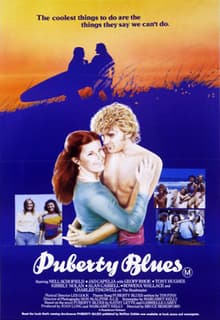
There is a rule in the surf culture of Puberty Blues that the film never states and never needs to: girls do not surf. They watch. They sit on the sand, or on the hood of a panel van, and they hold the cigarettes and the towels and the opinions of boys who are, for the most part, not worth holding anything for. The picture’s first achievement is to make this look exactly as boring and as consequential as it was.
Bruce Beresford’s film, released in 1981, adapts the 1979 novel by Gabrielle Carey and Kathy Lette, two young women writing about the Cronulla surf scene they had recently survived. Margaret Kelly wrote the screenplay. Joan Long produced, which matters: Long had written the screenplay for Caddie (1976) and produced it, and she belongs to a short, important lineage of women who got Australian films about women made in a decade when almost no one else was funding them. It is useful to see Puberty Blues as the second chapter of that story, not as a teen comedy that happened to be directed by the man who had just made Breaker Morant.
A picture of waiting
The film’s structure is waiting, and Beresford, who had already shown in Breaker Morant that he could build a case out of procedure, treats it as procedure. Debbie (Nell Schofield) and Sue (Jad Capelja) go through the rituals of acceptance in a gang of surfers: the right clothes, the right car, the right boyfriend, the right silence. The film observes each ritual at a flat distance, and its comedy comes from the gap between the seriousness of the participants and the plain absurdity of what they are doing.
Don McAlpine’s cinematography is crucial here. The beach is bright, white and indifferent, and McAlpine shoots it without much glamour, so that the sunlight is a kind of pressure rather than a pleasure. The surf, when it appears, is a world the girls are looking at from the outside. The camera is on the sand with them.
The humiliations are specific
Puberty Blues is known for its frankness about sex, drugs and the casual cruelty of teenage hierarchies, and the frankness is real. But it is the specificity that keeps the picture from becoming either a scandal or a nostalgia piece. The film remembers exactly how a boy talks to a girl he does not respect, and exactly how a girl learns to pretend she has not noticed. It remembers the vocabulary. It remembers who sits where, and who has to move.
What Beresford refuses to do is to hand the audience a comfortable distance. The film is not an exposé of the surf culture seen from above. It is a view from inside it, by people who are not yet sure they want to leave, and it is as interested in the pleasures of belonging as in the price. That ambiguity is what separates it from the many later films that turned the same material into a cautionary tale.
Nothing in the picture is dressed up for the audience’s comfort. The parents are present and not very present; the school is a place that happens to the characters; the older brothers and their friends are a weather system that arrives in vans. Beresford keeps the adult world mostly out of frame, and the omission is a point of view. It is the world as it looks from the age of fifteen, where nobody who could help is paying attention.
The turn toward the water
The film’s shape is a slow corrective. Debbie and Sue begin as spectators and end, in a final movement that the picture has quietly been preparing for all along, by taking the boards into the water themselves. The act is small and the film plays it as small, which is exactly right. The revolution is not a speech; it is a decision to paddle out.
It is a conclusion that the film earns because it has spent so long on the sand. We have watched every reason the girls had not to do it, and every pressure that kept them in their place, so that when they finally enter the surf the effect is of a person walking out of a room they have been told is the whole house.
A lineage that is still in use
The Network Ten television series of 2012 returned to the same material, and the existence of a series is a measure of how thoroughly the novel and the film got into the culture. But the series, for all its pleasures, had room to explain. The 1981 film does not. It trusts the audience to understand the cost of every small compromise, and it trusts the images to carry what the dialogue will not.
In a period that produced Gallipoli and Mad Max 2, it is easy to overlook a picture about two teenage girls on a beach as a minor work. It is not. It is one of the few Australian films of its period that treats the daily social life of young women as a subject worth a full-length film, and it does so with a clarity that has not dated. The picture is still, after four and a half decades, telling us something we have been slow to learn: that the boredom was never the point, and the rules were never the weather.

Bronte writes long-form criticism of Australian cinema and the international art films that feed into it. She was on the ground at Cannes in 2019 and has not entirely forgiven the festival for 2020. Patient with slow films; impatient with tidy ones.
MORE BY BRONTE HAUGHEY →
Breaker Morant and the country that adopted its scapegoat
Bruce Beresford's 1980 courtroom drama made an English-born soldier into an Australian martyr, and the picture's argument about empire has outlived its historical certainties.
Walkabout is a British film about a country it never claims
Nicolas Roeg's 1971 picture is claimed as an Australian classic, though it was made by a Londoner, financed by two Americans and sold by 20th Century Fox. Its best argument is how little it pretends otherwise.

The Devil's Playground split its prize between a boy and a Brother
Fred Schepisi's juniorate drama opened fifty years ago last month, and the most accurate verdict it ever received was an acting award shared between a thirteen-year-old and a Brother.