Priscilla and the question of who gets on the bus
The 1994 road comedy is remembered as the film that let Australia laugh at itself. Look at who it left off the bus, and the generosity gets more complicated.
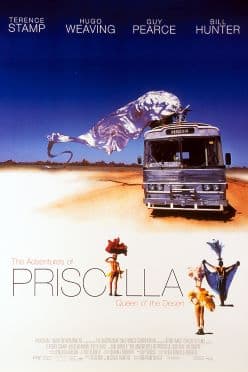
I want to say something nice about Priscilla, Queen of the Desert, and then I want to take most of it back.
The nice thing is easy. It is a very kind film. Three performers (Hugo Weaving’s Tick, Guy Pearce’s Adam, Terence Stamp’s Bernadette) set off across the Australian desert on a bus they christen Priscilla, towards a casino in Alice Springs, and the film’s whole project is to keep them together and keep them moving. People are cruel to them along the way. In Broken Hill they are abused and the bus is vandalised with graffiti, and the film is not naive about that. But it will not let cruelty be the last thing in the frame: Adam spends a whole day repainting Priscilla lavender. The answer to the slur is paint.
I grew up on films that treated Australia as something you survived. Priscilla treats it as something you can lip-sync across. That is a different kind of generosity, and it changed what the outback could be on screen. It is still a gift.
Now the part I take back.
The bus was not the first bus
The film was based on the lives of three real drag queens who performed as Cindy Pastel, Strykermeyer and Lady Bump. The original concept was that they would play themselves. That idea was dropped once the project attracted a large budget and it was decided that ‘bankable’ actors were needed, which in practice meant three straight men with no background in drag. As The Age later put it, the people on whose lives the hit was based were overlooked. They were profiled the following year in a documentary, Ladies Please. Another performer, Carlotta, has claimed to have inspired the film, in particular Bernadette, and recalled in her autobiography touring the outback in a bus with the Les Girls revue, ‘way before Priscilla was ever thought of as a movie’. The revue is named in the film several times.
I do not want to over-read this. Casting stars to secure money is how most films work, and the performances are good, sometimes better than good. Stamp’s Bernadette is the heart of the picture. But I think it is fair to notice something. A film about three people finding a place to stand began by deciding the real people could not stand where the cameras were.
The mountain they were not allowed to climb
There is a moment late in the film in which the three travellers fulfil Adam’s dream of climbing a great red outcrop in full drag regalia. The production’s original intention was to film it at Uluṟu. Permission was refused by the organisations responsible for the monument, including the Uluṟu Board of Management, because climbing the rock for a film would have violated Indigenous Australian religious beliefs. The scene was shot at Kings Canyon (Watarrka) instead, with the dialogue rewritten to suit.
I find that detail moving, and I find it clarifying. The refusal is a piece of real-world law: someone told the filmmakers there was a place they could not take their bus. They accepted it, adjusted, and made the scene somewhere else. It is a small instance of a country’s rules about who stands where being visible on set.
And inside the film, the same country appears more loosely. When their bus breaks down, a group of friendly Aboriginal Australians with whom they perform at a corroboree help them get Priscilla to a mechanic. The scene is warm. It is also, to my eye, brief and instrumental: the community is there to rescue the travellers and to be gracious, and then the bus moves on. I do not think the film means harm. I think it is the standard grammar of a road movie, in which the landscape and its people are a series of encounters for the protagonists to be changed by. But a road movie is a decision about whose story gets the engine.
Cynthia
Bob, the mechanic (Bill Hunter), joins the bus after his wife Cynthia, who is Filipina, leaves him. The depiction drew controversy at the time, and the film scholar Tom O’Regan noted that it left the film with ‘an ambiguous reputation’. I will not rehearse the whole argument. I will say that I was braced for her scenes on this viewing, and I was both relieved and not relieved. She is in the film. She is not at its centre. The bus has a seat for her only in the sense that it has to pass her on the way to somewhere else.
(What I mean is: the question of who gets on the bus is not a question about the three people in the front. It is about everyone standing on the road as it goes by.)
What I will keep
I am not here to demote the film. It cost 2.7 million Australian dollars, with the producers, Michael Hamlyn and Al Clark, and the director, Stephan Elliott, each taking $50,000, and a crew that agreed to share in profits. Because the Australian Film Finance Corporation was involved, only one non-Australian actor was allowed in the cast. It premiered in Un Certain Regard at Cannes in 1994, took about $18.5 million at the Australian box office (the fifth-highest-grossing Australian film of all time, at the point it was measured), and won the Academy Award for Best Costume Design. It introduced queer lives to a mainstream audience in a way few films had, and it did it with a lavender bus.
I will keep all of that. What I will not do is pretend the film solved the problem it dramatises. A generous film still has an edge, and the edge is the people standing outside the frame. It is what makes the thing worth watching again, now, with that in mind.
The right response to Priscilla is not to refuse the ride. It is to ask, kindly, the way the film itself would: who else was waiting at the stop?

Mara writes essays. She came to film writing from a decade of literary criticism and still reaches, sometimes, for a novel before she reaches for a shot list. She lives in the inner north of Melbourne and does not explain which city that is.
MORE BY MARA DENG →
Floating Life and the family that was never going to land
Clara Law's 1996 film about a Hong Kong family scattering across the world was Australia's Oscar submission and barely registered at the local box office. It remains the most honest film we have about arriving.

Anyone But You made $220 million and Australian cinema still does not know what to do with that
The most commercially successful film ever shot in this country is a romantic comedy that pretends to be American, and the success tells us something we do not want to hear.
Strictly Ballroom is a film about who is allowed to teach the steps
Baz Luhrmann's 1992 comedy is sold as a story about dance. It is also a story about an Australian champion who has to be taught his own steps by a Spanish-Australian family in their own house.