Muriel's Wedding and the song about losing
P.J. Hogan's 1994 comedy is built around ABBA records, and the songs it chose are almost all about defeat. Muriel hears them as promises.
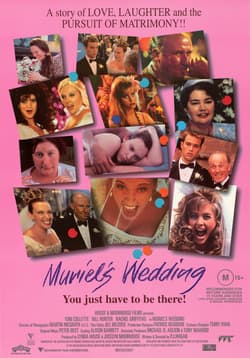
Muriel Heslop plays ABBA records the way other people say their prayers. She plays them in her bedroom in Porpoise Spit, with the door shut, and she does not listen to them as music. She listens to them as instructions. If the voice in the song says that a person can be happy, then a person can be happy, and the only thing left to figure out is the logistics.
P.J. Hogan’s Muriel’s Wedding came out in 1994 and was credited, along with The Adventures of Priscilla, Queen of the Desert the same year, with feeding a revival of interest in a group that had been written off as embarrassing. The songs are not decoration. They are the film’s emotional grammar. Hogan wrote the screenplay with the music in mind, and the picture is structured as a series of encounters between a woman’s longing and a set of pop songs that cannot quite deliver on it.
Waterloo is a song about surrender
Start with the choice of song. Waterloo won the Eurovision Song Contest in Brighton in April 1974, and it is written, in its lyric, as a love song in the vocabulary of military defeat: the singer has lost, she has been beaten, and she is, with a kind of delight, giving in. It is a pop song that treats being conquered as the best thing that could happen. Muriel, who wants more than anything to be taken by something larger than herself, takes it as a love song with no irony in it at all.
The film knows better, and it lets the audience hold both readings at once. When Muriel and her friend Rhonda (Rachel Griffiths) perform the song, the performance is a joyous act of defiance and a small public humiliation, and the film does not choose between them. The song lets it do both.
The score underneath
Peter Best’s original score does less of the work than the songs, and that is a mark of its intelligence. Best, whose credits include the soundtrack to Crocodile Dundee, writes cues that give the film’s Queensland world a breezy, slightly forced cheerfulness, an optimism that does not quite fit the people it covers. The score is the sound of the town’s own opinion of itself. The ABBA records are the sound of Muriel’s. The film lives in the gap.
The two forms of music are rarely allowed to meet. When they do, the effect is sharp: an orchestral cue sliding under a record that Muriel has put on to calm herself, the town’s voice leaking into her room. The mix tells you what the picture is about before any of the dialogue does.
A dress-shop sequence and what it means
The best-known stretch of the film is the sequence in which Muriel tries on wedding dresses, set to I Do, I Do, I Do, I Do, I Do. It is a sequence a lesser film would have played as a gag, and it does play as a gag, a funny one. But the song is a plea, and the vision of a woman looking at herself in white and finding something she can believe in is not a joke. It is the only moment in the film where Muriel sees a version of her future she can live in. The fact that it is made of fabric and a store window is the point.
Hogan understood what a pop song does to a person in a bad place. It does not lie, exactly. It offers a feeling that is slightly more than the circumstances can support, and the listener has to decide how much of it to believe. Muriel believes all of it, until she cannot.
There is also the question of what the songs are doing for the other characters. For Muriel’s father, Bill Hunter’s Bill Heslop, the music is a noise in the house he has stopped listening to. For her mother, Jeanie Drynan’s Betty, it is one more thing that is not being said. For Rhonda, who arrives later and sees through everything, it is a language she can use to tell Muriel the truth without breaking her. The same records mean something different in each room, and the film keeps cutting between those meanings without pointing at the join.
The songs she grows out of
The film’s quiet arc is Muriel’s gradual shift from a woman who listens to the songs as promises to one who listens to them as songs. That is a smaller change than it sounds, and it is the one the film is really about. By the end she has not stopped loving the records. She has stopped using them as a map.
It is why the picture still works for audiences who have no particular fondness for ABBA. A song about a woman who has been defeated and does not mind is, in the end, a song about the dangerous generosity of wanting. Muriel’s Wedding takes that song, and a dozen others like it, and shows what it costs to take them at their word. The cost is real. So is the pleasure. Hogan lets us hear both, in the same chorus, and for the length of a film refuses to say which one wins.

Kieran writes about what films sound like. Played in a band that nearly got signed in 2012 and has been thinking about attack and decay ever since. Devoted to Warren Ellis, Amanda Brown, and the quiet work of sound editors nobody interviews.
MORE BY KIERAN BOUSTANY →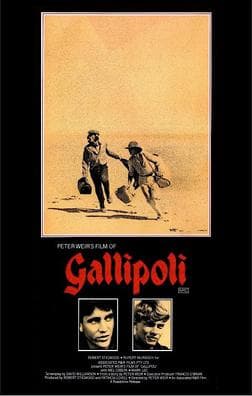
Gallipoli and the two pieces of music that are not Australian
Peter Weir's 1981 war film has no composed score to speak of. It has a French synthesiser record and a baroque lament, and between them they say everything the picture needs.
The Proposition was scored from motifs, and that is why it sounds like heat
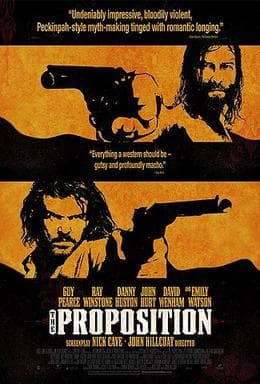
Nick Cave and Warren Ellis wrote the music for John Hillcoat's western from motifs, not from frames, and the film's strange, hymn-like heat is the result.
Bluey's music was made the way the Heelers play
Up Here put a hundred Brisbane musicians behind Joff Bush's Bluey cues, and the lovely result proves the small band had the scale right all along.