Bluey's music was made the way the Heelers play
Up Here put a hundred Brisbane musicians behind Joff Bush's Bluey cues, and the lovely result proves the small band had the scale right all along.

The first Bluey scores were made the way the Heelers play: with whatever was already in the house. Joff Bush got a friend in on violin and another on woodwinds, filled the rest out with accordion and keyboard, and sang the parts himself. ‘Which is actually a problem because I’m not a good singer,’ he told the ABC in April, ‘so I had to get really good at Auto-Tune.’
Hold on to that picture, because it explains nearly everything about why the music on this show works, and it explains why the new orchestral album, Up Here, is at its best in exactly one place.
A score for every seven minutes
The decision that shaped the sound was Joe Brumm’s, not Bush’s. Brumm had worked in the United Kingdom on Charlie and Lola, a show that gave its episodes their own original music, and when he made Bluey at Ludo Studio in Brisbane he insisted that every episode be individually scored. Not a library of cues rotated across the season. A new piece of music for each seven-minute story.
That is an enormous commitment for a children’s cartoon, and Bush, who met the executive producer Daley Pearson at the Queensland Conservatorium and had come to Bluey from The Family Law and Australian Survivor, built a team to meet it. He writes about half the music himself and leads the rest, with David Barber among the regulars. He has said that each episode gets its own musical style, and that he likes to be involved while the episodes are still being scripted.
The result is a show where the music is always the same size as the room. A game on the lounge-room floor gets a small band. A walk to the creek gets a song with two voices in it. When the show wants something grand, it borrows it: Beethoven’s “Ode to Joy”, Mozart’s Rondo alla Turca, Pachelbel’s Canon under an episode called “The Claw”. And it borrows it the way a kid borrows a sheet to make a cape, which is to say at the scale of the kid.
A hundred players in Brisbane
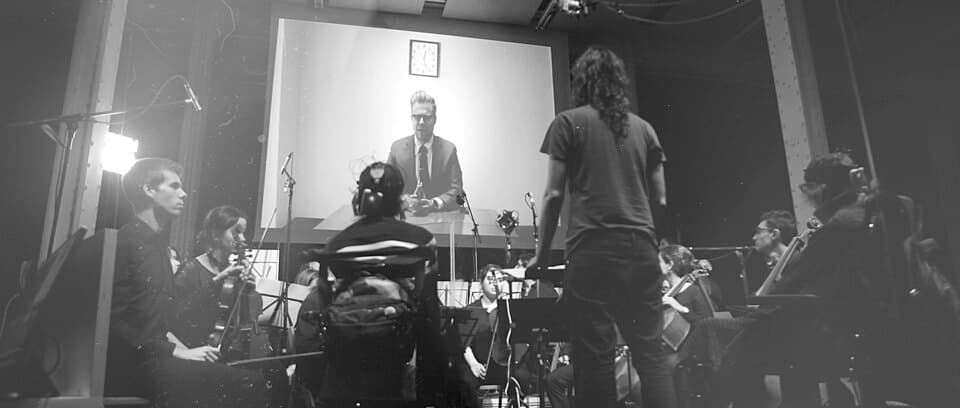
Up Here came out on 27 March, the fourth Bluey soundtrack after Bluey: The Album in 2021, Dance Mode! in 2023 and Rug Island in 2024. Seventeen tracks, forty-one minutes, and for the first time a full symphony orchestra: more than a hundred musicians, mostly Brisbane-based, with players from the Queensland Symphony Orchestra and Camerata, Queensland’s chamber orchestra, alongside the people the Bluey team usually calls. Joseph Twist conducts, and arranges a good deal of it with Bush.
Bush described walking into the session and hearing the orchestra warm up on his own material. ‘That really shocked me,’ he said. ‘I had to sit down for a minute.’
You can hear why. The orchestral version of the theme, which opens the record, is Twist and Bush emptying the toy box: Eine kleine Nachtmusik, the first movement of Vivaldi’s “Spring”, Bach’s fifth Brandenburg, Rhapsody in Blue, the Rondo alla Turca and “The Sailor’s Hornpipe” all get a turn inside three and a half minutes. Elsewhere Handel turns up under “Seesaw”, Bach’s third Brandenburg under “Stumpfest”, Tchaikovsky’s “Waltz of the Flowers” under “Ice Cream”, and “Simple Gifts” under “Relax”.
It went to number one on the ARIA classical chart. It is a warm, generous record, and I do not want to be the man at the party who complains about the quality of the cake.
But a hundred players cannot help sounding like a hundred players. An orchestra’s attack is broader and its decay longer, its natural room is a concert hall rather than a lounge room, and a lot of these cues were written for the lounge room. The charm of the TV versions is that they sound like people you could fit around a kitchen table, and that is not a limitation the show was working around. It is the show. Bluey is about parents making something enormous out of a couch, a hallway and a bedsheet. The music, at its best, does the same trick with a violin and an accordion.
The one that goes home
Then there is “Sleepytime”, which runs five minutes and a second, the longest thing on the album, and the reason to own it.
The episode went to air on 11 April 2020, a few weeks into the first lockdown. Brumm wrote it; Richard Jeffery directed it and won an Australian Directors’ Guild award for it, and the episode took the Prix Jeunesse International in 2022. Bingo wants to sleep the whole night in her own bed. She dreams her way through the solar system with her toy rabbit Floppy while, in the real house, she drifts from bed to bed, and in the dream her mother is the sun.
Underneath it is Holst: “Jupiter, the Bringer of Jollity”, from The Planets, and in particular that broad central tune Holst himself later fitted to the words of “I Vow to Thee, My Country”. Bush has said that he and the team ‘seeded’ it through the episode, so that ‘we’ll have a little echo of it playing, whenever the parents are showing love to their children.’ He has also said the tune has ‘gone beyond its original intended meaning’, which is true twice over, once for the hymn and once for every Australian parent who now cannot hear it without thinking of a small blue dog changing beds in the dark.
Here is the point about scale. Holst wrote The Planets for one of the largest orchestras of its day. The Jupiter tune was built for massed strings and brass in a big hall. On television, it had to fit inside a seven-minute cartoon about a child and her bed.
So Up Here does something to “Sleepytime” that it cannot do to “Seesaw” or “Relax”. It does not enlarge the music. It returns it. The tune goes back to the size it was written for, and it arrives carrying the whole episode with it, the beds, the rabbit, the mother as the sun. That is the only track on the record where the orchestra is not an upgrade. It is a homecoming.
The size of the room
There is a Bluey film coming, due in August next year, and a cinema is a bigger room than a lounge. Maybe Up Here is a sound check for it. I would not be surprised.
I hope whoever scores it remembers the violin and the woodwinds and the accordion, and the composer who learnt Auto-Tune because nobody else in the house was going to sing. The music on this show was never small because it had to be. It was small because it was playing in somebody’s house, with the family, on the floor.
The orchestra is welcome. It just has to take its shoes off at the door.
Kieran writes about what films sound like. Played in a band that nearly got signed in 2012 and has been thinking about attack and decay ever since. Devoted to Warren Ellis, Amanda Brown, and the quiet work of sound editors nobody interviews.
MORE BY KIERAN BOUSTANY →
Burkhard Dallwitz wrote the score everyone credits to Glass
Eleven of the twenty tracks on The Truman Show soundtrack are by a Melbourne composer, and almost nobody outside the credits has ever said his name out loud.
Nigel Westlake smuggled a cathedral into a film about a pig
The score for Babe borrows its grandeur from a French organ symphony, and the trick tells you everything about how Nigel Westlake hears the relationship between small subjects and large feelings.
Every Australian film has a sound and most of them go unheard
This column has spent six years listening to what Australian cinema sounds like, and the answer keeps changing.