The Lost Flowers of Alice Hart cannot decide if it trusts its audience
Sigourney Weaver commits fully to the Australian accent and the Australian landscape; the scripts commit to neither.
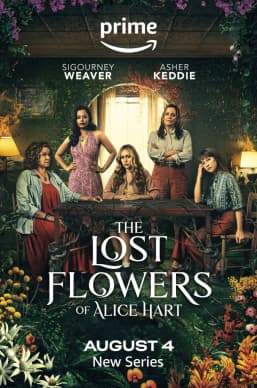
Sigourney Weaver does the accent. I want to start there because it matters. She plays June Hart, the matriarch of a flower farm in the Northern Territory, and she does the Australian accent, and she does it well, and at no point does the show give her a line of dialogue that trusts the audience to keep up with what she is doing. Every emotional beat is explained. Every metaphor is translated. Every moment of ambiguity is resolved within the scene, usually by a character saying out loud what the camera has already shown you. Weaver does the work and the scripts undo it, over and over, for seven episodes.
The Lost Flowers of Alice Hart is adapted from Holly Ringland’s 2018 novel and produced for Amazon Prime Video. It was shot across multiple locations in Australia, including South Australia and the Northern Territory, and the landscape photography is frequently stunning. There are shots of the outback in this show that belong in a gallery. Red dirt, vast sky, the particular quality of light in the Top End that makes everything look both beautiful and indifferent. The show’s visual team (directed primarily by Glendyn Ivin) knows exactly what they have and frames it with real intelligence. If the scripts had the same confidence, this would be a different conversation.
The problem of over-explanation
Here is what happens, structurally, in almost every episode. A scene will establish something through action, image, or performance. Alice (played by younger actors in the early episodes and by Alycia Debnam-Carey as an adult) will experience something painful or complicated or ambiguous. The camera will hold on a face, a flower, a landscape. And then someone will explain what just happened. Not through subtext, not through a later scene that refracts the meaning, but directly, in dialogue, as though the writers received a note from someone who was worried the audience might not understand that fire is a metaphor for destruction and renewal.
This is not a problem unique to The Lost Flowers of Alice Hart, but the show is a particularly clean example of it. The flower language that structures the novel (each chapter is named after a flower with a specific symbolic meaning) is preserved in the show as a framing device, and it could work as a quiet, accumulating pattern that rewards attentive viewers. Instead, the meanings are stated explicitly. A character will hold a flower and another character will tell you what it means. The symbolism is not woven in. It is stapled on.
Why Australian drama keeps doing this
There is a pattern in Australian prestige television that goes roughly like this: an internationally marketable star is attached to a local project. The star commits genuinely to the material. The production is mounted with real resources, often with international co-financing that brings both money and notes. And somewhere in the development process, the scripts start hedging. They start explaining. They start writing for an audience that is assumed to need more help than it does.
I do not know where this impulse comes from, but I have a theory, which is that it comes from the co-financing. When Amazon or Netflix or a major US network puts money into an Australian production, the development process acquires an additional layer of feedback, and that feedback tends to push toward clarity, accessibility, and the elimination of anything that might confuse a viewer who has never been to Australia and does not know what a sugar bag is. The result is a show that looks Australian and sounds Australian (Weaver’s accent is proof of that commitment) but thinks in a language that has been pre-translated for export.
Compare this with something like Mystery Road, which does not explain the landscape, does not translate the silences, does not tell you what a character is feeling when the camera is already on their face. Mystery Road trusts its audience, and the audience responds to that trust, even when (especially when) they do not fully understand every reference. Difficulty is not the enemy of engagement. Condescension is.
Weaver and the weight of the matriarch
Despite all of this, Weaver is very good. She plays June as a woman whose authority has calcified into control, and she finds the specific texture of Australian matriarchal power in a way that an American actor has no obligation to find. June is not warm. She is not cold. She is a person who has decided what her family needs and will not revisit that decision regardless of the damage it causes, and Weaver plays this as a form of love that has curdled without losing its original shape. There are scenes where June is monstrous and scenes where she is heartbreaking, and Weaver makes clear that these are the same quality seen from different angles.
The supporting cast is strong across the board. Debnam-Carey carries the adult Alice with a physical tension that communicates trauma better than any line of dialogue the show gives her. Asher Keddie, Leah Purcell, and Frankie Adams all do precise work in roles that the scripts occasionally reduce to function. The performances, collectively, are ahead of the writing, and the gap is visible in almost every episode.
Production values and production courage
The Lost Flowers of Alice Hart looks like a prestige show. It has the cinematography, the score, the cast, the locations, the runtime. What it does not have is prestige courage, the willingness to let a scene sit in uncertainty, to let a character be opaque, to let the audience do the work of interpretation rather than having interpretation delivered to them like room service.
The distinction matters because Australian drama keeps getting closer to something genuinely its own and then pulling back at the last moment. The infrastructure is there. The talent is there. The landscapes are there, and they are extraordinary, and no other country has them. What is missing is the institutional confidence to let an Australian story be difficult, be strange, be itself, without a safety net of exposition underneath every scene.
Weaver did the accent. She did not need to. Nobody would have blamed her for going mid-Atlantic or vaguely British. She committed to the place, and the show, having invited that commitment, did not quite know what to do with it. That is the whole problem, really, in a single casting decision.
Rhys watches more television than is healthy and writes about it with a dryness that tips occasionally into cruelty. His favourite ABC drama is the one the ABC just cancelled, whichever that happens to be.
MORE BY RHYS TAVITA →
The Office Australia works because Felicity Ward is not playing a version of anybody else
Ward's Hannah Howard is not David Brent, not Michael Scott, and not a blend of both; she is a new species of terrible boss, and the show is better for the invention.
Deadloch proves that Tasmania can do noir if you let comedians write it
Two Kates built a murder mystery in a freezing Tasmanian town and staffed it entirely with people you would cross the street to avoid.
The Newsreader keeps getting the small things wrong on purpose
Season two proves that the best Australian drama on television is the one most willing to look silly in a period wig.