The score for Gold keeps one note going until the desert swallows it
The scoring challenge is simple: one man, one hole, one piece of gold, and ninety minutes of waiting for something to go wrong.
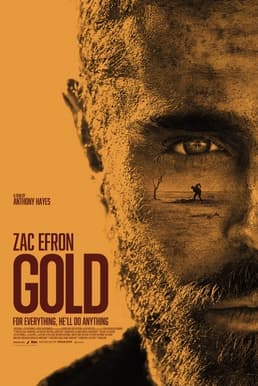
The problem is containment. Anthony Hayes’s Gold (2022) takes place, almost entirely, in a single location: a patch of desert where a man has found a massive gold nugget half-buried in the earth and refuses to leave it. Zac Efron plays the man. The desert is unspecified but filmed in South Australia, and it looks the way film deserts are supposed to look: flat, colourless, hostile, a landscape that has removed everything that is not essential. The film removes everything that is not essential too. There is no subplot. There is no love interest waiting at home. There is barely a second character for most of the running time. There is a man, a hole, a piece of gold he cannot lift, and the sun.
The scoring challenge follows directly from the dramatic one. How do you sustain musical tension for ninety minutes when nothing is moving? The conventional approach would be episodic: build cues around the discrete events of the man’s ordeal (the first night, the sandstorm, the arrival of a stranger, the hallucinations) and let the silence between them do the structural work. This is how most survival films are scored. The music arrives when something happens and retreats when the camera holds on the character waiting.
Gold does something different. The score, composed by Antony Partos and Matteo Zingales, does not retreat. It enters early and stays, not as a continuous presence but as a residue, a tonal sediment that accumulates over the length of the film until it becomes indistinguishable from the sound of the desert itself.
The drone and its discontents
The foundation is a drone. Low, steady, positioned in the sub-bass register where it functions less as a note than as a pressure change. You do not hear it so much as feel it in the chest, in the same place you feel the compression of a sealed room or the drop in pressure before a storm. The drone does not develop. It does not modulate. It sits beneath the film like the bedrock beneath the sand, and everything else, the higher textures, the intermittent melodic fragments, the environmental sound design, rests on top of it.
This is a compositional choice that carries real risk. A drone that does not move can bore. It can become inaudible through habituation, which defeats its purpose. It can also, if it sits at the wrong frequency, become physically uncomfortable in a way that pulls the audience out of the film rather than deeper into it. Partos and Zingales manage the risk by treating the drone not as a fixed element but as a living one: its overtone structure shifts across the film, responding to changes in light and temperature in the image. During the day sequences the drone is drier, more granular, as though the sub-bass itself were being desiccated. At night it softens, takes on a rounder quality, becomes almost consonant. These shifts are gradual enough that they operate below conscious perception, but they prevent the ear from settling into the flatline that a static drone would produce.
Where the music ends and the desert begins
The most sophisticated element of the score is its relationship to the sound design. In most films the boundary between score and sound design is clear: the music occupies one layer of the mix, the environmental sound occupies another, and the audience can distinguish between them even when they overlap. In Gold, that boundary dissolves. The sustained tones of the score bleed into the sustained tones of the wind. The granular textures of the electronic elements merge with the granular textures of sand moving across rock. There are passages in the middle of the film where it is genuinely impossible to determine whether you are hearing music or environment, and this ambiguity is deliberate.
The effect is claustrophobic. When you cannot separate the score from the landscape, the landscape becomes the score, and the character is trapped inside it. There is no musical space outside the desert. There is no harmonic vocabulary that promises relief or resolution. The man is surrounded, sonically as well as physically, and the score’s refusal to establish an independent identity, its insistence on merging with the noise of the place, creates a sense of enclosure that the wide-open landscape of the image, paradoxically, reinforces. The desert is vast. The sound is close. The discrepancy produces a particular kind of dread.
Efron, alone, and the problem of the unscored body
There is a secondary challenge that the score addresses indirectly. Efron spends most of the film alone, which means the camera spends most of the film on his face and body. A solo performance in a survival film lives or dies on the actor’s ability to externalise an internal process without dialogue, and Efron is better at this than his career to this point might have suggested. He plays the deterioration physically: the cracked lips, the sunburned skin, the incremental collapse of posture as dehydration and exhaustion erode the body’s architecture.
The score’s contribution to this deterioration is structural rather than emotional. It does not underscore Efron’s suffering with pathos. It does not crescendo when he reaches a crisis point. Instead it degrades alongside him. The drone, which begins the film as a clean, low-frequency presence, accumulates distortion as the runtime progresses. Harmonics that were consonant in the first act become dissonant in the second. The granular textures thicken. The distinction between pitched and unpitched material erodes until the score, like the man, has lost its capacity to maintain formal coherence. Music becoming noise. Signal becoming static. A sustained tone held so long that it begins to break apart under its own duration.
One note, held
Hayes made Gold as a genuinely Australian production, shot in the South Australian desert with an Australian crew, and the decision to cast Efron, an American, in the lead is one of the film’s few concessions to the market. The score makes no such concessions. Partos, one of the most distinctive voices in Australian film composition, brings to Gold the same uncompromising approach that characterises his work on Balibo (2009) and Wish You Were Here (2012): a refusal to comfort, a commitment to the idea that music in cinema should produce conditions rather than emotions.
The condition Gold produces is endurance. The score does not ask you to feel for the man in the desert. It asks you to sit with him, in the heat, with the drone in your chest and the sand in the mix and the gold in the ground, and wait. Attack: one. Sustain: the rest of the film. Decay: never. The note holds until the desert takes it.
Kieran writes about what films sound like. Played in a band that nearly got signed in 2012 and has been thinking about attack and decay ever since. Devoted to Warren Ellis, Amanda Brown, and the quiet work of sound editors nobody interviews.
MORE BY KIERAN BOUSTANY →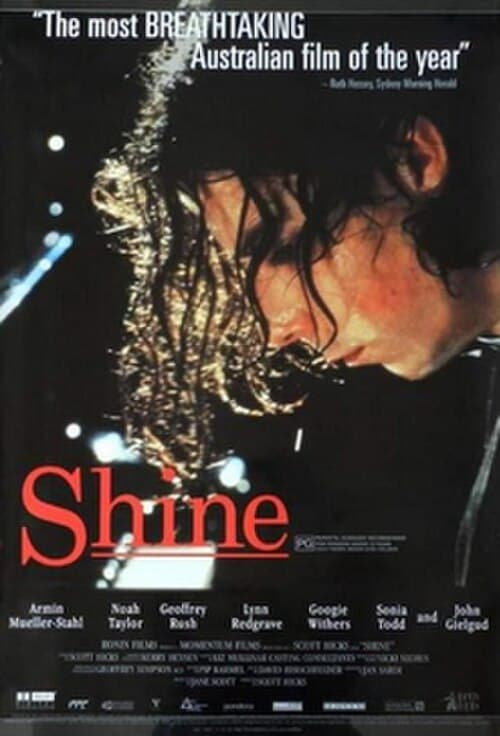
Shine and the score hiding under the Rachmaninoff
David Hirschfelder had to write original music that lives under the loudest warhorse in the piano repertoire, and the quiet writing is what carries the film.
Nigel Westlake smuggled a cathedral into a film about a pig
The score for Babe borrows its grandeur from a French organ symphony, and the trick tells you everything about how Nigel Westlake hears the relationship between small subjects and large feelings.
Every Australian film has a sound and most of them go unheard
This column has spent six years listening to what Australian cinema sounds like, and the answer keeps changing.