Force of Nature proves Eric Bana can carry a franchise nobody expected
Robert Connolly's sequel to The Dry is looser, colder, and more confident about what kind of film it wants to be.
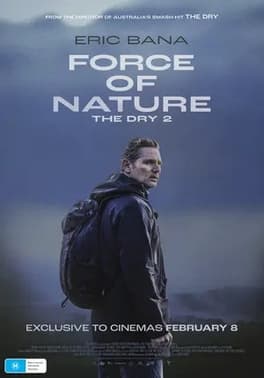
Australian cinema does not do franchises. This is not an oversight; it is a structural condition. The industry produces films in discrete units, each one funded through a patchwork of state agencies, federal offsets, private investment and distributor pre-sales that is assembled for one project and dissolved when that project wraps. The infrastructure for sequels, the expectation that a character will return, that an audience will remember, that the commercial logic of the first film will hold for a second, does not exist in the same way it does in the American studio system. When an Australian film succeeds, the usual response is to celebrate it as a singular achievement and then move on to the next singular achievement. The idea that Aaron Falk might come back was, in this context, quietly radical.
The Dry (2020) was Robert Connolly’s adaptation of Jane Harper’s bestselling novel about a Federal Police financial investigator who returns to his drought-stricken hometown for a funeral and finds himself pulled into a murder case that intersects with an older, unresolved death from his adolescence. It made $20.6 million at the Australian box office, an extraordinary figure for a local film, and it did this during COVID, which made the number even more remarkable. Eric Bana played Falk with a contained stillness that the film sometimes struggled to accommodate; the plot, faithful to Harper’s novel, moved quickly and loudly around a character whose essential quality was quietness. The picture worked, but it worked in spite of a tension between its star’s instincts and its source material’s pace.
The sequel loosens
Force of Nature: The Dry 2 corrects this. Connolly’s second adaptation, drawn from Harper’s follow-up novel, sends Falk into the Victorian alpine ranges on what should be a routine corporate retreat. A group of colleagues from a Melbourne-based company hike into the bush; one of them, Alice Russell (Anna Torv), does not come out. The structure is dual-timeline, cutting between the search for Alice in the present and the events of the hike itself, and this parallel construction gives the film a rhythm that the first picture lacked. The Dry was a procedural with flashbacks bolted on; Force of Nature is something more fluid, a film that trusts its audience to hold two timeframes simultaneously and to find the connections without having them underlined.
The setting matters enormously. Where The Dry used the parched landscape of regional Victoria as a correlative for moral exhaustion, a world drained of water and mercy in equal measure, Force of Nature operates in dense bush, fog, rain, vertical terrain that limits sightlines and compresses the drama. The shift is not just visual; it changes the film’s emotional register. Drought is legible. You can see what is missing. Dense forest is opaque. You cannot see what is there. Connolly and cinematographer Stefan Duscio exploit this opacity throughout, composing shots where the tree canopy closes over the characters like a lid, where the path ahead is never quite visible, where the wilderness is not hostile so much as indifferent to the question of whether these people survive.
Bana’s growing stillness
What Bana does in this second film is worth examining closely because it represents a kind of performance that Australian cinema rarely gets the chance to develop. In The Dry, his Falk was watchful, guarded, carrying the weight of a past that the film gradually disclosed. It was a good performance, controlled and economical, but it had the quality of a first encounter: Bana was establishing the character, laying down markers, showing you who Falk was. In Force of Nature, he has stopped showing. The performance has settled into something less demonstrative and more present. Falk moves through the film with the quiet authority of a man who has done this before, not the specific case but the broader work of entering damaged situations and finding the thread. Bana plays him the way certain actors play characters they have stopped performing and started inhabiting: the mannerisms have dropped away and what remains is attention.
This is what franchises can do when they work, and it is the thing that singular films cannot replicate. A character who returns is a character who has been lived with, by the actor, by the director, and by the audience. The second encounter carries the residue of the first. You do not need to be told that Falk is careful with people; you remember. You do not need the backstory recapped; it is present in the way Bana holds a silence, in the particular quality of his listening. The sequel earns a density of characterisation that the first film had to build from scratch, and it uses that density to do less explaining and more observing.
The women in the frame
Anna Torv’s Alice Russell is the film’s most complicated presence, and the dual-timeline structure allows Torv to play two versions of the character simultaneously: the Alice of the hike, sharp and socially abrasive and clearly hiding something, and the absent Alice of the search, whose personality is reconstructed through other people’s accounts. The gap between these two versions is where the film’s mystery actually lives. The question is not simply what happened to Alice but which Alice was real, the one her colleagues describe or the one we watched on the trail.
Deborah Mailman, Robin McLeavy and Sisi Stringer fill out the hiking group, and Connolly gives each of them enough screen time and specificity that the corporate retreat becomes a study in the small violences of professional proximity. These women know each other too well. They have accumulated grievances the way co-workers do, through repetition rather than event, and the bush strips away the office protocols that ordinarily keep those grievances contained. The film is quietly precise about this: the dynamics of the group are not dramatic in the cinematic sense but are recognisable in the way that workplace friction is recognisable, petty and real and capable of escalation.
Why it works, and what it means
Force of Nature took $8.2 million at the Australian box office, less than half of The Dry’s haul but still a strong result for a local production. The drop is partly circumstantial; the sequel did not benefit from the same pandemic-era conditions that concentrated audiences for the first film. But the number also reflects a broader uncertainty about whether Australian audiences will sustain a franchise that is not backed by the marketing machinery of a Hollywood studio. Harper has written five Aaron Falk novels. Connolly has indicated interest in continuing. Whether the economics support a third film remains an open question.
What is not in question is that the second film is better than the first. It is looser, more atmospheric, more trusting of its audience and its star. It has solved the central problem of the original, which was the tension between a quiet protagonist and a noisy plot, by giving Falk a narrative that matches his register. The alpine bush is quiet too, in its way; the danger is not announced but accumulated, felt in the body before it is understood by the mind. Bana walks through it as though he belongs there, as though the character has been waiting for this landscape, and the fit is so precise that you wonder why Australian cinema does not do this more often. The answer, as always, is money, and infrastructure, and the assumption that our stories only need telling once. Force of Nature suggests otherwise, quietly, in the fog, with the patience of a man who knows how to wait.
Bronte writes long-form criticism of Australian cinema and the international art films that feed into it. She was on the ground at Cannes in 2019 and has not entirely forgiven the festival for 2020. Patient with slow films; impatient with tidy ones.
MORE BY BRONTE HAUGHEY →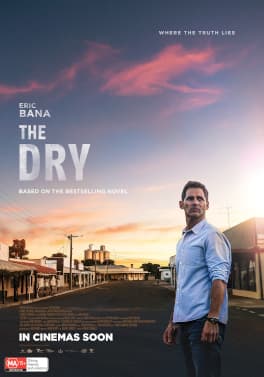
The Dry gives Eric Bana a landscape and lets him stand in it
Robert Connolly's adaptation knows the difference between withholding information and withholding feeling.
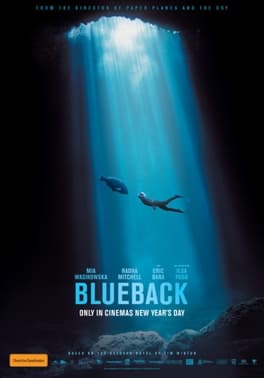
Blueback turns an ocean conservation story into something the reef can hold
Robert Connolly filmed underwater in Western Australia and found a drama that breathes better below the surface than above it.
The five Australian films of 2021 that will still matter in a decade
The year gave us a portrait of a mass killer, a drought-country thriller, a sheep-farming feud, and a lucid day with a grandmother, and all four will last.