Blueback turns an ocean conservation story into something the reef can hold
Robert Connolly filmed underwater in Western Australia and found a drama that breathes better below the surface than above it.
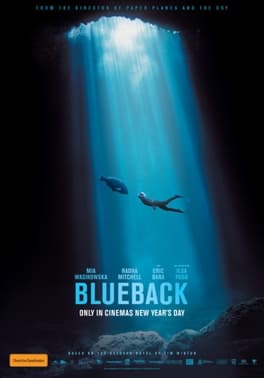
There is a scene in Blueback where the camera drops below the waterline and stays there, and the film becomes a different film. The dialogue stops. The narrative architecture of the thing, the family tensions, the property developers, the intergenerational friction, all of it dissolves into current and light and the slow lateral movement of a fish the colour of deep water. The camera does not hurry. The fish does not perform. For perhaps ninety seconds, the film forgets it has a screenplay and becomes something closer to observation, and it is in these moments that Robert Connolly’s adaptation of Tim Winton’s novella finds its real subject.
The real subject is not conservation, though conservation is what the film is ostensibly about. Abby (Mia Wasikowska as an adult, Ilsa Fogg as a child) grows up on the coast of Western Australia, forms a bond with a wild blue groper she names Blueback, and spends her adult life fighting for the marine environment. Her mother Dora (Radha Mitchell) is the local custodian of the reef, a woman whose relationship to the ocean is as practical as it is spiritual. Eric Bana appears as Abby’s father, a fisherman whose death early in the story sets the emotional coordinates for everything that follows. The plot moves through Abby’s childhood, her departure, her return. It is a structure that Tim Winton has used before, because it is a structure that works for the kind of story he tells: a person leaves a landscape, carries it inside themselves, and comes back changed enough to see it properly.
Connolly films this competently on land and beautifully underwater, and the gap between those two registers is the film’s central problem and its central achievement.
Below the surface
The underwater cinematography, supervised by Rick Rifici, is genuinely extraordinary. The Western Australian coast near Bremer Bay, where much of the film was shot, provides a palette that feels almost implausible: kelp forests in green-gold light, reef walls dropping into blue-black depth, schools of fish moving in formations that look choreographed but are not. Connolly and Rifici film these sequences with a patience that the above-water scenes do not always share. The camera holds on textures. The edits are slow. The sound design replaces dialogue with the creak and hiss of underwater acoustics, and the effect is immersive in a way that the word immersive usually fails to deliver.
What these sequences achieve is a register shift. When the film is underwater, it stops being a drama and starts being something closer to nature cinema, and that is where it is most itself. The blue groper, rendered through a combination of practical effects and digital work, is a convincing presence not because the effects are flawless but because the film gives the creature space to exist in its own terms. Blueback is not anthropomorphised. He is not given motivations or expressions. He is a large fish in clear water, and Abby’s attachment to him is allowed to be what such attachments actually are: not a projection of human feeling onto an animal, but a recognition that the animal’s existence is sufficient, that it does not need to mean anything beyond itself.
The Connolly landscape
Connolly has been circling Australian landscape as a subject for his entire career. The Dry (2020) used the parched farmland of the Wimmera as a character in its own right, a presence that shaped behaviour and memory and the particular quality of rural silence. Balibo (2009) sent Australian journalists into the landscape of East Timor, where the terrain was both beautiful and lethal. In each case, Connolly treats the physical environment not as backdrop but as an active participant in the drama, a force that determines what kind of story can be told within it.
Blueback extends this to the ocean, and the ocean proves to be a more generous collaborator than the land. The dry country in Connolly’s earlier work is hostile, withholding, a landscape of endurance. The ocean in Blueback is abundant, responsive, alive in a way that makes human drama feel small by comparison. This is both the film’s strength and its limitation. When the camera goes underwater, the abundance of the natural world makes the screenplay’s concerns feel thin. When it surfaces, the family drama feels like what it is: a vehicle for getting back into the water.
The Winton problem
Adapting Tim Winton is a specific challenge, because Winton’s prose does something that film cannot easily replicate. His sentences move between external description and interior experience without marking the transition. A character looks at the ocean and the prose shifts from what the ocean looks like to what it feels like to be a person looking at it, and the shift happens within a single clause. Film has to choose: show the ocean, or show the person looking at it. It cannot occupy both positions simultaneously.
Connolly’s solution is to let the underwater sequences carry the interior weight. When Abby is below the surface, the camera’s intimacy with the environment stands in for her psychological state. We do not need to hear her thoughts because the images are doing the thinking. This works. What works less well is the above-water drama, where the film falls back on dialogue and flashback structures that feel dutiful rather than necessary. The conservation plot, involving developers who want to exploit the coast, is functional but not surprising. The intergenerational dynamics between Abby and Dora are sketched rather than explored.
What the reef holds
The film was released in early 2023 to modest box office and mixed reviews, and I think the mixed reception reflects the genuine split in the film’s identity. As a family drama, Blueback is conventional, competent, occasionally moving but rarely surprising. As nature cinema, it is something finer: a patient, attentive record of a marine environment filmed with enough care to let the audience feel the temperature of the water and the weight of the light.
The scenes that stay with me are all underwater. The blue groper hanging in mid-water, turning slowly to regard the camera. The kelp forests bending in the current like weather. Abby as a child, her body small and bright against the dark reef wall, her movements awkward in the way that human bodies are always awkward underwater, designed for air and gravity and making do with density and drift.
Connolly found something in those sequences that the screenplay could not give him. He found a subject that did not need to be dramatised, that was dramatic in its own existence, that simply needed to be filmed with attention and care. The reef does not need a story. It needs a camera, and patience, and the willingness to stay under long enough for the surface to stop mattering.
Bronte writes long-form criticism of Australian cinema and the international art films that feed into it. She was on the ground at Cannes in 2019 and has not entirely forgiven the festival for 2020. Patient with slow films; impatient with tidy ones.
MORE BY BRONTE HAUGHEY →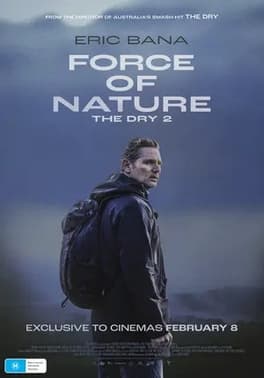
Force of Nature proves Eric Bana can carry a franchise nobody expected
Robert Connolly's sequel to The Dry is looser, colder, and more confident about what kind of film it wants to be.
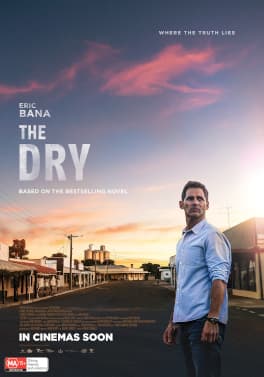
The Dry gives Eric Bana a landscape and lets him stand in it
Robert Connolly's adaptation knows the difference between withholding information and withholding feeling.
Breaker Morant and the country that adopted its scapegoat
Bruce Beresford's 1980 courtroom drama made an English-born soldier into an Australian martyr, and the picture's argument about empire has outlived its historical certainties.