The Dry gives Eric Bana a landscape and lets him stand in it
Robert Connolly's adaptation knows the difference between withholding information and withholding feeling.
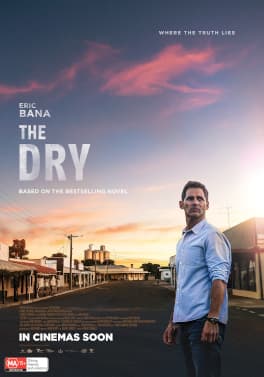
There is a particular kind of Australian film in which the land is not backdrop but participant, and the camera lingers on dry creek beds and fence lines not because they are beautiful (though they are, in their scorched and minimal way) but because they contain information the characters cannot speak aloud. The Dry (2020) belongs to this tradition, and it knows exactly how to use it. Robert Connolly’s adaptation of Jane Harper’s bestselling novel returns Eric Bana to Australian cinema after a long absence spent in Hollywood’s middle distance, and what it gives him is not a role so much as a landscape to stand in and a silence to carry. Bana, to his considerable credit, understands the assignment. He does almost nothing, and the nothing is full.
The premise is a whodunit wrapped in a homecoming. Aaron Falk (Bana), a federal police financial investigator based in Melbourne, returns to the fictional town of Kiewarra for the funeral of his childhood friend Luke, who has apparently killed his wife and child before turning the gun on himself. Falk does not believe it. Neither, crucially, does the audience, because the film signals its scepticism through landscape rather than dialogue; the town is too dry, too watched, too full of buried grievance for anything as simple as a murder-suicide to be the whole truth. Connolly and co-writer Harry Cripps restructure Harper’s plot with a screenwriter’s economy, cutting subplots, condensing characters, but they keep the novel’s essential insight: that drought is not weather but psychology, a condition in which everything contracts, secrets included.
Bana in the register of stillness
Bana’s performance operates in a register that Hollywood rarely asked of him. In Black Hawk Down, Troy, Munich, even in the underrated The Time Traveler’s Wife, he was always in motion, always deploying physical charisma against material that wanted more from his body than his face. Here, Connolly strips that away. Falk is a man who has trained himself to be still because movement attracts attention, and attention, in a small town with a long memory, is dangerous. Bana plays this with his shoulders, his jaw, the way he holds a beer glass without drinking from it. The performance is constructed from refusals: he refuses to raise his voice, refuses to quicken his pace, refuses to let his face betray the calculations running behind it.
This is a different kind of star turn, one that depends on the audience’s memory of Bana’s earlier physicality. We know what this body can do because we have seen it do it in other films; the restraint here reads as suppression, which gives Falk a coiled quality the script alone could not provide. It is a performance that borrows against the actor’s history, and it works because Bana does not wink at us about it. He simply stands in the heat, squints at the horizon, and lets the landscape do the talking.
The grammar of Australian drought cinema
Australian cinema has been filming drought for as long as it has been filming anything. From the silences of the Mallee in Wake in Fright (1971) to the red dust of The Tracker (2002), the parched interior has served as both setting and moral condition, a place where the usual social contracts thin out and something older, harder, less forgiving takes their place. The Dry positions itself within this lineage but updates it; Connolly shoots the Wimmera (standing in for Harper’s fictional Kiewarra) with a digital clarity that emphasises texture over mood, the precise grain of cracked earth, the individual blades of dead grass, the quality of light at four in the afternoon when the sun is still punishing but the shadows have begun to lengthen.
Stefan Duscio’s cinematography deserves separate consideration. Where a lesser film would have used the drought as visual shorthand for despair, applying desaturation and a bleach-bypass colour grade to drain the image of warmth, Duscio does the opposite. His images are warm, golden, almost inviting. The land looks beautiful, and this is the point: beauty and cruelty coexist here without contradiction. The town is gorgeous and terrible. The river, when we see it in flashback with water still flowing, is edenic and lethal. Duscio photographs the dual nature of the place with a steady hand, and the tension between what the images show and what we know lies beneath them generates a discomfort no amount of plot machinery could achieve alone.
What the adaptation understands
Harper’s novel is a well-constructed thriller with a dual-timeline structure, alternating between Falk’s present investigation and his teenage years in Kiewarra, when a young girl drowned in the river and Falk was driven out of town under suspicion. The film preserves this structure but compresses it, and the compression reveals something interesting about adaptation as a discipline. On the page, Harper has room to develop the town’s social ecology in granular detail: the farming families, the publicans, the teachers, the quiet hierarchies of resentment and obligation that govern small communities. Connolly cannot do this in two hours, so he makes a smart substitution. Where the novel builds the town through accumulation, the film builds it through landscape. Every wide shot of a dry paddock, every scene framed against a distant tree line, every cut from an interior to the blinding exterior light carries the information that the novel distributes across dozens of small interactions.
This is adaptation that understands its medium. The picture does not try to be the book; it translates the book’s concerns into the language of cinema, which is the language of space, light and the human face. Bana’s face, weathered and watchful, becomes a landscape in its own right, and Connolly’s camera treats it with the same patience it brings to the paddocks and the sky.
Standing in it
The film’s final act resolves its mysteries with workmanlike efficiency, and it is perhaps here that The Dry is least interesting; the mechanics of the whodunit, the reveals and confrontations, belong to genre convention and they satisfy without surprising. But this is a minor complaint about a film whose real achievement lies elsewhere. The Dry demonstrates that Australian thriller cinema does not need to import its aesthetic from Scandinavian noir or British procedurals, that the tools are already here, in the landscape, in the light, in the particular quality of silence that descends on a country town when the rain has not come and everyone is watching everyone else and nobody is saying what they know.
Bana, standing in that silence, gives the film its centre. He is not performing trauma or redemption or justice; he is performing presence, the simple act of a man being in a place, and the place responding to him. It is a quiet achievement, easily overlooked, and it is the reason the film works. Connolly gives his star a landscape, and Bana stands in it, and the space between the man and the land fills with everything the film is too disciplined to say aloud.
Bronte writes long-form criticism of Australian cinema and the international art films that feed into it. She was on the ground at Cannes in 2019 and has not entirely forgiven the festival for 2020. Patient with slow films; impatient with tidy ones.
MORE BY BRONTE HAUGHEY →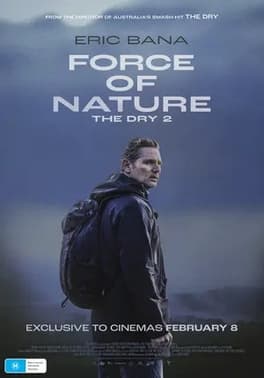
Force of Nature proves Eric Bana can carry a franchise nobody expected
Robert Connolly's sequel to The Dry is looser, colder, and more confident about what kind of film it wants to be.
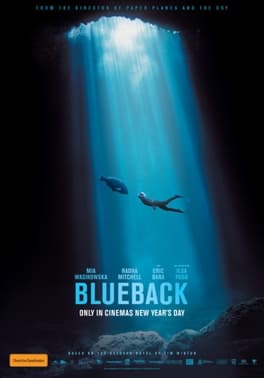
Blueback turns an ocean conservation story into something the reef can hold
Robert Connolly filmed underwater in Western Australia and found a drama that breathes better below the surface than above it.
The Surfer traps Nicolas Cage on a beach and discovers that the ocean is the real antagonist
Lorcan Finnegan's beach thriller gives Cage nothing but sand and hostility, and what he does with both is more controlled than anyone expected.