Clickbait was made in Melbourne for a global audience and it shows
Netflix set a thriller in Oakland, filmed it in Melbourne, cast Adrian Grenier, and hoped nobody would notice the gum trees.
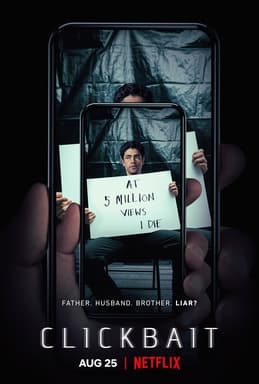
Look, Clickbait is a show that debuted at number one on Netflix globally and has been discussed by almost nobody. That is not a contradiction. That is the Netflix model working exactly as designed: content as volume, visibility as algorithm, cultural impact as an externality that was never in the brief. The show was watched by tens of millions of people in its first week and reviewed by a handful. It generated no discourse, launched no careers, and inspired no think pieces. It simply appeared, was consumed, and evaporated. That it was made in Melbourne, by a largely Australian crew, for a budget that could have funded several local productions, makes it worth looking at more carefully than the audience or the platform ever intended.
The premise is this: Nick Brewer (Adrian Grenier) is abducted. A video surfaces online showing him holding a card that reads “I abuse women. At 5 million views, I die.” Each of the eight episodes is told from the perspective of a different character in Nick’s orbit, each one revealing a new layer of the mystery. It is a structure borrowed from literary fiction (or, less charitably, from Rashomon via Gone Girl via every prestige thriller since 2014) and it works well enough to keep you watching. Whether it works well enough to justify its existence is a different question.
The uncanny valley of Australian locations
The show is set in Oakland, California, and Sacramento. It was filmed in Melbourne, primarily in the inner suburbs, and the result is a persistent visual uncanniness that anyone who has ever walked down a street in Fitzroy will recognise immediately. The houses are wrong. Not dramatically wrong, not “that is clearly a terrace house in Carlton” wrong, but subtly, consistently wrong. The front yards are too small. The fences are the wrong height. The trees are eucalypts that have been framed to avoid showing their full canopy. The letterboxes are Australian letterboxes with American numbers stuck on them.
The interiors are better. Production design can control an interior. But every time a character walks outside, the illusion wobbles. The light is Melbourne light, which is flatter and greyer than Northern California light. The streets are Melbourne streets, which are wider and emptier than Oakland streets. There is a scene where a character drives through what is supposed to be a Californian suburb and you can see a nature strip that has clearly been mowed by a council contractor. These are not things that most viewers would consciously notice. But they accumulate, and they contribute to the show’s overall feeling of being set in a place that does not quite exist.
Adrian Grenier, somehow
Grenier is an interesting piece of casting, and by “interesting” I mean confusing. He was, briefly, a significant screen presence because of Entourage, a show that has aged in ways nobody predicted and everybody should have. His performance in Clickbait is fine. He is in a cage for most of it, which limits the range required. When he is in flashbacks, he is doing competent work as a man with a secret, which mostly involves looking slightly uncomfortable in domestic scenes. The show does not need him to be great. It needs him to be a face that Netflix subscribers might vaguely recognise, and he delivers that.
The cast around him is more interesting. Zoe Kazan, as his sister, does the heavy lifting in the early episodes and does it well. Betty Gabriel, Phoenix Raei, and Abraham Lim fill out the ensemble, and Raei in particular brings a specificity to his detective role that the script does not always earn. The Australian actors in the cast (and there are several, performing with American accents of varying conviction) are doing the professional work of disappearing into a production that does not want to acknowledge where it was made.
The social media thriller, already a cliche
The show’s central conceit, that social media enables new forms of deception and violence, was already well-trodden ground by 2021. Searching did it better as a film. The Great Hack did it better as a documentary. Black Mirror has been doing it, with diminishing returns, since 2011. Clickbait does not bring a new idea to this conversation. What it brings is eight episodes, which is enough runtime to explore the concept but also enough to expose how thin the concept is.
The each-episode-a-different-perspective structure is the show’s best feature and also its limitation. It forces the writers to withhold information in ways that feel mechanical rather than dramatic. Characters who could resolve the mystery in episode three do not do so because it is not their episode yet. The result is a plot that advances through suppression rather than revelation, and the distinction matters. In a well-constructed mystery, you learn things that change the meaning of what you already knew. In Clickbait, you learn things that were simply not mentioned before. Honestly, the difference between those two experiences is the difference between being surprised and being managed.
The Melbourne crew economy
Here is the thing that matters beyond the show itself. Clickbait was produced by Tony Ayres and Christian White, both Australian. It was crewed almost entirely by Australians. The production spent an estimated $60 to $70 million in Victoria over its shoot, employed hundreds of local crew members, and contributed to Melbourne’s growing reputation as a production hub for international streaming content.
This is the trade-off that the Australian screen industry has been making since the Location Incentive was expanded. We provide the crews, the infrastructure, and the locations. The platforms provide the budgets, the IP, and the audience. The content that results is Australian-made but not Australian-set, Australian-crewed but not Australian-voiced. The crew gets paid, and paid well. The industry gets volume. What it does not get is Australian stories.
Clickbait is a perfectly watchable show set in a fictional America, made by Australians pretending to be somewhere else, for a platform that does not care where anything is made as long as it performs in the first 48 hours. It employed people and it was seen by millions and it has already been forgotten. Whether that constitutes success depends entirely on what you think the Australian screen industry is for.
Rhys watches more television than is healthy and writes about it with a dryness that tips occasionally into cruelty. His favourite ABC drama is the one the ABC just cancelled, whichever that happens to be.
MORE BY RHYS TAVITA →
Apple Cider Vinegar knows exactly what it is
Netflix turned Australia's most notorious wellness fraud into a glossy limited series, and the smartest thing it does is admit it is part of the racket too.
Boy Swallows Universe and what Netflix actually paid for
Twenty months after Netflix dropped the Trent Dalton adaptation in January 2024, the show has aged into one of the few streamer-funded Australian dramas that didn't get cancelled out of spite.

Territory wants to be Australia's Yellowstone and it gets close enough to matter
Netflix built a cattle-station dynasty drama in the Northern Territory and staffed it with enough Australian actors to fill a muster, and the result is louder and messier than anything the ABC would commission.