Blaze paints its trauma in colours that refuse to behave
Del Kathryn Barton's debut feature looks nothing like any other Australian film this decade, and that is both its weapon and its problem.
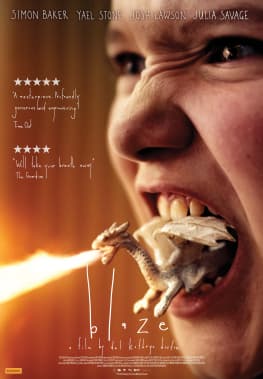
There is a scene early in Blaze in which a child, having witnessed something she cannot yet name, retreats into a fantasy that is rendered on screen as a burst of animated colour: tendrils of light, creatures drawn in the visual language of Del Kathryn Barton’s painting practice, a world that operates by the logic of a child’s interior life rather than any naturalistic grammar. It is beautiful. It is also, in its context, deeply uncomfortable, because the thing the child is retreating from is sexual assault, and the film is asking you to hold both registers at once; the aesthetic pleasure of the image and the horror of what produced it. This double demand is the engine of the picture, and it is the thing that makes Blaze both genuinely original and, at times, structurally incoherent.
Barton is one of Australia’s most prominent visual artists. She has won the Archibald Prize twice. Her work is characterised by its maximalism: dense, layered, saturated with organic forms, eyes, flora, bodies that dissolve into pattern. When she announced she was making a feature film, the question was not whether she had a visual sensibility strong enough for cinema but whether that sensibility could accommodate narrative, duration, and the particular demands of screen performance. The answer Blaze provides is complicated. The film looks extraordinary. It also struggles, at times, to reconcile its visual ambition with the dramatic requirements of its story.
The lineage it refuses
Australian cinema has a long and well-documented tradition of social realism. The picture of childhood trauma in this country’s filmography tends toward naturalism: muted palettes, handheld cameras, performances that sit close to documentary register. Think of Snowtown, The Boys, Hounds of Love. These films trust that the accumulation of observed detail will produce its own emotional force; that you do not need to stylise suffering to make it legible. It is a tradition with real strengths, and it has produced some of the most devastating work in the national cinema.
Blaze refuses this lineage entirely. Its palette is oversaturated. Its compositions are painterly in a way that draws attention to their own construction. The animated sequences, which recur throughout the film, occupy a visual register closer to Barton’s gallery work than to anything in the Australian screen tradition. This is not an accidental departure; it is a programmatic one. Barton has said in interviews that she wanted to make a film that represented trauma from the child’s perspective rather than the adult’s, and that this required a visual language capable of holding contradiction: terror and beauty, fragmentation and coherence, the literal and the imagined.
What the animation carries
The animated sequences are the film’s most distinctive and most contested element. They function as the inner life of Blaze, the twelve-year-old protagonist played by Julia Savage in a performance of remarkable composure. When the real world becomes unbearable, Blaze retreats into a space populated by a dragon and other figures drawn from her imagination; creatures that protect her, narrate her confusion, and give form to emotions she cannot articulate in language.
The risk here is obvious. Animation, when used to represent a child’s fantasy life, can slide toward the whimsical, the therapeutic, the reassuring. It can suggest that the imagination is a safe space, a refuge from the world’s violence. Barton is aware of this risk, and the animated sequences are, at their best, genuinely unsettling rather than comforting. The dragon is not a guardian angel; it is a volatile, shape-shifting presence whose intentions are not always legible. The colours are too bright, the forms too dense, the movement too frantic. There is something feverish about these passages, and the fever is the point: this is not escapism but processing, the mind’s attempt to metabolise an experience it cannot yet understand.
When it works, this approach produces images that have no precedent in Australian cinema. There is nothing in the local tradition that looks like Blaze’s animated passages, nothing that attempts to visualise a child’s interiority with this degree of formal ambition. The film earns its comparisons to Lynne Ramsay’s Ratcatcher or Lucile Hadzihalilovic’s Innocence, works that use stylisation not to aestheticise trauma but to represent the particular distortions of a child’s perception.
Where the structure falters
The difficulty is that these sequences exist within a narrative that does not always know how to accommodate them. The film’s story, stripped of its visual invention, is relatively straightforward: a child witnesses an assault on a stranger, is herself threatened by the perpetrator, and must navigate the aftermath without adequate adult support. The dramatic tension should come from the gap between what Blaze knows and what the adults around her are willing to see. But the screenplay, co-written by Barton and Huna Amweero, distributes its attention unevenly. The adult characters are thinly drawn. Simon Baker, as Blaze’s father, occupies a role that feels more structural than psychological; he is present to represent a certain kind of well-meaning parental inadequacy, but the film does not give him enough material to make that inadequacy specific.
The pacing, too, is uneven. The animated sequences, precisely because they are so visually commanding, tend to overwhelm the dramatic scenes that surround them. There are stretches in the middle act where the film feels caught between two modes, neither fully committing to the fantasy register nor grounding itself in the social reality of its premise. A more experienced director might have found ways to integrate these registers more seamlessly; Barton, working in an unfamiliar medium, sometimes allows the visual and the narrative to run on parallel tracks rather than converging.
The ambition that matters
None of this diminishes what Blaze achieves at its best. The film is an argument, delivered in images rather than polemic, that Australian cinema does not have to look one way; that social realism is a choice rather than an obligation; that the experience of a child confronting violence deserves a visual language as complex and contradictory as the experience itself. Barton brings to the screen a painter’s understanding of surface, density, and the emotional weight of colour, and there are moments in Blaze where that understanding produces something no other Australian film has attempted.
The picture is imperfect. Its structure does not always support its ambition, and there are scenes where the gap between what Barton wants to say and how the screenplay says it becomes visible. But imperfection in the service of genuine originality is a more interesting failure than polished competence, and Blaze is, whatever its flaws, a film that could not have been made by anyone else. In a national cinema that tends to reward restraint and penalise excess, that distinction carries its own weight.
Bronte writes long-form criticism of Australian cinema and the international art films that feed into it. She was on the ground at Cannes in 2019 and has not entirely forgiven the festival for 2020. Patient with slow films; impatient with tidy ones.
MORE BY BRONTE HAUGHEY →
June Again gives Noni Hazlehurst a second chance and does not waste it on sentiment
Hazlehurst plays a woman with dementia who gets one lucid day, and the film is wise enough to spend it on repair rather than nostalgia.
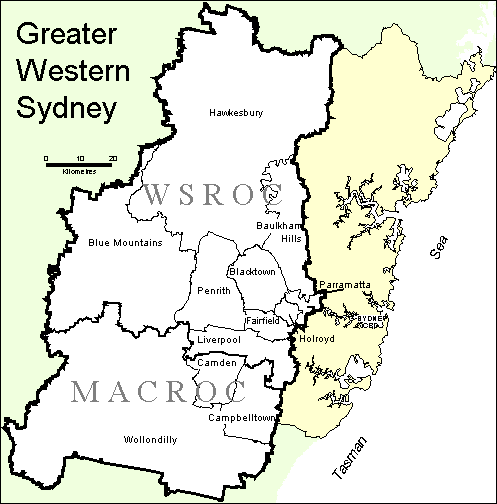
Here Out West built Western Sydney from eight directors and one shared street
Eight directors filmed eight stories on a single Western Sydney street, and the accumulation is more than any one of them could have managed alone.
Penguin Bloom brings Naomi Watts home and does not know what to do with her
Watts returns to Australian cinema for a true story about a magpie and a spinal injury, and the film is better when it trusts the bird.