Better Man scores Robbie Williams as a CGI monkey and the music has to hold the whole trick together
When the lead actor is a digital chimpanzee, the music is not accompaniment; it is the only human thing in the frame.
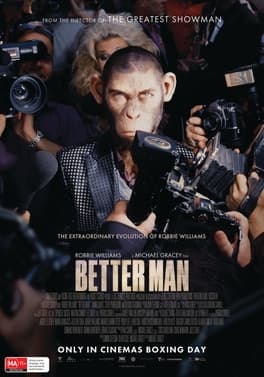
There is a problem at the centre of Better Man that no amount of visual effects can solve, and it is this: a chimpanzee cannot cry. It can bare its teeth, widen its eyes, hunch its shoulders in postures that approximate distress, but it cannot produce the specific muscular collapse of the human face in grief, the way the mouth pulls down and the brow crumples and the eyes lose focus. Michael Gracey’s film, which renders Robbie Williams as a motion-captured CGI chimpanzee from childhood through superstardom through breakdown, bets everything on the audience accepting this conceit, and the bet is won or lost not in the animation but in the music. When the face cannot deliver the emotion, the voice has to carry it. When the body is digital fur and simian proportions, the song has to be the body. The music in Better Man is not accompaniment. It is the only human presence in every frame the chimp occupies.
Williams voiced and motion-captured the role himself, and this decision reverberates through the film’s musical sequences with a force that the dramatic scenes cannot match. When the chimp performs “Feel,” standing on a stage in front of thousands of digital extras, what you hear is Williams’s actual voice, recorded decades after the original, worn and lower and carrying the accumulated damage of everything the film has just depicted. The vocal performance is a kind of archaeology. You hear the original track buried inside it, the younger voice preserved like a fossil, and layered over it the years of excess and collapse and recovery that the film chronicles. The gap between the two voices, the studio recording from 2002 and the weathered performance captured for the film, is where the emotion lives. Not in the chimp’s face, which cannot hold it. In the frequency.
The Gracey method
Gracey built his reputation on The Greatest Showman (2017), a film that understood something essential about the modern musical: the numbers are the argument. In a conventional biopic, the narrative carries the weight and the songs illustrate it. In Gracey’s work, the relationship is inverted. The songs are the structural events, the points around which the narrative organises itself, and the scenes between them serve as connective tissue rather than the other way around. The Greatest Showman applied this logic to P.T. Barnum with a brightness and kinetic energy that suited the material. Better Man applies it to Williams with the same structural conviction but a darker palette, and the contrast is instructive.
The Melbourne production shot across multiple locations in the city’s inner suburbs and at Docklands Studios, and Gracey’s team built elaborate sets for the musical numbers that function as emotional architecture. The “Rock DJ” sequence, in which the chimp strips on a surreal, heightened stage while the camera swoops through impossible angles, is staged with the maximalist choreography of a Busby Berkeley number filtered through a music video sensibility. It is overwhelming by design. Gracey directs musical sequences the way action directors stage set pieces: every element is in motion, the camera never rests, the editing is rhythmic and precise. The approach works for spectacle. Whether it works for intimacy is the question the film keeps asking itself.
The voice beneath the fur
The intimate numbers are where Better Man finds its nerve. “Angels,” performed in a sequence that strips away the production spectacle and places the chimp alone in a sparse environment, requires the audience to listen rather than watch. The animation simplifies: the chimp sits still, the camera holds, and Williams’s voice does the work that the face cannot. What it does is specific and hard to describe without resorting to the vocabulary of the recording studio. There is a quality in a voice that has been used hard, a grain, a slight friction at the top of the register, a thinning of the tone on sustained notes, that communicates lived experience more directly than any visual representation can. You hear the cigarettes. You hear the sleepless nights. You hear the medication and the withdrawal from medication. The voice is a body, and it is a human body, and it contradicts the animated one on screen with every breath.
This contradiction is the film’s great gamble and its genuine achievement. By removing the human face, Gracey forces the audience into a mode of listening that cinema rarely demands. In a conventional biopic, the actor’s physical performance does half the emotional work; you read grief in their posture, joy in their grin, collapse in the way they fold. Better Man denies this channel almost entirely. The chimp’s movements, governed by motion capture and animation, are expressive in a gestural sense but cannot achieve the micro-expressions that convey interior states. The result is that the voice carries everything, and the songs become the film’s only reliable emotional register.
The weight of the trick
The gamble does not always pay. There are sequences where the conceit draws attention to itself, where the audience’s awareness of watching a CGI primate overshadows the emotional content the scene is attempting to deliver. The childhood sequences, in which a young chimp navigates a working-class Stoke-on-Trent rendered with careful period detail, struggle to balance the whimsy of the visual with the bleakness of the biography. Williams’s upbringing, marked by an absent father and early exposure to the entertainment industry’s machinery, is not inherently funny, and the chimp renders it as partially comic whether the film intends this or not.
But when the music takes over, the trick dissolves. There is a sequence built around “Come Undone” that is the closest the film gets to genuine devastation. The chimp is alone. The arrangement is stripped to piano and voice and a string line that enters below the vocal like a tide coming in. Williams sings it with a rawness that the studio version, polished and compressed, never allowed, and for three minutes the conceit stops being a conceit and becomes something else: a portrait of a man who has chosen to be represented as an animal because the animal is the only honest metaphor for how fame made him feel. Not less than human but differently human, observed and exhibited and reduced to gestures that audiences consume without recognising as distress.
The music holds it. The music holds all of it. When the face is fur and the body is data and the biography is rendered as spectacle, the voice remains unprocessed, human, carrying the damage and the talent in equal measure, and the songs do what songs have always done better than cinema: they make the invisible audible. The attack of a consonant. The decay of a held note. The breath between phrases where the performer is not performing, just breathing, just alive, and for a half-second the chimpanzee disappears and there is only the sound of a man who cannot stop singing about how much it costs to be heard.
Kieran writes about what films sound like. Played in a band that nearly got signed in 2012 and has been thinking about attack and decay ever since. Devoted to Warren Ellis, Amanda Brown, and the quiet work of sound editors nobody interviews.
MORE BY KIERAN BOUSTANY →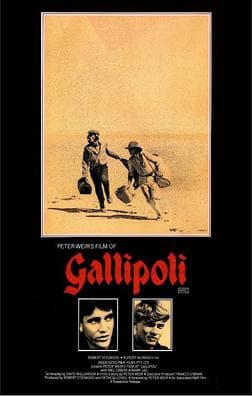
Gallipoli and the two pieces of music that are not Australian
Peter Weir's 1981 war film has no composed score to speak of. It has a French synthesiser record and a baroque lament, and between them they say everything the picture needs.
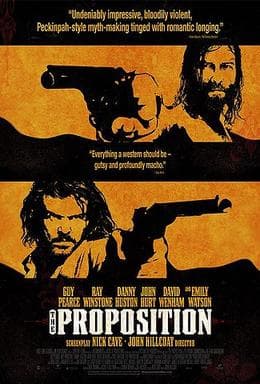
The Proposition was scored from motifs, and that is why it sounds like heat
Nick Cave and Warren Ellis wrote the music for John Hillcoat's western from motifs, not from frames, and the film's strange, hymn-like heat is the result.
Bluey's music was made the way the Heelers play
Up Here put a hundred Brisbane musicians behind Joff Bush's Bluey cues, and the lovely result proves the small band had the scale right all along.