Australian cinema in 2022 made the difficult films and then struggled to show them
The films were there, the festivals screened them, the cinemas booked them for two weeks, and then they were gone.
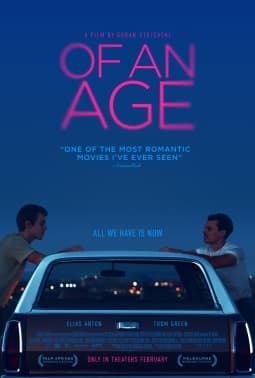
The year started with me watching Of an Age in a small cinema in Newtown, a Wednesday evening, maybe thirty people in the room, and it ended with me trying to find Blaze on any platform at all and failing and eventually watching a screener link that someone sent me in a text message. Between those two points, Australian cinema in 2022 did something it has not done in a long time: it produced a genuinely strong slate of films, varied in form and tone and ambition, and then it struggled, film by film, to get them in front of people. The making was not the problem. The showing was the problem. And the gap between the two is the thing I keep returning to as the year closes.
I want to name the films first, because they deserve to be named. Of an Age, Goran Stolevski’s tender, precisely observed story of a queer encounter in late-nineties Melbourne, which opened at Venice and played beautifully at festivals and then received a limited release that was, by the standards of what the film deserved, inadequate. Elvis, Baz Luhrmann’s enormous, swirling, maximalist biographical film, which was the exception to everything I am about to say because it had Warner Bros money and Warner Bros marketing and Warner Bros screens and it performed like a studio film performs, which is to say it found its audience because someone paid for the audience to be found. Blaze, Del Kathryn Barton’s astonishing, difficult debut about a child processing sexual assault through fantasy, which played at festivals to strong responses and then barely registered in commercial release. Gold, Anthony Hayes’s two-hander survival film set in a scorched near-future desert. The Stranger, Thomas M. Wright’s cold, forensic procedural about the Daniel Morcombe case. Seriously Red, which took Rose Byrne and Krew Boylan and Dolly Parton impersonation and made something stranger and sadder than the premise suggested.
These are good films. Several of them are very good films. The Stranger is as controlled and unsettling as anything Australian cinema produced this decade. Of an Age has a gentleness and a specificity that I cannot stop thinking about months later. The work was there. The question is where it went.
Two weeks and gone
Here is how it works, in practice, for a mid-range Australian film in 2022. You make the film. This takes years. You find your financing through Screen Australia and state agencies and private equity and co-production treaties and the particular alchemy of Australian film funding that requires you to be simultaneously commercially viable and culturally significant and accessible to a broad audience and artistically distinctive. You get your money. You make your film. You take it to a festival. It plays well. Reviews are strong. You sell it to a distributor, or your sales agent sells it, or in some cases you are your own distributor because the traditional distribution landscape has contracted to the point where some films cannot find a home.
The distributor books your film into cinemas. If you are fortunate, you get screens in the major cities, Sydney and Melbourne and maybe Brisbane and Perth. If you are less fortunate, you get Sydney and Melbourne only, and even there, you are in the smaller rooms, the off-peak sessions, the Tuesday afternoon slots that cinemas fill with anything they can find because nobody is coming on a Tuesday afternoon anyway. Your film opens. It runs for two weeks. Maybe three, if the opening numbers are decent. Then it is gone, pulled to make room for the next American release, and your film has had its theatrical window, and that window was so narrow that most of the people who might have wanted to see it did not know it existed until it was no longer available.
This happened to Blaze. This happened to Gold. This happened, in a slightly different way, to Seriously Red. It did not happen to Elvis, because Elvis had a different infrastructure behind it. And it did not entirely happen to The Stranger, which benefited from the true-crime hook and from Joel Edgerton’s name, though even that film’s run was modest by the standards of what the reviews suggested it deserved.
The streaming window that arrives too late
Then comes streaming. Your film appears on Stan or Binge or, if the deal was structured differently, on an international platform. This happens weeks or months after the theatrical run. By the time it lands, the conversation has moved on. The reviews are archived. The social media moment, if there was one, is over. The audience that might have found the film in a cinema and carried it into their lives through the particular gravity of theatrical viewing, the darkness, the scale, the commitment of having left your house and paid money, that audience is now scrolling past your film on a platform alongside four hundred other options, and your film’s thumbnail is competing with the thumbnail of a new season of something American that has been marketed with a budget larger than your entire production cost.
I watched The Stranger in a cinema and was shaken by it. The film earns its slow pace. It earns the discomfort. Joel Edgerton and Sean Harris do something in that film that requires the concentration a cinema enforces, the inability to pause, the inability to check your phone, the contract between the audience and the screen that says: you will sit here and you will watch this and you will not look away. That contract does not exist on a laptop. I do not know how The Stranger plays on a laptop. I suspect it plays like a slow film about two men talking in cars, which is what it is if you remove the weight of the room around it.
Where I watched things
My own year in Australian film was split between three locations: a cinema, my couch, and a friend’s projector setup in Marrickville that we used for films we could not find anywhere else. The cinema was where I saw Elvis and The Stranger and Of an Age. The couch was where I eventually caught Seriously Red and Gold, weeks after their theatrical runs, on platforms I pay for monthly and browse through with the glazed half-attention of a person who has been scrolling for ten minutes and has not committed to anything. The projector in Marrickville was where I saw Blaze, from the screener link, projected onto a bedsheet pinned to the wall, the image slightly yellow because the projector was old, and I sat on a beanbag and watched Del Kathryn Barton’s extraordinary visual imagination unfold on a bedsheet and thought: this is a film about the inner life of a traumatised child, and it is full of colour and fury and formal ambition, and I am watching it on a bedsheet because the distribution system could not find a way to keep it in cinemas long enough for me to get there.
The question underneath the question
The question everyone asks is: how do we get more people to watch Australian films? And the question underneath that question, the one the industry does not always want to sit with, is: where do Australian films actually live now? Because the answer is not cinemas, for most of them. The answer is not streaming platforms, where they appear and vanish into catalogues. The answer, increasingly, is festivals. Australian films live at MIFF and SFF and Adelaide and BIFF, where they play to audiences who have specifically chosen to watch them, who have bought tickets and made plans and committed to the experience. Festivals are the theatrical run, for many Australian films. The cinema release that follows is a contractual obligation more than a genuine second life.
This is not sustainable and it is not good enough. A national cinema that exists primarily within the festival circuit is a cinema talking to itself, to the converted, to the people who already care. The people who do not already care, who might care if the film found them, who might be changed by Of an Age or disturbed by The Stranger or moved by Blaze if they encountered it in the right conditions, those people are not at festivals. They are at home, scrolling, and the algorithm is not going to recommend an Australian film about a queer Serbian-Australian teenager in 1999 Melbourne because the algorithm does not know how to value what that film offers.
I do not have a solution. I do not think anyone does, or if they do, it requires a restructuring of distribution economics that nobody with the power to restructure it has the incentive to attempt. What I have is a list of films from 2022 that I want people to see, and the knowledge that most of them will not see them, and the feeling, familiar by now, of having watched a strong year of Australian cinema play out in half-empty rooms and on small screens and on a bedsheet in Marrickville, where the colour was wrong but the film was right.

Mara writes essays. She came to film writing from a decade of literary criticism and still reaches, sometimes, for a novel before she reaches for a shot list. She lives in the inner north of Melbourne and does not explain which city that is.
MORE BY MARA DENG →
This year I watched forty Australian films and the best ones made me nervous
The comfortable films were fine, the difficult ones were better, and the gap between the two is where Australian cinema lives.
Australian cinema does not know what it wants to be next and that might be the whole point
Six years of writing about Australian film has taught me that the industry's identity crisis is not a bug; it is the condition under which the best work gets made.
The cinema is not dying but it is learning to share the room
The argument between cinema and streaming was never about screens; it was about who gets to decide what watching means.