Australia's Oscar entry is in Mongolian and that is the argument
Gabrielle Brady's film has no Australian faces, no Australian landscape and no English in it, and the selection committee was unanimous.
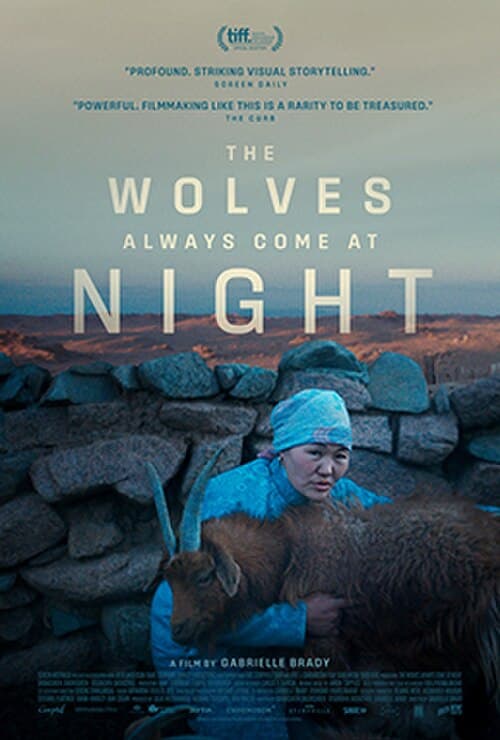
In September 2025, the Australian selection committee announced, unanimously, that the country’s entry for Best International Feature Film at the 98th Academy Awards would be The Wolves Always Come at Night. It is ninety-five minutes long. It is in Mongolian. It was shot in the Gobi and in Ulaanbaatar, it contains no Australian faces, no Australian country, and no English, and I have not been able to stop thinking about it since.
Not because I object. Because I think it is the most honest thing an Australian selection committee has done in years, and I do not think anybody quite meant it that way.
What the film is
Gabrielle Brady directed it. Davaasuren Dagvasuren and Otgonzaya Dashzeveg, the herding couple at its centre, are credited as co-writers with her, which is not a courtesy and is worth saying out loud early. The film follows them through the loss of their livestock in a sandstorm, the slow arithmetic of whether to stay, and the move to the ger districts on the edge of the capital, where Davaasuren drives and Otgonzaya holds a family together in a place that has no room for the skills they spent their lives acquiring.
Michael Latham shot it. Katharina Fiedler cut it. Aaron Cupples wrote the score. It premiered in the Platform strand at Toronto on 8 September 2024, went on to London, Zurich, IDFA and Sydney, and had its Australian release through Madman with a theatrical run that ended late in 2025. Screen Australia put in principal production investment. WeirAnderson Films and Storming Donkey Productions carried significant private money. BBC Storyville and SWR/Arte are on it, along with development support from the German Federal Film Board and Filmbüro Bremen. It is an Australia, Germany and Mongolia co-production, and the paperwork is genuinely three-country paperwork, not a flag of convenience.
It is also a hybrid, which matters. Brady works in the register where documentary subjects perform reconstructions of their own lives, staging what has already happened to them, and the camera treats the staging as no less true than the observed material. Latham and Cupples were both on Island of the Hungry Ghosts, her 2018 first feature, and they are doing the same thing here that they did there.
The film she made before this one
I want to sit with that, because the pairing is the whole essay.
Island of the Hungry Ghosts is set on Christmas Island. It follows Poh Lin Lee, a trauma therapist working with people the Australian state was holding indefinitely in a detention centre, and it cuts her sessions against the annual migration of tens of millions of red crabs across the same island, and against the Chinese-Australian community’s rituals for the dead who never made it home. It won Best Documentary Feature at Tribeca. It is a film about Australian policy, made on Australian territory, in English, by an Australian director.
Australia did not send that one anywhere. It was not eligible for the international category, of course, because of the language rule. That is the mechanical answer and it is true and it is also not the interesting part.
The rule that made Brady’s Mongolian film eligible is the same rule that made her Christmas Island film invisible to the category. Best International Feature asks a country for a film predominantly not in English. For most submitting nations this is unremarkable. For Australia it produces a small annual crisis, and the crisis is instructive: to be represented in the world’s most-watched film category, this country has to send something that does not sound like itself.
What we usually do with that problem
There is a standard Australian answer, and it is a good one. You send a film in a First Nations language. Samson and Delilah, Ten Canoes, Sweet Country, The Moogai in part. Those films answer the eligibility rule and the national question in the same gesture, and they are the strongest argument going that the languages of this continent are not a workaround but the oldest thing here.
The committee did not do that this year. It sent a film in Mongolian, and its statement called the film “a striking and original portrait of a family deeply affected by climate change” and “requisite cinema viewing”.
I have read that statement more times than is reasonable. There is nothing in it about Australia.
The reading I keep arriving at
Here is what I think happened, and I offer it without cynicism, because I think the outcome is better than the process.
An Australian director, funded in significant part by Australian public money, made a film about people losing their country to weather. Not losing an argument about country. Losing it, materially, the way you lose a house: the grass goes, the animals die, the ground stops being able to hold you, and you move to the edge of a city where nobody needs what you know.
That is not a foreign subject. That is the subject, on a continent that has spent the last decade watching towns run out of water and coastlines rearrange themselves, and it is the subject we are least able to film at home without the whole thing collapsing into either a disaster picture or a policy segment.
Brady found it eight thousand kilometres away, in a language she does not speak, working with two people who insisted on authoring their own reconstruction.
Or rather, she did not find it. She went and asked, for years, and the film has the texture of having been waited for.
The part that should be uncomfortable
Davaasuren and Otgonzaya were denied visitor visas by Canada and could not attend the Toronto premiere of the film they co-wrote and appear in. The film played the Platform competition without them.
I do not think that detail is incidental to anything I have written above. A film that Australia would eventually send to the Academy Awards as its national representative premiered on a continent its central subjects were not permitted to enter, and the country that then claimed it has its own long practice of deciding which bodies may cross which lines. Brady’s previous feature was about exactly that practice.
The film does not make this argument. It is too disciplined for that, and the discipline is why it works. It stays with two people and a horse and a set of financial decisions, and it lets the ger district do the political speaking simply by being photographed at eye level over a long enough period that you stop reading it as a slum and start reading it as a suburb.
What I want us to keep
The film was not nominated. Australia has not been nominated in this category, and I suspect an unnominated submission tells you more about a national cinema than a shortlisted one, because nobody was managing the optics.
What we sent was a film with almost nothing Australian in the frame, made by an Australian, about people being moved off their land by a climate that is not negotiating, co-written by the people it is about.
If that is what our national cinema submits when it is being honest about itself, I will take it, and I would like the next committee to notice what it did and do it deliberately. Not as an escape from the English-language rule. As a position. A country that cannot yet look straight at its own displacement is still a country capable of recognising displacement when it sees it, and of paying for the film, and of putting its name on it.
The name on it is ours. The country in it is not. Both of those things are true and only one of them is a technicality.

Mara writes essays. She came to film writing from a decade of literary criticism and still reaches, sometimes, for a novel before she reaches for a shot list. She lives in the inner north of Melbourne and does not explain which city that is.
MORE BY MARA DENG →
Together is an Australian horror film that learned to say trunk
Michael Shanks made a Melbourne body horror film about two people fusing into one, then sanded the Australian out of it. I keep looking for the seam.
The Home Song Stories and the mothers we have to explain
Tony Ayres made a film about a Chinese migrant mother and refused to redeem her. Nineteen years on it is still the bravest thing about it.

Of an Age and the country a 24 hour love can hold
Goran Stolevski's second feature is a 24 hour love story shot in suburban Melbourne. The country it photographs is one I keep going back to.