The Correspondent is a grief film wearing a prison film
Kriv Stenders built an Egyptian prison on a Sydney soundstage in six weeks, and the picture he made inside it is not about Egypt at all.
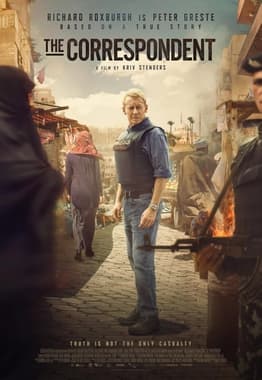
There is a category of Australian film that gets reviewed as journalism rather than as filmmaking, and The Correspondent walked directly into it: a picture about Peter Greste, the Australian journalist held in Egyptian prisons for four hundred days from December 2013, adapted by Peter Duncan from Greste’s 2017 memoir The First Casualty, directed by Kriv Stenders, released here through Maslow on 17 April 2025 after a premiere at the Adelaide Film Festival the previous October. The reviews were warm and they were, almost without exception, about press freedom. The Guardian and the Herald both gave it four stars and both spent their word count on the case.
I want to argue for a different reading, because the picture is doing something the coverage did not describe. Stenders has made a film about the Cairo imprisonment in order to make a film about a death in Mogadishu nine years earlier, and every formal decision in it is organised around that substitution.
The other journalist
Kate Peyton was a BBC producer. She was shot outside a hotel in Mogadishu in February 2005, on her first day on that assignment, and she died in hospital. Greste was there. He had asked her to come.
Yael Stone plays her, and the film keeps returning to her in a register that is not quite flashback and not quite hallucination; she arrives in the cell, in the corridor, in the yard, conversational, unhurried, occupying the same photographic space as the present tense rather than being marked off from it by the usual grammar of grade and lens. Veronika Jenet, who cut The Piano and Rabbit-Proof Fence and has been shaping Australian pictures for four decades, is the reason this reads as continuity rather than as device. The cuts into her are flat. No swell, no dissolve, nothing announcing an interior state.
The effect is that Greste’s imprisonment and Greste’s guilt are given the same visual status, and the film declines to tell you which one is the real subject. That is a considerable risk for a picture that arrived with a public-interest banner attached to it, and it is the reason the thing has weight.
What six weeks in Sydney buys you
The production shot for six weeks, in Sydney, on a budget that plainly did not extend to Cairo. Geoffrey Hall photographed it, and Hall is a useful name to hold in mind here: he shot Chopper for Andrew Dominik in 2000, a film that also made a virtue of confinement and of the way a face behaves when there is nowhere for it to go.
Hall does not attempt to disguise the limitation. The Egyptian exteriors are handled economically and briefly. The cell is where the money and the attention went, and the picture is at its most confident when it stays there: three men in a room, the light from a high window doing the timekeeping, the camera close enough that the negotiation of physical space between cellmates becomes the drama.
This is a chamber picture, and Stenders, whose lineage runs from Red Dog through Kill Me Three Times and Danger Close, has not previously shown much appetite for chamber work. He shows it here. The scenes with Julian Maroun as Mohamed Fahmy and Rahel Romahn as Baher Mohamed are the film’s best writing, largely because Duncan’s screenplay refuses to make the three men natural allies. Fahmy is Egyptian-Canadian, ambitious, furious at being collateral in someone else’s international story. Baher Mohamed is the local producer with the most to lose and the least leverage, and Romahn plays him with a watchfulness that quietly rebukes the film’s own framing: the Australian is going home, eventually, and the fixer might not.
Roxburgh, and the problem of playing decency
Richard Roxburgh has spent a career being interesting in parts written for charm, and Greste as written is neither charming nor difficult. He is a professional. The screenplay gives Roxburgh very little to push against.
What he finds is a physical rhythm: a man managing his own attention as a resource. Roxburgh plays the routines, the running in circles, the counting, the exercises, as work rather than as pathos, and he lets the deterioration show up in the small failures of that work rather than in any scene of collapse. There is no breakdown set piece. It would have been the easiest thing in the world to write one and the picture is better for its absence.
Tom Ellard’s score deserves a note. Ellard founded Severed Heads in Sydney in 1979, one of the first Australian electronic groups of any consequence, and he brings to this an instinct for texture over theme. The cues are largely atmospheric, low, close to room tone, and they thin out almost entirely in the Peyton passages. The silence around Kate is the loudest thing in the film.
The second look
The Correspondent was received as a worthy picture, which is a compliment that kills. It did modest business. It will now do what Australian films of this kind do, which is find its audience slowly, on a streaming tile, over years.
When it does, the thing to watch for is not the trial or the campaign or the release. It is the cutting: how often the film leaves a scene about injustice and arrives in a scene about a woman who is not there. Stenders and Jenet have made an argument about what actually haunts a working correspondent, and it is not the state that locked him up. It is the colleague he asked to get on a plane.
Bronte writes long-form criticism of Australian cinema and the international art films that feed into it. She was on the ground at Cannes in 2019 and has not entirely forgiven the festival for 2020. Patient with slow films; impatient with tidy ones.
MORE BY BRONTE HAUGHEY →
Furiosa and the country George Miller will not leave
Two years after Furiosa underperformed in May 2024, the picture has clarified into the most patiently photographed film of George Miller's career, and possibly the last one he will shoot in the Hay plains.
Six years of Australian cinema and the argument is still open
The films got better, the audiences stayed complicated, and the critics kept writing.
Sydney Film Festival 2026 opens with a question the programme cannot answer alone
The programme is strong, the Australian titles are stronger, and the question of who will be in the audience remains.