Shine and the score hiding under the Rachmaninoff
David Hirschfelder had to write original music that lives under the loudest warhorse in the piano repertoire, and the quiet writing is what carries the film.
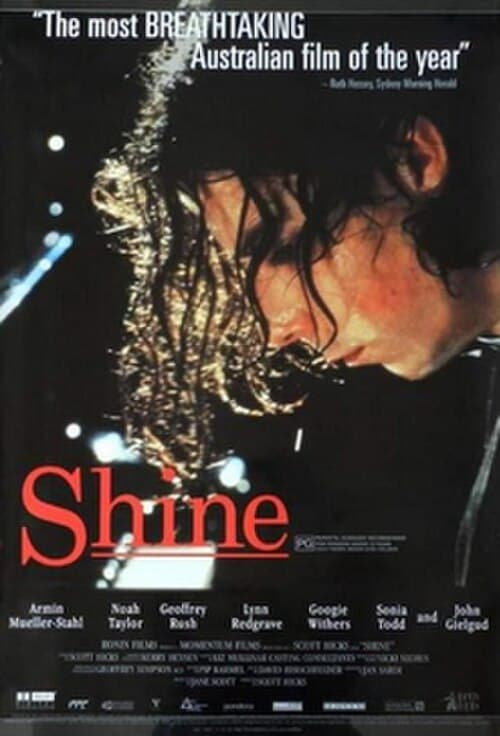
Everybody remembers Shine for the Rachmaninoff, and everybody is half wrong. The Third Piano Concerto, the Rach 3, is the thing the film is about, the Everest David Helfgott’s father dares him to climb and the cliff he falls off when he does; it is the loudest forty minutes of music in the standard repertoire and Scott Hicks built his 1996 picture around the moment it breaks a man in half. But the concerto is not the score. The score is the small, nervous, beautifully recessive writing David Hirschfelder threaded underneath and between the warhorses, and it is the part doing the emotional work while the Rachmaninoff does the damage.
That is a strange and difficult brief, and worth sitting with. Hirschfelder had to compose original music for a film whose soundtrack is otherwise a parade of the most thunderous piano literature ever written: the Rach 3, Liszt’s La Campanella and the second Hungarian Rhapsody, Chopin, Vivaldi’s Gloria, Schumann’s Kinderszenen drifting in on a Wilhelm Kempff recording. You do not out-shout that. So he did the opposite. He went under it.
The problem with following a warhorse
Think about what a composer is up against here. The concert pieces arrive with a century of weight already attached; an audience does not hear the Rach 3 neutrally, it hears ambition and madness and a father’s voice. Anything Hirschfelder writes in that company risks sounding like filler between the real music. His solution was to build his cues from the same pianistic DNA, the same restless arpeggios and falling figures, but to keep them small and keep them quiet, so they read as the connective tissue of David’s mind rather than as competing concert items.
You hear it in the transitions. A cue will pick up a shape from the Liszt, strip it back to two or three notes and a held pedal, and carry the feeling of the playing into a scene where nobody is playing anything. The piano becomes how David thinks even in silence. That is composition as psychology, and it is the kind of thing that gets no applause because it is designed to be barely noticed. You do not out-shout the Rach 3, so Hirschfelder did the opposite: he went under it, and the going-under is the score.
What Helfgott’s hands put on the tape
The other decision that makes Shine sound like Shine is not strictly Hirschfelder’s, but the score lives or dies with it: a good deal of the piano you hear is David Helfgott himself. Not a studio virtuoso brought in for a clean take. Helfgott, with the urgency and the smudge and the muttering that the real man brings to a keyboard.
It matters because his attack is wrong in all the right ways. He rushes. He hammers where a competition pianist would float. The decay of his chords is never quite controlled, and you can hear the room he is in, the mic close enough to catch breath and the small percussion of fingernails. A cleaner recording would have lied. This one tells you, in the physical sound of the playing, that the man at the instrument is brilliant and broken at once, and no amount of orchestration could have said that as plainly as the imperfections do.
Hirschfelder scores around that texture rather than smoothing it. When his original writing enters behind Helfgott, it is mixed soft and warm, strings and low piano sitting back in the field so the foreground stays human and slightly out of true. The score never corrects the playing. It cradles it.
The cue that is not the concerto
The famous sequence is the breakdown, the competition performance of the Rach 3 where David finally plays the impossible thing and collapses under the weight of having done it, and Hicks and his cinematographer Geoffrey Simpson shoot it as a drowning. Most people would tell you that is the musical peak of the film. I would point a few minutes either side of it.
What carries the scene is not the concerto at full cry; it is the way Pip Karmel’s editing and Hirschfelder’s underscore prepare and release the room around it, the small nervous figures that build the dread before a single concert note, and the held, almost weightless writing in the aftermath, when the sound drops out and the man is on the floor. The Rach 3 is the illness. Hirschfelder’s quiet cues are the diagnosis and, later, the slow convalescence, and the film trusts the quiet cues with everything that actually moves you.
That is the architecture of the whole soundtrack in miniature. The borrowed masterpieces are the events. The original score is the weather between them, and the weather is where you live.
What the awards half-saw
The 69th Academy Awards nominated Hirschfelder for Best Original Dramatic Score, and he lost to Gabriel Yared’s The English Patient, which is no disgrace; at home he took the AFI Award for the music and an APRA award for the film score, recognition that landed nearer the mark. But award categories are clumsy with a job like this, because the achievement is partly invisible by design. The voters heard the Rachmaninoff and the Liszt, the unmistakable big tunes, and some of that grandeur inevitably rubbed off on the nominee. The real craft was the discipline to stay out of their way.
Listen to Shine now with the concert pieces bracketed off, just the Hirschfelder, and you find a score about restraint written for a film about a man with none. It is small where its subject is enormous, recessive where the playing is florid, and it understands that the most useful thing a composer can do, when a genuine masterpiece is detonating in the next bar, is to build the room it goes off in and then get quiet. He built the room. That is the score, and it is one of the best Australian film music has produced, precisely because you were never quite meant to notice it.
Kieran writes about what films sound like. Played in a band that nearly got signed in 2012 and has been thinking about attack and decay ever since. Devoted to Warren Ellis, Amanda Brown, and the quiet work of sound editors nobody interviews.
MORE BY KIERAN BOUSTANY →
Nigel Westlake smuggled a cathedral into a film about a pig
The score for Babe borrows its grandeur from a French organ symphony, and the trick tells you everything about how Nigel Westlake hears the relationship between small subjects and large feelings.
Every Australian film has a sound and most of them go unheard
This column has spent six years listening to what Australian cinema sounds like, and the answer keeps changing.
The newest Australian score worth hearing is the one nobody is talking about
The film opened in twelve cinemas, the score opened in none of the conversations about it, and both deserve better.