Rams gives Sam Neill and Michael Caton a flock of sheep and nothing left to say to each other
Jeremy Sims' remake finds its heart in the silence between two brothers who share a fence line and absolutely nothing else.
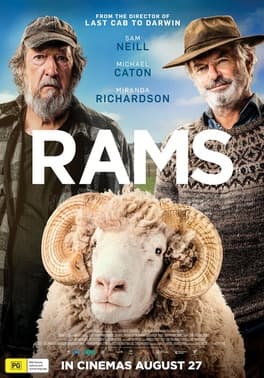
The fence between Colin (Sam Neill) and Les (Michael Caton) is not metaphorical. It is a real fence, made of real wire and real posts, running through real Western Australian farmland, dividing one brother’s property from the other’s. They share a boundary line and a bloodline and a breed of merino sheep descended from the same stud ram their father bought decades ago. They share, in other words, everything that matters, and they have not spoken to each other in years. The fence is not a symbol. It is a practical arrangement between two men who decided, at some point in the past that the film does not fully disclose, that silence was preferable to whatever the alternative was.
Rams (Jeremy Sims, 2020) is a remake of Grimur Hakonarson’s Icelandic film of the same name, which won the Un Certain Regard prize at Cannes in 2015. The original was set in a remote Icelandic valley, and it had the benefit of a landscape so alien to most audiences that the isolation felt almost mythological. Two brothers, separated by stubbornness, raising the same breed of sheep in adjacent farms, forced back into contact by a livestock disease that threatens to destroy their flocks. The premise is absurd and specific and deeply sad, and the Icelandic version treated it with a dry, almost geological patience. Things happened slowly. The brothers communicated through their dogs. The snow did a lot of narrative work.
Sims moves the story to the Mount Barker region of Western Australia, and the transposition works better than it has any right to, partly because Western Australia has its own version of the same isolation. The landscape is different in every particular but identical in effect: vast, indifferent, beautiful in a way that makes human disputes look small. The brothers’ feud, which in Iceland felt like something shaped by centuries of Nordic reserve, becomes in Australia something shaped by a different but equally powerful cultural force: the rural Australian commitment to not talking about the thing that needs talking about.
Two actors, two registers
The casting of Neill and Caton is the film’s smartest decision and its biggest risk. These are two performers who operate in fundamentally different registers. Neill is a dramatic actor who can do comedy; Caton is a comedic actor who can do drama. Neill works from the inside out, building a character through internal logic and letting the surface behaviour follow. Caton works from the outside in, starting with the physical detail, the gait, the vocal cadence, the way a man holds his beer, and trusting that the interior will emerge from the specificity of the exterior. In most films, this mismatch would produce tonal whiplash. In Rams, it produces something that feels like an accurate description of brotherhood: two people who came from the same place and developed entirely different strategies for surviving it.
Colin, Neill’s character, is the quieter brother, the one who stayed close to the original terms of the family farm, who breeds his sheep with meticulous care and lives alone in a house that looks like it has not been redecorated since their father died. Les, Caton’s character, is louder, more sociable, more willing to engage with the town, and more obviously wounded by whatever happened between them. Caton plays Les with a bluster that keeps threatening to crack, and the moments when it does crack are the moments when the film finds its depth. There is a scene where Les, drunk, stands at the fence line and shouts at Colin’s house, and the shouting is funny and pathetic and furious and heartbroken all at once, and Caton holds all four of those things without letting any one of them dominate. It is the kind of performance that gets called “natural” by people who do not understand how much technique is required to look that unpolished.
Neill, by contrast, gives Colin a stillness that could read as blankness if you are not paying attention. But the stillness is precise. Colin is a man who has organised his entire life around the avoidance of feeling, and Neill communicates this not through repression but through redirection: every emotion Colin might feel toward his brother gets channelled into his relationship with his sheep. The tenderness he shows the animals is real. It is also a displacement, and Neill lets you see both things at once without commenting on either.
The Icelandic original and what changes
The differences between the two versions are instructive. Hakonarson’s film had a bleakness that was environmental as well as emotional. The Icelandic landscape imposed itself on the characters; the snow and the darkness and the geographic remoteness were not backdrop but condition. The brothers’ estrangement felt like an extension of the landscape, as if the valley itself had cracked them apart.
Sims’ version cannot replicate this because Western Australia, for all its remoteness, is a warmer and more populated world. The town has a pub. There are neighbours. A local vet (Miranda Richardson, doing good work with limited screen time) circulates between farms and functions as a kind of social infrastructure that the Icelandic valley entirely lacked. This changes the nature of the brothers’ silence. In Iceland, you could believe they simply ran out of opportunities to speak. In Australia, where they live near a town with a functioning community, the silence is clearly a choice, maintained with effort, and the effort is part of the point.
The disease that drives the plot, a fictional livestock condition called Ovine Johne’s Disease in the Australian version, forces the brothers into proximity by creating a shared crisis. The government orders all sheep in the area destroyed. Colin and Les must decide, independently but in parallel, whether to comply or to save their bloodline. The film is at its best when it watches them arrive at the same decision through opposite processes: Colin through quiet calculation, Les through stubborn refusal. They are more alike than either will admit, and the sheep, which carry the genetic inheritance of a single animal their father once prized, are the living proof.
What the landscape does
Cinematographer Steve Arnold shoots the Western Australian countryside with a respect that stops short of reverence. The paddocks are golden and dry and enormous, and the light has that particular late-afternoon quality that makes everything look both ancient and temporary. But Arnold does not compose postcards. The landscape in Rams is a working environment, not a spectacle. The fences need mending. The troughs need filling. The sheep need moving from one paddock to another, and these tasks fill the brothers’ days and give them a reason to exist that does not require examining why they stopped speaking.
This is what the film understands about rural silence. It is not that people in the country do not feel things. It is that the structure of agricultural work provides an alternative to articulation. You do not need to say what you feel if you can instead fix a fence, shear a sheep, drive a ute to the back paddock and check the water levels. The work absorbs the emotion. The work makes the emotion unnecessary, or at least postponable, and the postponement can last a lifetime if nobody forces the issue.
An ending earned
The ending of Rams, which I will not describe in detail, earns its emotional release because the film has been so disciplined about withholding it. For ninety minutes, these two men have communicated through intermediaries, through animals, through the architecture of their adjacent properties. When they finally do what the audience has been waiting for them to do, the moment lands because it has been properly set up, not through foreshadowing or narrative mechanics but through the accumulation of small, specific, behavioural details that make these two men feel like people rather than positions in a thematic argument.
Neill and Caton deserve most of the credit for this. They make the reconciliation believable because they made the estrangement believable first, and the estrangement was believable because it was never explained. We do not learn, in any definitive way, what caused the rift. We learn its effects. We learn its cost. We learn that two men who love the same animals and live on the same land and carry the same father’s legacy can spend decades refusing to acknowledge each other’s existence, and that the refusal is itself a form of attention, a way of saying you matter so much that I cannot afford to look at you. That is what the fence is for. Not to keep the sheep in. To keep the brothers apart, which is the only way either of them knows how to stay whole.
Bronte writes long-form criticism of Australian cinema and the international art films that feed into it. She was on the ground at Cannes in 2019 and has not entirely forgiven the festival for 2020. Patient with slow films; impatient with tidy ones.
MORE BY BRONTE HAUGHEY →
Bring Him to Me puts Sam Neill in a car and lets the drive do the work
Luke Sparke's thriller is ninety minutes in a car with a hitman and a target, and the confinement is the point.
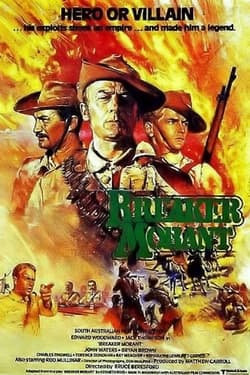
Breaker Morant and the country that adopted its scapegoat
Bruce Beresford's 1980 courtroom drama made an English-born soldier into an Australian martyr, and the picture's argument about empire has outlived its historical certainties.
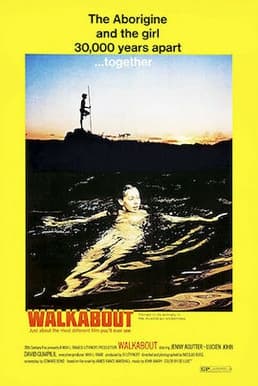
Walkabout is a British film about a country it never claims
Nicolas Roeg's 1971 picture is claimed as an Australian classic, though it was made by a Londoner, financed by two Americans and sold by 20th Century Fox. Its best argument is how little it pretends otherwise.