Queer Australian cinema found a new register and it sounds like tenderness
From Head On to Of an Age, queer Australian cinema shifted from fury to patience, and the loss and the gain are both worth measuring.
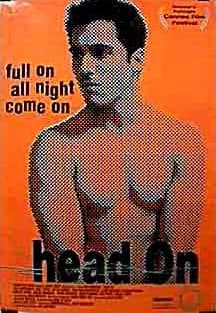
I am not the intended audience for these films, and I want to be upfront about that because it shapes what I can say and what I should probably not say. I am a straight woman writing about queer cinema, and the risk of that position is that I turn someone else’s experience into my own aesthetic appreciation. I am going to try not to do that. I am going to try to write about what I saw and what it made me feel and where the limits of my seeing are, and if I get it wrong I would rather get it wrong honestly than get it right by pretending to a perspective I do not have.
What I saw, watching Head On and then Holding the Man and then Of an Age in a sequence that spans twenty-four years, is a shift in register. The volume changed. The temperature changed. The films went from screaming to speaking quietly, and the distance between those two modes contains an entire history of who was listening.
Head On and the scream
Ana Kokkinos’s Head On (1998) is a film that operates at the level of the body. Ari (Alex Dimitriades) moves through Melbourne in a single night, and the movement is relentless: sex, drugs, confrontation, more sex, more drugs, a family dinner that feels like a war zone, streets that are both liberation and trap. The film is adapted from Christos Tsiolkas’s novel Loaded, and it carries the novel’s rage into the visual register with a directness that still feels confrontational twenty-four years later.
What Kokkinos understood, and what makes Head On more than a provocation, is that Ari’s fury is not a character flaw. It is a rational response. He is a young Greek-Australian man in the late 1990s, queer in a community that has no space for his queerness, and the film does not ask you to sympathise with him. It asks you to keep up. The camera moves when he moves. The cuts are sharp. The sound design is aggressive. You are not watching Ari from a safe distance. You are in the room with him, in the car with him, in the club with him, and the experience is exhausting in a way that feels deliberate.
I watched Head On for the first time in university, and I remember the physical sensation of it more than the plot. The heat. The claustrophobia. The film did not want me to be comfortable, and I was not comfortable, and I think that was the point. Comfort was not available to the character, so it was not available to the audience.
Holding the Man and the elegy
Neil Armfield’s Holding the Man (2015) occupies different emotional territory entirely. The film is based on Timothy Conigrave’s memoir of his relationship with John Caleo, from their meeting at Xavier College in Melbourne in the 1970s through Caleo’s death from AIDS-related illness in 1992. It is a love story, a grief story, and a historical document, and it does all three things with a sincerity that risks sentimentality and mostly avoids it.
The register here is elegy. Ryan Corr and Craig Stott play Tim and John with a warmth that the earlier tradition of Australian queer cinema would not have permitted. These are characters who are allowed to be happy, allowed to be domestic, allowed to be ordinary. They cook dinner. They argue about small things. And then AIDS takes the life apart, piece by piece, and the film watches the dismantling with a steadiness that is more devastating than any scream.
I want to say something careful here. The shift from Head On to Holding the Man is not a simple progression from anger to acceptance. It is a shift in what the films ask of their audience. Head On asks you to witness fury. Holding the Man asks you to grieve. Both are demands. But the grief is easier for a straight audience to access than the fury, and I am aware that “easier to access” is not the same as “better,” and that the comfort I felt watching Holding the Man compared to Head On says more about me than about the films.
Of an Age and the whisper
Goran Stolevski’s Of an Age (2022) is the film that made me want to write this essay. It is set in Melbourne in 1999, and it follows Kol (Elias Anton), a Serbian-Australian teenager, through a single day during which he meets Adam (Thom Green), his friend Ebony’s older brother. What happens between them is not dramatic in the way that Head On is dramatic or elegiac in the way that Holding the Man is elegiac. It is tender. That is the word I keep coming back to. The film is tender in a way that feels new, or at least new in Australian queer cinema, a tenderness that is specific and unhurried and unafraid of silence.
Stolevski does something remarkable with time in this film. The single day unfolds slowly. Kol and Adam drive. They talk. They stop talking. They look at each other and look away. The camera holds on faces for longer than you expect, and in those extended moments you see something that neither character is saying, which is that they are both aware that this day is finite, that whatever is happening between them has a boundary, and that the boundary makes the experience more intense rather than less.
The film then jumps forward to 2010, and the jump is devastating not because anything catastrophic has happened but because time has passed. The boys are men. The day is a memory. What the film asks you to sit with is not loss in the sense of death or violence but loss in the sense of time moving forward and taking a specific version of yourself with it. This is a quieter loss than Holding the Man depicts, and a gentler one than Head On would have allowed, and it felt, to me, like the most honest depiction of how desire and memory interact that I have seen in an Australian film.
What the shift means and who it is for
Here is where I reach the limit of what I can say with confidence. The shift from fury to tenderness in Australian queer cinema is real. You can trace it through these three films and through others: Priscilla (1994), The Sum of Us (1994), 52 Tuesdays (2013). The register has changed. The volume has lowered. The films have moved from confrontation to intimacy, from demanding that the audience acknowledge queer existence to assuming that acknowledgment and exploring what comes after it.
But I am cautious about celebrating this shift uncritically. The fury of Head On was not a limitation to be outgrown. It was a response to conditions that made tenderness impossible, or at least dangerous. Ari could not be tender because tenderness required safety and safety was not available. The fact that Kol and Adam can be tender in Of an Age is a measure of how much has changed, but it is also a measure of what was endured to make that change possible.
I also wonder who the films are made for now. Head On was made, I think, primarily for a queer audience, and if straight viewers were uncomfortable, that discomfort was part of the film’s purpose. Of an Age feels made for everyone, and “everyone” includes me, and I am glad to be included, and I am also aware that inclusion can be a form of dilution, that a film that makes space for my comfortable viewing might be making less space for the uncomfortable truths that Head On insisted on.
I do not have a resolution for this. I have three films that I admire for different reasons, and a trajectory that looks like progress if you squint but looks like something more complicated if you do not. What I can say is that Of an Age made me cry in a way that Head On did not, and that the crying felt earned, and that I am not sure whether the difference is in the films or in me or in the twenty-four years between them. Probably all three. The register changed, and the change sounds like tenderness, and tenderness is not the whole story, but it is a chapter worth reading carefully.

Mara writes essays. She came to film writing from a decade of literary criticism and still reaches, sometimes, for a novel before she reaches for a shot list. She lives in the inner north of Melbourne and does not explain which city that is.
MORE BY MARA DENG →
Of an Age and the country a 24 hour love can hold
Goran Stolevski's second feature is a 24 hour love story shot in suburban Melbourne. The country it photographs is one I keep going back to.
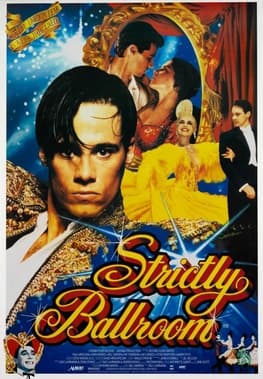
Strictly Ballroom is a film about who is allowed to teach the steps
Baz Luhrmann's 1992 comedy is sold as a story about dance. It is also a story about an Australian champion who has to be taught his own steps by a Spanish-Australian family in their own house.

Looking for Alibrandi was the first Australian story handed to me as mine
It was not my family's story. It was the shape of my family's story, put on a screen in a country that had never once bothered to hold it before.